
A Golf Cart Battery Discharge Warning Usually Means “Charge Now”—Not “Replace the Pack”
Learn what a golf cart battery discharge warning means, when to stop driving, and how to separate low charge from charger, wiring, or battery faults.
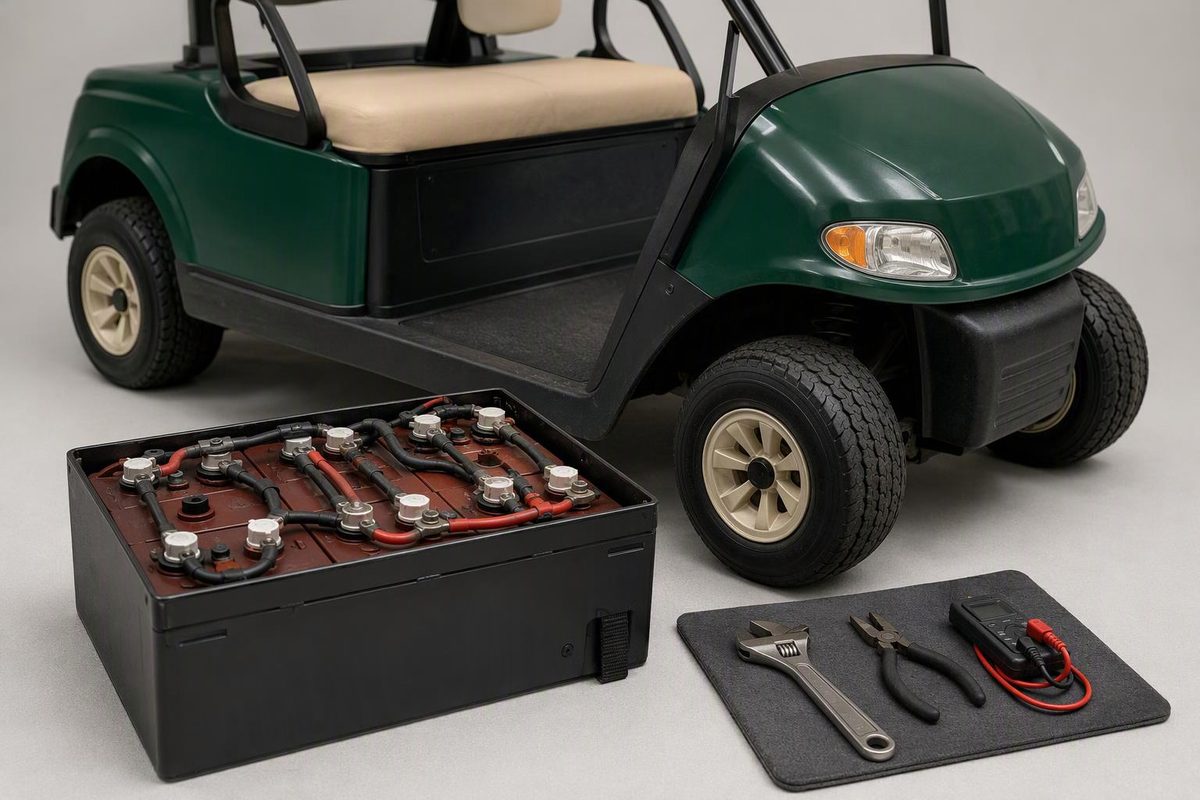
On an electric golf cart, a battery discharge warning usually means the traction battery has little usable charge remaining. Charge the cart before continuing to use it. The message does not, by itself, prove that the battery pack needs replacement.
Manufacturers use different wording and displays. An E-Z-GO RXV ELiTE shows “LOWBAT” when its lithium pack must be charged immediately. Garia labels its segmented state-of-charge gauge a “battery discharge indicator”; it separately specifies a critical battery-level message that limits the vehicle to 4 mph and calls for urgent charging. Those examples show why the cart’s make, model, year, battery chemistry and exact message matter. Consult the applicable E-Z-GO RXV ELiTE manual or Garia Golf/Via/Monaco manual, rather than applying another model’s light pattern to your cart.
This interpretation is for electric carts. A gas cart has a 12V starting and accessory battery rather than a traction pack. If a gas cart or an aftermarket display shows this wording, use the manual for that exact gauge or vehicle before diagnosing it.
What to do when the warning appears
-
Park near a safe charging location. Avoid starting a long return trip, climbing steep grades or continuing until the cart shuts down. A low pack can reduce speed or stop powering the cart.
-
Photograph the warning. Record whether it is solid or flashing and whether the cart has reduced power. Also note the model year, nominal pack voltage and whether the batteries are flooded lead-acid, AGM or lithium.
-
Switch off accessories. Turn off lights, USB devices, audio equipment, heaters and other added loads. Some accessories can remain active with the key off; E-Z-GO warns that this can discharge the pack in its RXV ELiTE manual. Garia likewise notes that some equipment remains powered with the ignition off and recommends switching off main power for longer storage.
-
Use the charger approved for that cart and battery system. Do not substitute a charger merely because its plug fits. Voltage, chemistry, charge profile, connector, polarity and any battery-management-system communication requirements must agree. Our 48V charger compatibility guide explains those checks.
-
Let the charger complete its cycle. Charge in the location and manner specified by the cart and charger manuals. If you need to plan the downtime, see how long a golf cart takes to charge.
If the warning clears after a complete charge and the cart delivers its normal runtime, low state of charge was probably the immediate cause. Watch for the warning returning unusually quickly.
When it indicates more than normal discharge
Investigate further if the warning:
- returns soon after a completed charge;
- appears after the cart sat unused;
- is accompanied by sharply reduced range or power;
- remains on while the charger reports a fault; or
- appears with a hot cable, melted connector, burning smell, swelling, leakage or sparking.
Depending on the cart, possible causes include an interrupted or failed charge, an incompatible charger, a loose or corroded connection, an accessory that remains energized, one weak lead-acid battery in a series pack, a deteriorated pack, or an inaccurate meter or battery-management system. Do not order batteries from the warning alone.
With the key off and charger disconnected, visually inspect accessible charger cords, plugs and receptacles for damage. Follow the model-specific shutdown procedure before accessing a battery compartment, and do not touch or tighten a hot, damaged or unfamiliar high-current connection. Never open a lithium pack or place tools across terminals. E-Z-GO’s Express ELiTE manual says lithium-pack service must be performed by authorized personnel, labels the pack as having no user-serviceable parts and requires insulated tools in the battery area to avoid blowing the internal BMS fuse.
For a flooded lead-acid pack, voltage testing is useful only under controlled conditions. Trojan says accurate open-circuit readings require the batteries to remain idle—with no charging or discharging—for at least six hours, preferably 24. Its chart also shows that expected voltage depends on battery or pack voltage and state of charge, rather than one universal “good battery” number. Follow our chemistry-specific battery testing guide and compare each series battery under the same conditions. Trojan’s battery maintenance guidance also calls for replacing damaged cables and further evaluating batteries that remain below its published values after charging.
Stop using the cart when safety or control may be affected
Do not continue driving if the cart repeatedly enters limp mode, loses power unpredictably, cannot complete a charge, or has a hot or visibly damaged electrical component. Park it, remove the key and arrange service appropriate to the model. Do not bypass a lithium battery-management system or other protection device to keep the cart moving.
One final distinction: if you saw “battery discharge warning” in a Hyundai or Kia passenger vehicle rather than a golf cart, it generally concerns the 12V auxiliary battery, not necessarily an EV traction battery. Hyundai says its message can appear when 12V voltage is low or the vehicle detects current draw that could drain the battery. Kia identifies added devices used while parked, such as a dashcam, as a possible cause. Remove external loads and follow that vehicle’s manual; if the warning persists, have the vehicle inspected. See Hyundai’s cluster-message explanation and Kia’s 12V discharge notice.