
Golf Cart Battery Life and Replacement Signs
Compare lead-acid and lithium golf cart battery lifespan, then use age, range, charging behavior and load performance to judge replacement timing.
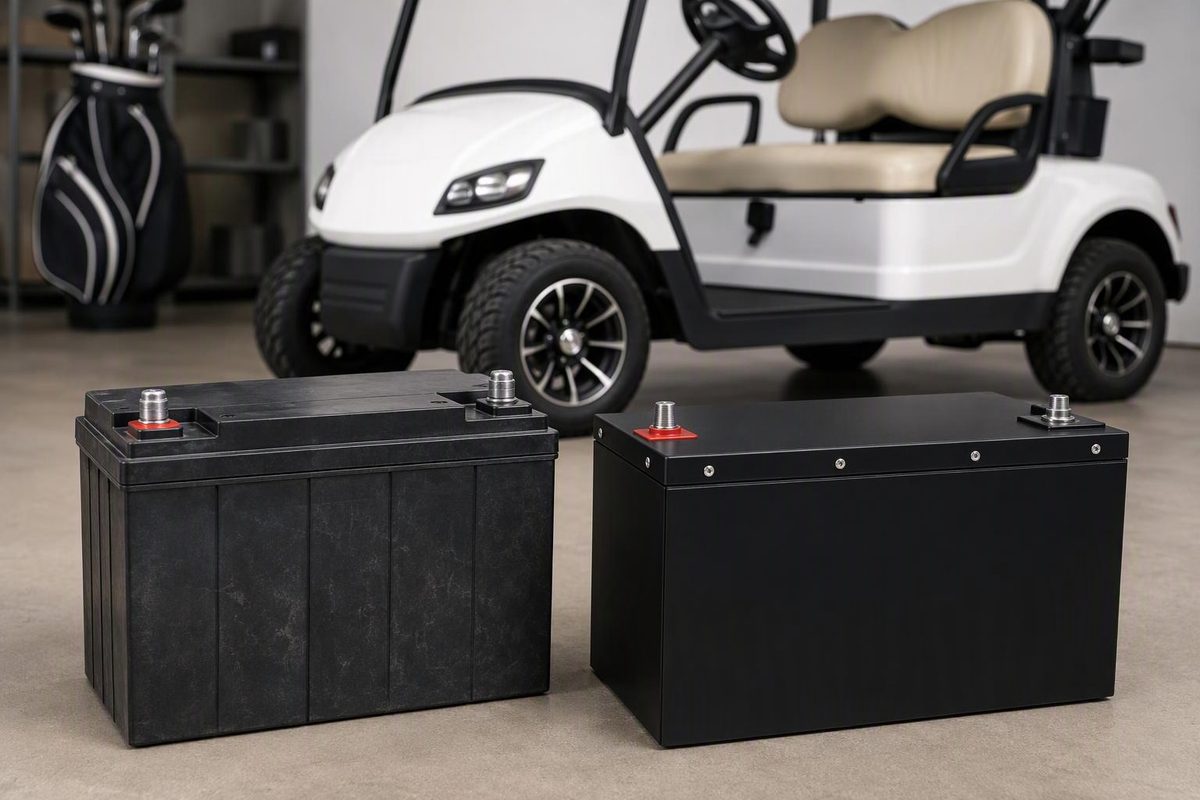
A well-maintained lead-acid golf cart battery pack commonly lasts about 4–6 years, while a quality lithium pack may last 10 years or more. Those are budgeting ranges rather than automatic replacement dates: measured range, performance under load, charging behavior and the battery manufacturer’s specifications are better evidence of whether a pack is finished.
Choose the battery type, enter its age and select its current condition to see the appropriate next step.
Battery Life Check
Decimals are accepted. A blank age remains unknown.
With normal performance and no age entered, continue normal maintenance and judge the pack by range, charging behavior and loaded testing rather than the calendar alone.
Source note: Planning ranges and decision points use the Interstate Batteries, Trojan Battery and Club Car guidance cited in the article. AGM lifespan is shown as unknown because no general figure is established.
| Battery type | Planning range | What to verify |
|---|---|---|
| Flooded lead-acid | About 4–6 years with good care | Watering, cycle data, charger profile and warranty |
| AGM lead-acid | Varies by product and use | Cycle chart, stated discharge depth and AGM charge profile |
| Lithium, commonly LiFePO4 | Potentially 10+ years | Cycle rating, stated discharge depth, BMS limits and warranty |
Interstate Batteries gives a four-to-six-year average for maintained lead-acid golf cart batteries and 10 years or more for properly cared-for lithium batteries. Trojan likewise says a decade can be reasonable for modern lithium-ion packs but cautions that products vary widely. These are manufacturer planning figures, not guarantees for every pack or cart (Interstate Batteries; Trojan Battery).
A cart making several rounds or neighborhood trips every day can consume available battery cycles much faster than a lightly used personal cart. Poor charging, repeated deep discharge, high temperature and neglected storage can also bring useful life to an early end. Conversely, a pack that has passed the usual age range can remain serviceable if it still completes its normal route and tests well.
Cycle Use Matters More Than Calendar Age
A battery cycle is not necessarily one trip or one connection to the charger. Published cycle-life specifications are tied to depth of discharge, meaning the portion of available capacity used before the battery is recharged. Shallower use generally causes less wear than repeatedly running a pack nearly empty.
That makes a cart’s workload central to estimating life. Two packs installed at the same time can age differently if one cart makes frequent long trips and the other handles occasional short trips. Calendar age alone does not reveal how much energy has moved through either pack or how deeply it was routinely discharged.
Do not compare lithium cycle counts unless the stated depth of discharge is also the same. Trojan, for example, publishes 4,000 cycles at 70% depth of discharge for its OnePack Extended Range battery. Another product may publish its cycle figure at a different discharge depth or use a different definition of end-of-life capacity. The two headline cycle counts would then be poor direct comparisons (Trojan Battery).
For a useful comparison, identify the exact battery model and look for the cycle rating, the depth of discharge attached to that rating and the capacity threshold used to define the end of cycle life. If any of those details is absent, the cycle figure does not establish how the product will compare with a pack tested under different conditions.
Warranty length provides another piece of buying evidence, but it does not promise full original range for the entire coverage period. Club Car’s Onward warranty illustrates the distinction: its listed lithium coverage ends at the earlier of a time limit or specified cumulative energy throughput, depending on the pack and warranty level (Club Car). The applicable terms depend on the exact cart make, model, year, battery pack and type of use.
Flooded Lead-Acid Life Depends Heavily On Maintenance
Flooded lead-acid batteries need regular charging and electrolyte attention. Leaving them partly discharged for an extended period reduces capacity and service life. Repeated deep discharge adds further wear; Trojan recommends discharging flooded batteries by 50% or less where practical and identifies 80% discharge as the maximum safe limit.
Charging errors can shorten life from either direction. Undercharging can cause premature failure. Overcharging causes excessive gassing, heat and battery aging. The charger voltage and charging profile must match the pack rather than merely fitting the cart’s connector.
Electrolyte level also matters. If the level drops far enough to expose the plates, permanent damage can result. Check water at the interval specified for the batteries and use the correct fill sequence and level. The procedure is covered in how to add distilled water to golf cart batteries.
Trojan advises charging lead-acid batteries after each use, checking flooded-battery water regularly, avoiding prolonged deep discharge and giving stored batteries a boost charge at 70% state of charge or below (Trojan Battery). An unused cart still needs the storage procedure specified for its battery and charger; parking it does not stop self-discharge or aging.
Temperature affects the pack even when maintenance is otherwise correct. High temperature accelerates aging and self-discharge. Storage and charging practices therefore have to account for the conditions where the cart actually sits, not only the conditions during a round.
Avoid mixing new and worn flooded batteries in the same pack. Trojan advises against partial replacement because batteries of different ages respond differently during charging and discharging. Before replacing only one battery, compare the manufacturer’s instructions with the condition of the rest of the pack.
AGM Life Cannot Be Reduced To One General Figure
The draft evidence does not support a single planning lifespan for all AGM golf cart batteries. AGM is a lead-acid design, but useful life varies by product, depth of discharge, charging profile and use.
For an AGM pack, consult the exact manufacturer’s cycle chart rather than borrowing the flooded lead-acid range or a lithium claim. The chart should state the discharge depth used for its cycle figure. Confirm that the charger has the required AGM profile as well; a charger being suitable for another lead-acid battery does not by itself establish that it is correct for the AGM product in the cart.
When an AGM cart loses range, use the same condition-based approach applied to other packs: confirm a full charge, inspect connections and compare performance under a controlled load. Age may help with budgeting, but the product specifications and test results have to carry the decision because no universal AGM figure is established here.
Lithium Can Last Longer Without Being Maintenance-Free
Lithium packs commonly used in golf carts can offer a longer planning horizon, with quality products potentially lasting 10 years or more. That does not mean every pack labeled lithium will deliver the same service life. Cell design, cycle rating, depth of discharge, temperature exposure, battery-management limits and warranty terms all affect the comparison.
A lithium battery-management system, or BMS, manages operating limits, but its presence does not make charger compatibility optional. A lithium pack still needs the manufacturer-approved charging profile and operation within its stated temperature limits. Do not assume an old lead-acid charger is suitable after a lithium conversion.
When comparing conversions, match claims to the exact pack model rather than to lithium chemistry in general. Check whether the cycle rating states its depth of discharge, whether the warranty has an energy-throughput limit and whether the cart and charger meet the pack maker’s requirements. A long advertised cycle count without those conditions is not enough to predict years of use.
Lithium also changes routine maintenance rather than eliminating every inspection. There is no flooded-battery watering task, but cables, charging behavior, warning indications and pack condition still require attention. Unusual heat, swelling, smoke or charging behavior calls for the manufacturer’s isolation and service procedure rather than continued testing by driving the cart.
Replace The Pack By Condition, Not Age Alone
A four-year-old lead-acid pack that still completes its normal route under load may remain serviceable. A two-year-old pack that has been chronically undercharged may not. The usual age range is useful for budgeting, but it cannot diagnose the batteries.
Investigate the pack when you notice:
- A substantial loss of range after a confirmed full charge.
- More speed loss or voltage sag on hills and under acceleration.
- One accessible battery that differs materially from the others after equal charging and rest.
- Charging that takes much longer than it used to or never completes normally.
- Cracked, leaking, bulging or unusually hot batteries.
- Plausible resting pack voltage without the ability to support a controlled load.
Range loss should be compared with the cart’s established normal route and workload. A shorter trip caused by changed terrain, payload or use is not the same evidence as the cart failing a route it previously completed under similar conditions. Confirm the full charge before treating reduced range as a capacity result.
Do not condemn a pack from cart age, dashboard gauge position or resting voltage alone. First identify the battery chemistry and pack voltage, then confirm charger compatibility and inspect cable condition. Fully charge the pack, allow the required rest period and compare accessible batteries under identical conditions.
A resting measurement can look plausible even when the pack cannot deliver adequate power under load. If resting measurements do not explain poor range or hill performance, use a controlled capacity or load test. The test sequence and interpretation are covered in how to test golf cart batteries.
A material difference in one battery deserves investigation, but it does not automatically justify installing one new battery among worn flooded batteries. Confirm the reading, inspect the connections and follow the pack manufacturer’s replacement guidance. Different-aged batteries can respond differently as the pack charges and discharges.
Safety Damage Overrides The Lifespan Estimate
Stop using or charging a battery that is leaking, cracked, badly swollen, smoking or overheating. Keep sparks and flames away, avoid contact with electrolyte, and follow the battery or cart manufacturer’s isolation and service procedure.
Do not continue charging a visibly damaged battery merely to complete a capacity test. A calendar-based estimate has no role once the pack shows a hazardous physical condition. Isolation and qualified service come before diagnosis or replacement budgeting.
For a pack without those danger signs, plan around about 4–6 years for maintained flooded lead-acid batteries and potentially 10 years or more for a quality lithium pack. For AGM batteries, use the exact product’s cycle data because no single lifespan figure is established here. Let measured range, loaded performance, tested capacity, charging behavior and the applicable cycle and warranty terms determine when replacement is actually due.