
Fix the Connection Without Damaging Your Golf Cart Battery
Find out when a golf cart battery connection needs cleaning and correct torque, and when damaged cables, threads or posts mean taking it out of service.
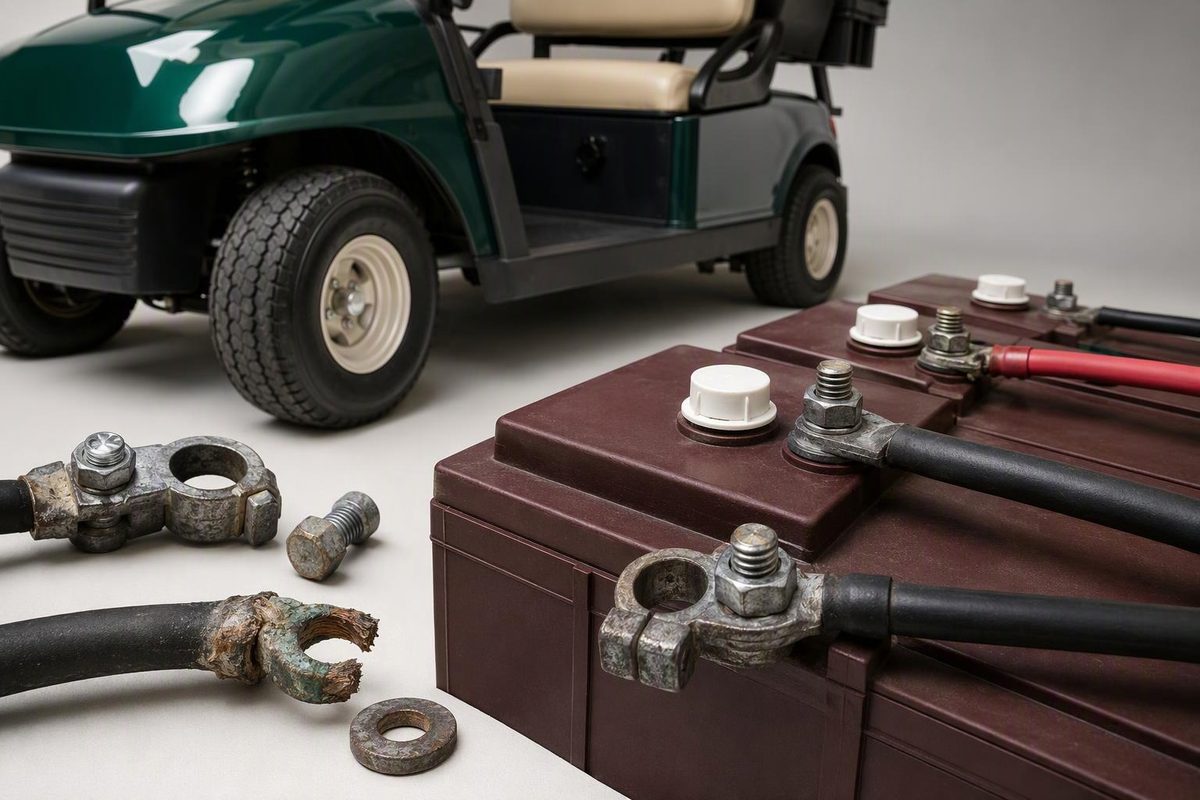
A loose battery terminal on a golf cart usually needs cleaning, correct assembly and tightening to the specified torque—provided only the cable connection is loose and the parts are undamaged. If the battery post itself moves, the threads are damaged or anything has melted, stop using the cart; more tightening is not the repair. Trojan warns that faulty connections can impair performance and damage battery components, while over-tightening can break or melt posts and cause fire. Trojan battery cable guide
Select the condition you have safely observed to see whether the connection needs servicing, replacement or professional assessment.
Connection Repair Decision
Do not touch a live connection or force a post to check it. Identify the cart and battery, then follow their shutdown procedure.
Do Not Choose A Repair Yet
Identify the cart and battery and obtain the prescribed shutdown procedure. If you cannot inspect safely or lack the required experience, use a qualified technician.
Do not drive or charge if you see heat damage, a cracked case or leaking fluid.
| Finding | Next Action |
|---|---|
| Loose lug; sound terminal | Inspect, clean and assemble to the exact specification. |
| Damaged cable or lug | Replace the cable assembly with the correct specification. |
| Clamp slips; threads fail | Replace defective hardware; have battery-terminal threads assessed. |
| Moving, cracked or melted post | Leave out of service for professional assessment or replacement. |
| Owner pack service prohibited | Use authorized personnel; do not open the pack. |
Sources: Trojan cable guide and the model-specific Club Car and E-Z-GO manuals cited in the article. This tool does not diagnose the cart or supply a torque setting.
Before choosing a procedure, identify the cart’s make, model and year, whether it is gas or electric, and the installed battery model, chemistry and pack voltage. A 12V gas-cart starting battery, a 36V or 48V lead-acid traction pack and a lithium conversion do not necessarily use the same hardware or shutdown procedure.
Heat Damage Means Stop Driving And Charging
Intermittent power, hesitation or failure to start are reasons to inspect the connections—not proof of a loose terminal. Look for corrosion, a displaced cable lug or a visibly loose fastener. Frayed cable strands, cracked insulation and a damaged lug indicate that tightening alone will not fix the connection.
Scorching, melted insulation, a deformed battery post, a cracked case or leaking fluid are reasons to leave the cart out of service. Trojan recommends inspecting batteries for cracks and leaks, checking cables for loose or damaged parts, and replacing suspect cables. Club Car warns that damaged or corroded cable terminals can overheat during operation and cause fire. Trojan inspection guidance · Club Car Precedent owner’s manual, battery care
Do not drive or charge a cart with a damaged connection to see whether it improves. Do not touch a suspect terminal to judge its temperature or wiggle a cable while someone presses the accelerator.
Follow The Exact Shutdown Procedure Before Touching Cables
Park on level ground, secure the parking brake, remove the key and chock the wheels. Set the direction control as required by the cart manual. Stop charging and disconnect the charger according to its instructions.
Remove jewelry and use insulated tools and the eye, face and hand protection specified for battery work. Never bridge terminals with a wrench. Work in a ventilated area away from smoking, flames and sparks. Trojan’s battery-handling guidance specifies these precautions for battery work. Trojan battery-handling precautions
Key OFF or Tow mode alone does not make battery terminals safe to handle; disconnected batteries still contain energy. Follow the exact cart and battery shutdown procedure rather than applying a sequence from a different model.
For example, the June 2016 Club Car Precedent manual for ERIC-equipped electric vehicles specifies Tow before battery disconnection, negative cable first, then a 90-second wait for controller capacitors to discharge. Its reconnection sequence starts with positive. These instructions apply only to the vehicles covered by that manual’s build-code range—not every Precedent or every cart.
Club Car also specifies trained technicians for service and repair, with electrical and mechanical repair knowledge required even for simple work. If you lack that experience or cannot identify the prescribed procedure, use a qualified technician. Club Car Precedent manual, safety precautions and pages 15–18
For lithium carts, check whether owner servicing is allowed at all. The E-Z-GO Express 2/4/6 ELiTE manual labeled “Model Year 2025 – Current” states that battery-pack service, removal and installation require authorized personnel and that there are no user-serviceable parts. Do not open that pack or apply a lead-acid repair procedure to it. E-Z-GO ELiTE owner’s manual
A Loose Cable Lug Is Different From A Loose Battery Post
After completing the prescribed shutdown and disconnection procedure, distinguish the cable attachment from the battery terminal itself. Do not force a post to test it. A nut that feels tight does not prove the lug has good electrical contact.
| Finding | Next Action |
|---|---|
| Lug or clamp moves on an otherwise sound terminal | Remove and inspect the connection; clean and reassemble correctly. |
| Cable moves inside its lug, or strands or insulation are damaged | Replace the cable assembly with the correct specification. |
| Clamp cannot grip, or threads will not hold specified torque | Replace defective hardware; have damaged battery-terminal threads assessed. |
| Post moves in the case, is cracked or has melted | Leave the battery out of service for professional assessment or replacement. |
For serviceable lead-acid connections, clean the terminal and cable mating surfaces with an appropriate terminal brush. Trojan’s cable guide calls for removing corroded cables, cleaning the mating surfaces, neutralizing external corrosion with baking soda and water, and drying thoroughly. Keep flooded-battery vent caps installed so cleaning solution cannot enter the cells. Trojan cleaning instructions
Use The Battery’s Hardware And Torque Specification
Follow the battery’s terminal assembly diagram. Where washers are specified, they must not interrupt direct contact between the cable lug and terminal. Trojan’s AES AGM guidance places the washer above the wire connection, between it and the nut—not underneath the lug, where it can create high resistance and terminal meltdown. Trojan AES AGM terminal guidance
There is no single golf-cart battery-terminal torque. Trojan lists these dry torque values for the following terminal types:
| Trojan Terminal Type | Dry Torque |
|---|---|
| Flooded UT/WNT/DWNT | 95–105 in-lb |
| AGM M8 | 85–95 in-lb |
| AGM M6 | 25–35 in-lb |
These are examples for those Trojan terminal types, not settings for other batteries. Match the exact battery and terminal specification, and use a suitable torque wrench. Inch-pounds are not foot-pounds. If the cart manual and replacement-battery instructions differ, get clarification rather than choosing the higher number. Trojan torque chart
Do not improvise a shim or keep tightening a damaged clamp. Apply the specified corrosion protection after making the connection, then restore terminal covers.
Verify The Connection Before Replacing Other Parts
Reconnect and restore the cart to operation using its prescribed sequence. With tools removed and covers installed, check operation in a safe, traffic-free area.
If the connection loosens again, inspect cable fit, routing and battery restraint rather than simply adding torque. Club Car requires batteries to be secured against movement without cracking the case; use the battery-care guidance in the Precedent manual cited above.
If the connections are sound but the fault remains, move to battery testing by chemistry. For a cart that still clicks but will not move, continue with solenoid diagnosis—do not replace the solenoid solely because tightening a terminal did not solve the problem.