
AGM Golf Cart Batteries: Check the Pack and Charger Before Buying
AGM golf cart batteries need no watering, but fit and charging still matter. Check voltage, capacity, terminal clearance and charger approval before buying.
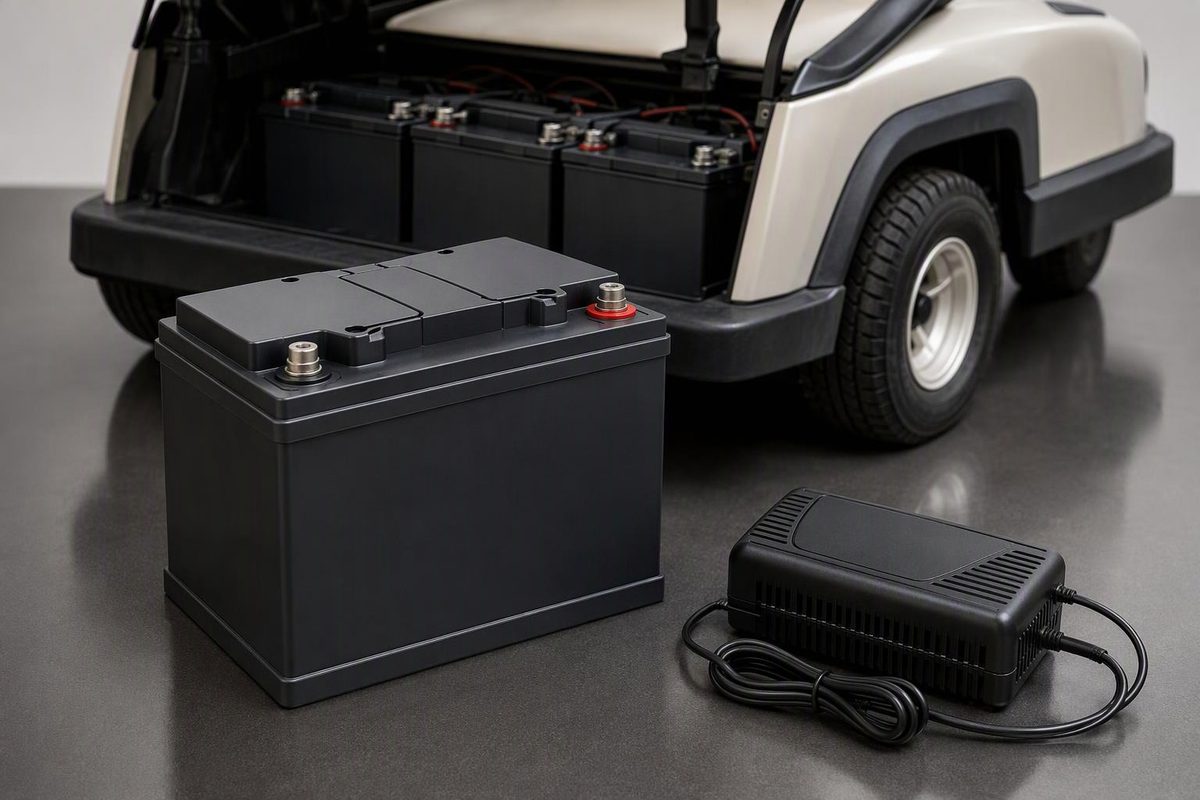
AGM golf cart batteries are a sensible option when you want a lead-acid traction pack without routine watering. They are not automatically a drop-in replacement for flooded batteries: the pack voltage, physical fit, capacity and charger profile still need to match.
This guide concerns the batteries that propel an electric cart, not the starting battery in a gas cart. Before shopping, record the cart’s make, model, year or serial number, installed pack voltage, battery model numbers and charger model.
What AGM changes—and what it does not
AGM means absorbed glass mat. The electrolyte is held in fiberglass mats rather than freely flowing as it does in a flooded battery. AGM is still lead-acid technology; choose a deep-cycle model intended for repeated discharge, not an automotive starting battery chosen mainly for its cranking-amp rating. Trojan’s battery guidance explains the construction, while its AGM maintenance guide distinguishes deep-cycle and starting batteries.
The practical benefit is no watering. “Maintenance-free” does not mean you can ignore charging, cable condition or terminal connections. Nor does “sealed” mean the compartment can be airtight: AGM batteries still require ventilation. U.S. Battery specifically excludes sealed or gas-tight containers.
If avoiding watering is your main goal, compare a complete AGM installation quote with a compatible lithium installation—not just individual battery prices. Our lithium conversion guide covers the additional compatibility checks.
Four checks before ordering
1. Match the pack, not just one battery
Read the installed battery labels and confirm the required voltage with the cart documentation. In a series string, battery voltages add together. A 36V pack could use six 6V batteries; a 48V pack could use eight 6V, six 8V or four 12V batteries. Trojan lists those 48V arrangements, but that does not establish that every arrangement fits your cart.
Treat an unfamiliar or modified pack as a stop point: have its layout verified before buying. Do not select batteries from the cart brand alone.
2. Check dimensions, terminal height and weight
Measure the tray, hold-downs and clearance beneath the seat, including space for cable bends and terminal covers. Check the selected terminal option—not only the case dimensions—and confirm that the complete pack’s weight is acceptable for the cart and tray.
For example, Trojan’s May 2026 T875-AES datasheet lists heights of 11.41 inches with AP adapters and 12.07 inches with LT adapters. It also specifies at least 0.5 inch of spacing between batteries. A battery that fits by footprint can still be too tall once the correct adapter is fitted. Confirm the overall height of the supplied configuration with the seller. T875-AES datasheet
3. Compare capacity at the same discharge rate
An amp-hour rating needs its test rate beside it. Lead-acid batteries deliver less capacity at higher discharge currents, so a 20-hour rating is not a promise of golf-cart runtime. Trojan explains the rate dependency.
These manufacturer-listed examples illustrate what to compare, not a universal fitment shortlist:
| Deep-cycle AGM model | Nominal voltage | 20-hour capacity | 5-hour capacity | Weight per battery |
|---|---|---|---|---|
| U.S. Battery US AGM 2000 | 6V | 210Ah | 177Ah | 60 lb |
| Trojan T875-AES | 8V | 170Ah | 142Ah | 88 lb |
Sources: US AGM 2000 specifications and T875-AES datasheet, revised May 6, 2026.
Ask the supplier to size the pack for your passengers, terrain and daily use. Do not convert an Ah figure directly into miles.
4. Confirm the charger’s actual profile
A matching plug and “48V” label are not enough. Get confirmation that the charger model and selected algorithm are approved for the exact battery model and pack configuration. U.S. Battery says charging parameters depend on both battery and charger type, and directs users to obtain the correct algorithm selection or programming. Charging instructions
As a model-specific example, Trojan specifies 57.6V absorption and 54.0V float at 77°F/25°C for a 48V T875-AES pack, with temperature compensation and an approved charger. Those are charging settings—not resting-voltage readings or universal AGM settings. T875-AES datasheet
If the charger’s profile cannot be verified, stop the purchase until it can. Our 48V charger compatibility guide covers the connector and cart-side checks.
Care and replacement decisions
Follow the selected battery’s manual. For Trojan AES AGM batteries, that means never adding water or removing vent caps, never equalizing, charging in a ventilated area and using temperature-compensated charging. Trojan recommends full charging after each use of 30 minutes or more and advises against discharge beyond 80%. AES AGM maintenance instructions
For storage, the same guide calls for a full charge first, voltage checks every two to three months—more often in hot conditions—and a boost charge at 75% state of charge or below.
If an existing pack has lost range, test the batteries before replacing them. Poor performance alone does not identify a failed battery. If replacement is justified, avoid casually inserting one new battery into an aged string: Trojan warns that mixed-age AES batteries can produce overcharging or undercharging and does not recommend partial replacement.
For the buying decision, request an itemized quote covering the whole matched pack, charger configuration or replacement, cables and adapters, installation, core charges and written warranty terms. Choose AGM because that complete setup fits your cart and use—not because “maintenance-free” sounds like “nothing to check.”