
Trojan T-875 Batteries: Check the Pack Before You Buy
Trojan T-875 golf cart batteries are 8V, 170Ah flooded batteries. Check six-battery 48V fit, charger compatibility, watering and replacement costs.
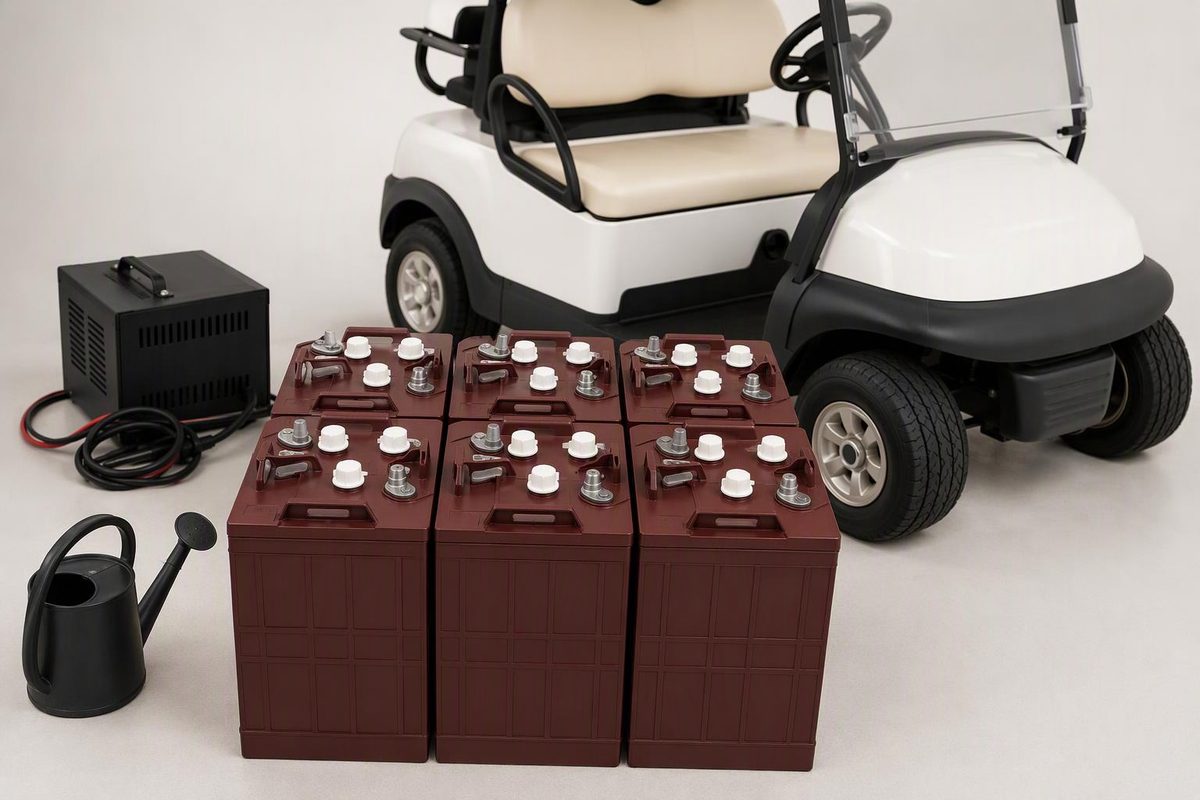
The Trojan T-875 is an 8-volt flooded lead-acid deep-cycle battery rated at 170Ah at the 20-hour rate. Six connected in series make a nominal 48V electric golf-cart pack. It is a replacement candidate for a cart already using six 8V flooded batteries—not a universal fit for every Club Car, E-Z-GO or Yamaha. Trojan’s specifications and battery-selection guidance establish those starting points.
Before ordering, confirm the cart’s make, model, year, installed pack and charger. This guide concerns electric traction batteries, not a gas cart’s starter battery.
T-875 specifications that matter
| Specification | Trojan T-875 flooded battery |
|---|---|
| Nominal voltage | 8V |
| Battery group | GC8 |
| Capacity, 20-hour rate | 170Ah |
| Capacity, 5-hour rate | 145Ah |
| Rated runtime at constant 25A | 295 minutes |
| Rated runtime at constant 56A | 117 minutes |
| Listed length × width × height | 10.27 × 7.10 × 11.14 inches |
| Listed weight | 63 lb per battery |
| Maintenance | Watering required |
These figures come from Trojan’s product page and its T-875 datasheet. The datasheet shows dimensions with the high-profile terminal and notes that handles or terminals can change dimensions; verify the exact version being supplied.
Six batteries in series give 48V at 170Ah, not 1,020Ah. Their listed combined weight is approximately 378 lb before cables and mounting hardware.
The 170Ah rating is not a promise of cart range. It uses a slow, controlled discharge; Trojan lists lower amp-hour capacity at the faster five-hour rate. The runtime figures are constant-current tests, not driving tests. Compare alternatives at the same discharge rate rather than choosing the largest advertised Ah number.
Check fit and charging before paying
Use the existing batteries as a reference, but confirm them against the cart manufacturer’s specification—especially on a used or modified cart.
- Verify voltage and count. A 48V pack can use six 8V, eight 6V or four 12V batteries. Those arrangements are not physically interchangeable just because their total voltage matches. A six-battery 36V pack using 6V batteries is not a direct T-875 replacement application. Trojan’s selection guide explains the different arrangements.
- Measure the compartment. Check each battery position, hold-down arrangement, overhead clearance and access to the watering caps. Trojan’s datasheet calls for at least 0.5 inch spacing between batteries. Allow clearance for cable lugs and protective covers, not just the case. T-875 datasheet
- Match the terminals. Confirm terminal type, polarity layout and whether the existing cables reach without strain. Use the torque specification for the supplied terminal—not a generic battery-terminal setting.
- Confirm the charger profile. Ask the charger supplier to confirm compatibility with a six-battery T-875 flooded pack. A “48V” label alone does not establish the correct charging settings; Trojan’s charging guidance distinguishes flooded and AGM requirements. See the 48V golf-cart charger compatibility guide.
Stop if the tray, hold-downs or charger compatibility cannot be confirmed. Resolve those details before buying a pack.
Do not confuse T-875 with T875-AES
The similarly named T875-AES is an AGM battery, not the flooded T-875. Trojan lists it at the same 170Ah 20-hour capacity, but at 88 lb with dimensions of 10.30 × 7.06 × 10.73 inches. It needs no watering and uses an AGM charging profile. Trojan T875-AES specifications
That makes it a separate buying decision. Six AES batteries weigh about 150 lb more than six flooded T-875s using the listed weights. Check load, fit and charging rather than treating “875” as proof of interchangeability. Our AGM battery buying checks cover that alternative.
Test an existing pack before replacing it
For an open-circuit voltage check, Trojan specifies at least six hours idle with no charging or discharging, preferably 24 hours, and all loads disconnected. Follow the cart manufacturer’s shutdown and isolation procedure before testing. Trojan’s reference values for an 8V flooded battery are 8.49V at full charge and 8.07V at 50% charge. These are resting values, not under-load limits. Trojan testing guidance
A resting reading alone does not establish usable runtime. If range is poor, follow the battery-testing guide before condemning the pack.
Trojan advises against partial replacement of flooded battery banks because old and new batteries respond differently during charging. For an aging pack, budget for a matched set rather than assuming one new T-875 will restore it. Trojan replacement guidance
Ownership and quote checks
Start by checking water levels monthly, then adjust to actual use. Trojan’s watering guidance recommends this initial schedule.
Normally add distilled water after a full charge. If plates are exposed beforehand, add only enough to cover them, charge, then finish filling. For standard deep-cycle batteries, Trojan specifies 1/8 inch below the bottom of the vent well. Never add acid or overfill. Wear protective clothing, gloves and goggles, keep sparks away and charge in a ventilated area. Trojan maintenance instructions
For a detailed sequence, use the distilled-water guide.
Request a written six-battery installed quote identifying the exact T-875 terminal version, tax, delivery, core charges or credits, old-battery recycling, cables, hold-down repairs and warranty terms. Choose the flooded T-875 when the cart accepts that pack and you can maintain it—not solely because the individual battery price looks attractive.