
AGM Versus Gel: Choose by Cart Load and Charger Fit
Compare AGM and gel golf cart batteries by power delivery, cycle-life ratings and charging needs, then check the complete pack before buying.
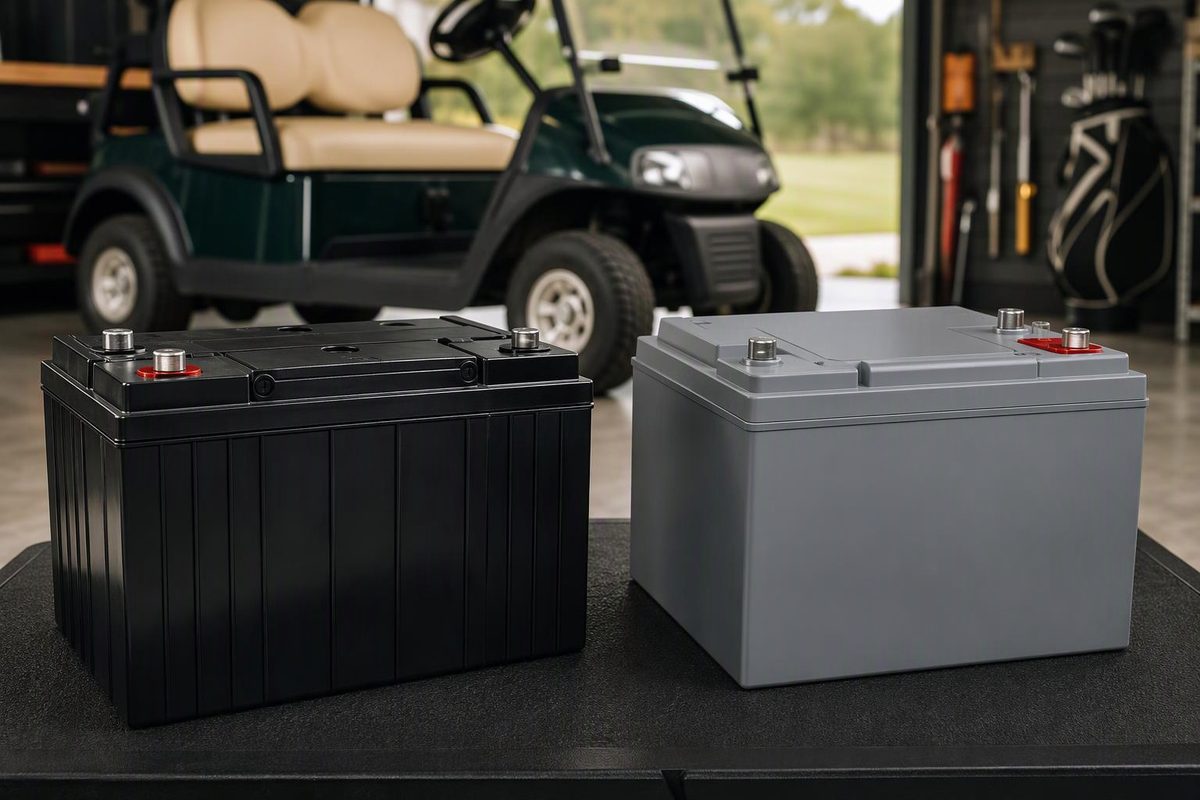
AGM is worth investigating first for short bursts of high current and driving below freezing; gel deserves consideration when its documented cycle life and approved charging setup suit your cart. Neither is a universal upgrade. Choose a purpose-built deep-cycle battery that fits the cart and works with its charger—not simply whichever sealed battery costs less.
This comparison concerns the traction pack in an electric golf cart. A gas cart’s starting battery has a different job; follow its make, model and year requirements rather than this traction-pack buying advice.
What actually differs?
Both AGM and gel are valve-regulated lead-acid (VRLA) batteries. AGM means absorbent glass mat: the electrolyte is held in glass-fiber material between the plates. Gel immobilizes the electrolyte with a silicate additive. Neither needs watering, and neither should be opened to add water. “Sealed” or “maintenance-free” alone does not identify which type you have—check the battery model and data sheet. Discover explains the construction and watering restrictions.
| Buying question | AGM | Gel |
|---|---|---|
| Short bursts of high current | Generally better suited | Generally lower effective capacity at high discharge rates |
| Power below freezing | Stronger starting shortlist | Power declines faster in Discover’s comparison |
| Cycle life | Depends on the specific design | Can exceed comparable conventional AGM designs |
| Charging | Needs a profile approved for the exact model | Needs a profile approved for the exact model |
| Watering | None | None |
These are tendencies, not guarantees for every product. Victron’s AGM/gel data sheet supports the high-current and cycle-life trade-off. Discover’s comparison describes faster gel power loss below 32°F/0°C, but also says the difference in high-current performance is very small at room temperature.
For hills, frequent acceleration or heavier passenger loads, make the actual model’s discharge performance a priority. A high starting-current rating is not proof of suitability for repeated golf-cart discharge cycles. Look for traction/deep-cycle suitability, not just cranking amps. Discover’s golf-cart battery guidance calls for purpose-built deep-cycle batteries to support electric-drive surge loads.
Does gel really last longer?
Sometimes—but compare models under the same conditions.
For example, Victron lists a cycle design life of 600 cycles at 50% depth of discharge for its conventional AGM Deep Cycle range and 750 cycles at the same depth for its Gel Deep Cycle range. Those figures describe those product families, not every AGM and gel battery or expected life in your cart. Its data sheet also shows that deeper discharge reduces cycle life. Source: Victron cycle-design specifications.
Ask a seller for:
- Cycle life at the same depth of discharge, with test conditions stated.
- Capacity measured at the same discharge rate.
- Warranty coverage for golf-cart use, including charging requirements.
Do not translate a “12-year float life” claim into 12 years of golf-cart service. Float service describes a battery kept charged for standby duty; driving and recharging a cart is cycling service. Victron lists those ratings separately.
The charger is the stop point
Do not order a replacement chemistry until charger compatibility is confirmed. Matching nominal pack voltage and having a plug that fits are not enough.
Delta-Q recommends checking the charger’s available algorithms before selecting replacement batteries. It directs owners to the vehicle manufacturer or supplying authorized distributor for supported battery/profile combinations. Battery type and amp-hour capacity both affect algorithm selection. Source: Delta-Q charge-profile guidance.
Give the supplier your cart’s make, model, year, installed pack voltage, charger model and proposed battery model. Get confirmation of:
- The approved charge profile or algorithm.
- Permitted charging current and temperature-compensation requirements.
- Whether the existing charger can be configured appropriately or needs replacement.
Do not assume a generic “AGM/gel” setting suits both products. Nor should you apply a flooded-battery equalization routine: Trojan’s user guide warns against equalizing AGM or gel batteries. Follow the exact battery manufacturer’s instructions, not a generic high-voltage recovery procedure.
For a 48V cart, use our 48V charger compatibility checklist before buying.
Compare the complete installed pack
Once charging is settled, compare pack voltage and layout, capacity at the same discharge rate, dimensions, terminal clearance, cable reach and total weight. A 20-hour amp-hour rating is not a promise of cart runtime: Victron documents falling effective capacity as discharge current increases.
Series wiring adds voltage, not amp-hour capacity. Six identical 170Ah batteries in one series string still form a 170Ah pack, not 1,020Ah. Trojan’s guide explains series and parallel connections.
Compare complete-pack quotes including any charger configuration or replacement, cables, installation and recycling—not individual battery prices alone. Our AGM fit and buying guide covers the physical checks in more detail.
Both chemistries remove watering, not all maintenance. Keep connections clean and torqued to the battery’s specification, and charge in a ventilated area: AGM and gel batteries can vent gas if pressure builds during charging. Trojan’s guide covers those precautions.
Choose AGM when its documented load performance and compatible installation win the comparison. Choose gel when a compatible traction-rated model offers a worthwhile cycle-life advantage for your use. If the seller cannot document charger approval, stop there.