
What Does Amp Hour Mean for a Battery? Golf Cart Examples
Understand battery Ah, hour-rate tests, 48V pack capacity and runtime estimates before choosing replacement golf cart batteries.
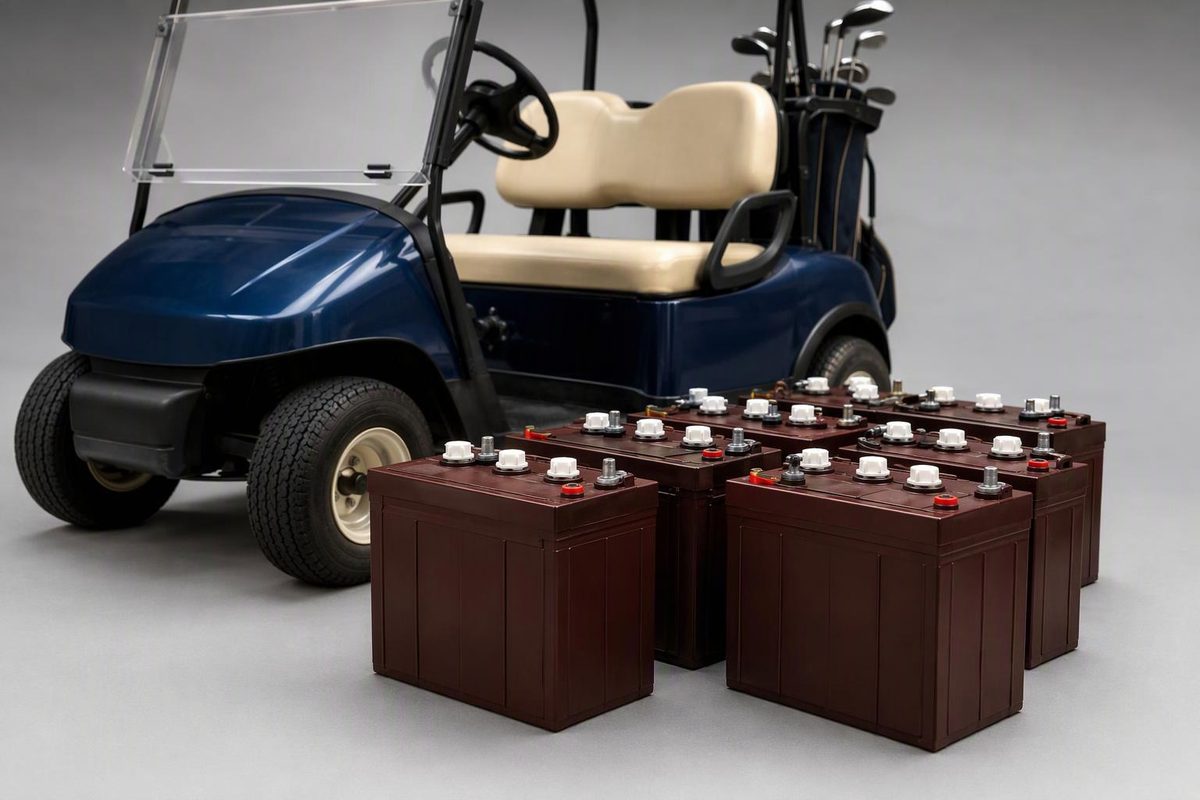
An amp-hour (Ah) measures electrical charge capacity: how much current a battery can deliver over time under specified test conditions. For an electric golf cart, it helps you compare potential runtime—not top speed or maximum current output. The Ah label is a rated capacity, not a reading of how much charge remains today.
For a steady current, the basic relationship is:
Amp-hours = current in amps × time in hours
For example, a battery rated 100Ah at the 20-hour rate is rated to deliver 5 amps for 20 hours to the test’s specified end voltage. That does not guarantee 100 amps for one hour. Battery capacity depends on discharge current, particularly with lead-acid batteries, as Trojan explains in its battery-rating guidance.
Ah, amps and volts mean different things
These label numbers answer different questions:
| Label | What it tells you | Golf cart use |
|---|---|---|
| A — amps | Current flowing, or a specified current limit | Check whether the battery can support the cart’s electrical demand |
| Ah — amp-hours | Charge capacity at a stated discharge rate | Compare potential runtime |
| V — volts | Electrical potential; battery labels usually state nominal voltage | Match the battery system to the cart |
| Wh — watt-hours | Energy capacity | Compare stored energy when voltages differ |
For a rough nominal-energy comparison:
Watt-hours ≈ nominal volts × amp-hours
A hypothetical 48V, 100Ah pack represents about 4,800Wh, or 4.8kWh. A 36V, 100Ah pack represents about 3.6kWh. Same Ah, different energy. This follows the voltage–current–power relationship described in Victron’s electrical theory guide; usable energy will depend on operating conditions and discharge limits.
Read the hour rate before comparing batteries
A real golf cart example is the Trojan T-875, an 8V flooded lead-acid battery. Trojan lists these capacities for the same battery:
| Discharge test | Rated capacity | Constant test current, calculated as Ah ÷ hours |
|---|---|---|
| 20-hour rate | 170Ah | 8.5A |
| 10-hour rate | 155Ah | 15.5A |
| 5-hour rate | 145Ah | 29A |
Those figures come from Trojan’s T-875 specifications. As the battery is discharged faster, its available Ah decreases.
Compare like-for-like ratings: 170Ah at the 20-hour rate and 145Ah at the 5-hour rate are not competing specifications here—they describe one battery under different loads.
Chemistry matters, too. For comparison, Trojan lists its lithium OnePack S2 at 105Ah across the 5-, 10- and 20-hour rates. That does not establish which pack gives your cart more range; voltage, usable discharge depth and actual load still matter.
Six batteries do not necessarily mean six times the Ah
Series connections increase voltage; parallel connections increase capacity, as explained in Victron’s battery-bank guide.
For example, six matched 8V, 170Ah T-875 batteries connected in one series string form a 48V, 170Ah pack—not a 48V, 1,020Ah pack. Add the voltages, not the Ah ratings. The 170Ah rating still refers to the 20-hour discharge rate.
Two matched 48V, 100Ah packs connected in parallel would nominally provide 48V, 200Ah. That arithmetic is not permission to modify your cart: only use configurations approved by the battery and cart-system manufacturers.
Use Ah to estimate runtime, then check compatibility
The starting calculation is:
Estimated runtime in hours ≈ usable Ah ÷ average battery current in amps
If you assume 80Ah is usable and average pack draw is 40A, the arithmetic gives two hours. That is an illustration, not a golf cart range claim. Use capacity appropriate to the load, and allow for your battery’s discharge limits. Cold conditions reduce lead-acid capacity, and Trojan generally recommends discharging its lead-acid batteries by only 20–50% of rated capacity for optimum life and performance in its lead-acid guidance.
Before buying a higher-Ah replacement, check:
- Cart identity and pack voltage: make, model, year and installed system—not just battery count.
- Rating conditions: hour rate, test temperature and discharge endpoint.
- Current capability: continuous and peak discharge limits, including lithium battery management system (BMS) limits.
- Installation compatibility: dimensions, weight, terminals and approved charger profile.
A higher Ah rating can offer longer runtime in an otherwise comparable setup; it does not make an incompatible battery suitable. For a chemistry change, use the golf cart lithium conversion checks. If your existing cart has lost range, start with battery testing rather than treating the original Ah label as proof of its present capacity.