
Use Distilled Water Only in Flooded Golf Cart Batteries
Learn which golf cart batteries need distilled water, when to add it, the correct fill level, and how to avoid overfilling and acid exposure.
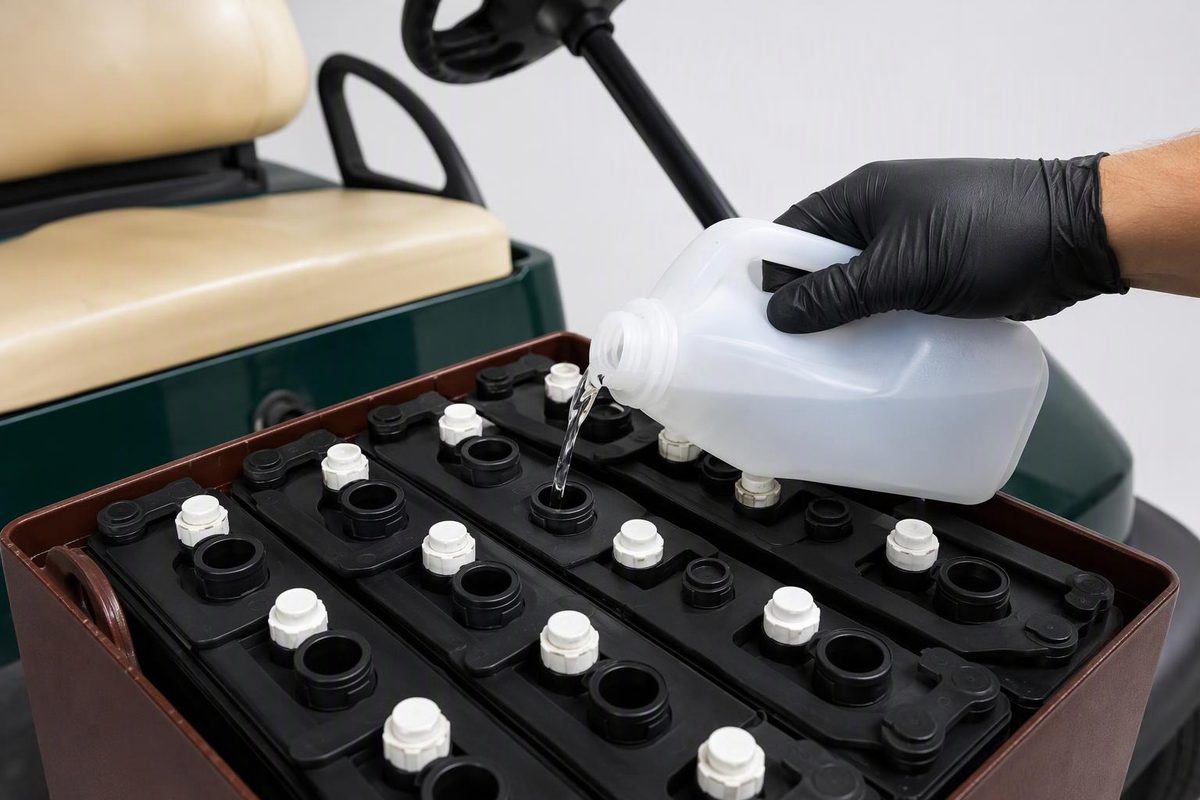
Use distilled water only in a flooded lead-acid golf cart battery designed to be watered. Do not add water to lithium, AGM, gel or other sealed batteries. Trojan, for example, says its AGM batteries require no watering and warns owners not to remove their vent caps (Trojan Battery).
The rule is the same for 36V, 48V and 72V carts. Pack voltage determines how the batteries are arranged; battery chemistry and the instructions for the installed battery model determine whether they need water.
What water should you use?
Use store-bought distilled water. Do not add:
- Tap water
- Spring or mineral water
- Drinking water merely labeled “purified”
- Battery acid
- A baking-soda mixture
Minerals and other contamination can shorten battery life. Some manufacturers permit water that has been filtered and tested to their purity specification, but distilled water is the straightforward choice when water quality has not been verified. Trojan recommends distilled water and says never to add acid during routine watering (Trojan Battery).
Baking soda is used to neutralize residue on the outside of a battery. Do not let it enter a cell.
When to add distilled water
Check and complete the final fill after the batteries have reached a full charge. Electrolyte is at its highest level when the battery is charged, so filling a discharged battery to its final level can cause an overflow during charging.
There is one exception: if the plates are exposed before charging, add only enough distilled water to cover them. Then charge the pack and complete the fill afterward. This charge-first sequence and exception are specified in Trojan’s flooded-battery watering procedure.
Start by checking monthly, then adjust the interval for the cart’s use and conditions. Club Car recommends a 30-day check for typical use and more frequent checks when a cart is used more often (Club Car). Hot weather and heavy use can also increase watering needs.
If one cell repeatedly loses much more water than the others, look for leakage. If the whole pack suddenly needs water more often, have the charging system and batteries checked rather than continuing to top them up without diagnosing the cause. The guide to testing golf cart batteries explains how to compare batteries under consistent conditions.
How to fill flooded golf cart batteries
- Confirm the battery type. Check the label or battery manual for “flooded,” “wet cell” or equivalent wording. If it says AGM, VRLA, gel, sealed or lithium, stop—do not open or water it. If the pack has a single-point watering system, follow that system’s instructions rather than opening individual cells.
- Park safely. Put the cart on level ground, set the parking brake, turn the key off and remove it. Follow the owner’s manual for the cart’s exact Run/Tow or maintenance-switch setting; this varies by model.
- Protect yourself. Work in a ventilated area. Wear acid-resistant gloves and safety goggles or a face shield. Remove jewelry, and keep flames, sparks and uninsulated metal tools away from the pack. Flooded batteries contain corrosive electrolyte and can release hydrogen during charging.
- Complete the charge. If the plates are covered, charge before adding water. Let the charger finish and disconnect it before opening the vent caps.
- Inspect every cell. Remove the caps carefully. Use a flashlight—not a flame—and do not rest tools on the batteries.
- Add distilled water slowly. A plastic squeeze bottle or battery-watering gun provides more control than pouring from a jug. Fill each low cell to the battery manufacturer’s specified mark.
- Secure the caps. Reinstall every cap and leave the battery tops clean and dry.
If electrolyte reaches your skin or eyes, flush the affected area immediately with clean water and seek medical attention; the E-Z-GO manual warns that the acid solution can cause severe burns (E-Z-GO Valor owner’s manual).
How full should each cell be?
Do not fill to the cap or the top of the opening. The battery needs expansion space.
The exact level varies by design. Trojan specifies 1/8 inch below the bottom of the vent well for its fully charged standard deep-cycle batteries. Its Plus Series instead uses a maximum-level indicator (Trojan Battery). The E-Z-GO Valor lead-acid manual specifies electrolyte 1/2 inch above the plates and about 1/4 to 3/8 inch below the vent tube (E-Z-GO Valor owner’s manual).
That variation is why the installed battery’s label and manual take priority over a universal measurement. Record the battery brand and model—not just the cart’s make, year and pack voltage—before looking up the fill specification.
Overfilling can force acidic electrolyte through the vents during charging, causing corrosion and reducing the acid concentration left in the cell. Underfilling can expose and permanently damage the plates. Aim for the specified level after charging, not “as full as possible.”