
Club Car Charger Repair: Find the Fault Before Buying Parts
Diagnose Club Car PowerDrive and ERIC charger faults, separate charger failures from cart-side problems, and know when repair needs a technician.
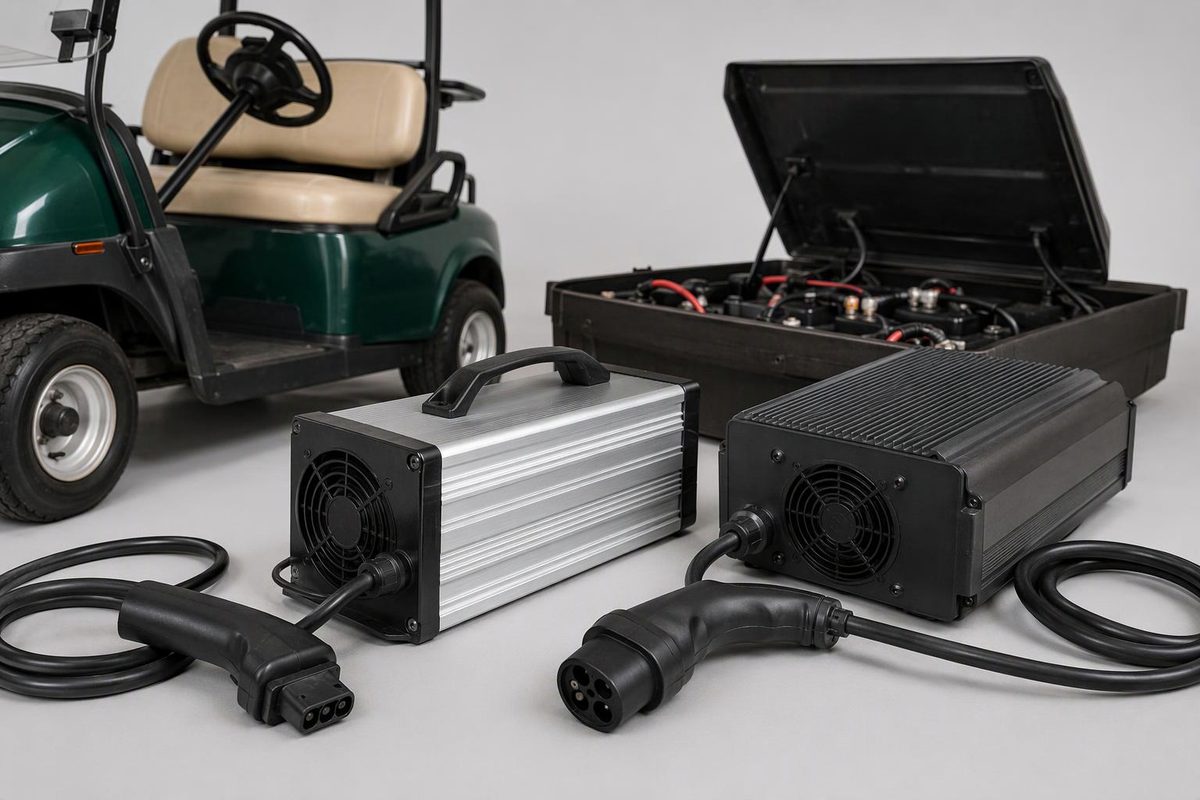
A Club Car charger that will not start is not necessarily broken. On the PowerDrive models covered below, the cart’s onboard computer (OBC), battery voltage and receptacle wiring can prevent charging. Once the fault is isolated, the older transformer-based chargers have documented component repairs; ERIC chargers have a different diagnostic and reset procedure.
This guide covers 48V electric Club Cars using the original PowerDrive external charger models 17930-11, 17930-18 or 17930-19, plus the ERIC system described in Club Car’s 2013 Precedent Excel owner’s manual. The PowerDrive procedures do not cover PowerDrive 2, PowerDrive 3 or onboard chargers. Do not apply these tests to a 36V charger, a lithium conversion or an unidentified aftermarket unit. The PowerDrive service manual and ERIC owner’s manual are system-specific; for ERIC, confirm that your cart falls within the manual’s back-cover build-code range.
1. Identify the charger and stop for damage
Record the cart model, serial/build code, charger model number, installed battery type and any previous charging-system modifications. Photograph the labels and note exactly what happens: no click, click without hum, hum without indicated current, or an ERIC warning light.
Before inspecting the charging connectors, unplug the charger from both AC power and the cart. Stop using it if there are exposed wires, damaged insulation, corroded contacts, a loose or burned connector, or abnormal heat at the plug and receptacle. The ERIC manual specifically says not to straighten bent plug pins—replace the plug through a qualified service person. Do not charge frozen batteries or batteries with bulged cases. Club Car’s connector and charging warnings identify these as fire or injury risks.
Owner checks should stay outside the charger case: inspect the cords and receptacle, check the supply breaker/GFCI, and use a known-working, properly grounded outlet suitable for the charger. Keep the charger ventilated. Club Car’s service warnings reserve charger repair and servicing for trained technicians; disconnecting it is essential but does not make every repair an owner-level task.
2. PowerDrive: follow the click, hum and ammeter
For the three PowerDrive models above, Club Car’s troubleshooting chart separates faults this way:
| What you observe | What needs checking before replacement |
|---|---|
| No relay click, no transformer hum, no ammeter movement | Disconnected batteries, low pack voltage, poor plug/receptacle contact, damaged DC cord, cart-side wiring/fuses or OBC |
| Relay clicks, but no hum or ammeter movement | AC supply, AC cord, internal breaker, relay contacts, transformer primary circuit or ammeter |
| Relay clicks and transformer hums, but ammeter stays at zero | Charger fuse, diodes, transformer or OBC |
| Output is low | A failed diode, transformer fault or OBC problem |
| Charger shuts off early | Interrupted AC power, OBC trouble—or batteries already charged |
These are possible causes, not parts-buying verdicts. The PowerDrive troubleshooting chart, pages 3-12–3-14, supplies the corresponding tests. Its gray sense-lead fuse and receptacle fuse-link checks apply to vehicles other than Precedent; for Precedent, it instead identifies relevant wire connections at the OBC. Do not assume every cart has the same fuse arrangement.
Do not condemn it from an unplugged-output test
With AC connected but the DC plug disconnected from the cart, these PowerDrive chargers should have zero volts across the positive and negative output pins, no relay closure and no transformer hum. Zero output in that condition is normal—not proof of a failed charger. Club Car’s operation test, page 3-11, explicitly specifies this behavior.
Low battery voltage can also prevent startup. The manual’s battery-voltage test and low-voltage recovery section address that condition, but a charger’s startup requirement is not a healthy-battery benchmark. If the pack is deeply discharged, have its condition and recovery options assessed rather than bridging the relay yourself. Use our battery-testing guide for the separate battery diagnosis.
Separate charger failure from cart-side failure
Club Car’s OBC test uses a known-working compatible charger, followed by testing the suspect charger on a known-working compatible cart:
- If the second charger fails in the same way on your cart, investigate the vehicle charging circuit rather than buying charger parts.
- If your charger works properly on the other cart, it does not need repair for that symptom.
Have a shop perform this comparison if compatibility is uncertain. The test does not mean any Club Car-shaped plug is suitable, nor does failure on your cart alone prove the OBC is bad. PowerDrive test procedures, pages 3-18–3-19.
3. What a PowerDrive repair may involve
Club Car documents replacement procedures for the DC cord, heatsink/diode assembly, transformer, ammeter, fuse link, voltage suppressor, relay, AC breaker and AC cord. A confirmed component fault can therefore justify repairing one of these chargers instead of replacing the whole unit. PowerDrive repair procedures, pages 3-27–3-33.
Two details matter when reviewing a repair quote:
- A blown fuse may be the result, not the cause. Club Car associates a single blown charger fuse link with a shorted diode or, occasionally, heat from a loose fuse connection. Both blown links can point to reversed polarity or diode failure. Replacing the fuse without checking those causes is not a complete repair.
- The specified diode repair is the complete heatsink assembly. The manual’s isolated diode test checks conduction in one direction only; conduction both ways or neither way calls for heatsink replacement. Diode tests, pages 3-20–3-21.
Do not substitute a larger fuse, bypass protection or leave the relay bridged. Ask for a quote identifying the failed part, the underlying cause and a post-repair charging/shutoff check. Compare that installed cost with a correctly matched replacement—not merely another 48V charger.
4. ERIC: read the light before considering repair
For the ERIC system in the cited Precedent manual:
- Solid blue: AC power is present; this alone does not establish that charging is happening.
- Flashing orange: the charger was unable to complete the charge.
- Solid red triangular indicator: a charger error; Club Car instructs owners to reset power before replacement.
The ERIC manual, pages 35–38, also identifies a cart-side 30A inline charging-circuit fuse near the solenoid. An incomplete charge is not automatically an internal charger failure.
The documented ERIC reset
For a solid red error indication:
- Unplug the DC cord from the cart.
- Unplug AC power.
- Wait until the red light goes out, then wait another 30 seconds.
- Reconnect AC power.
- When the blue AC indicator comes on, reconnect the DC cord.
If the triangular error indicator returns, contact a Club Car dealer. If it does not, attempt normal charging. This sequence comes from “Resetting ERIC Charger Power,” page 38.
For dealer diagnosis, provide the light pattern, charger label, battery details and whether the fault began after battery replacement. ERIC’s USB service-port and battery-compatibility instructions reserve the port for authorized-technician data transfer, reconfiguration and updates, and warn that a different battery type may require a new charging algorithm. Do not treat a persistent warning as a reason to install random firmware or apply PowerDrive relay tests.