
Choose the Cart Brand You Can Actually Own and Service
Club Car, E-Z-GO, and Yamaha are the starting shortlist; compare parts access, warranty terms, configuration, and matched out-the-door quotes.
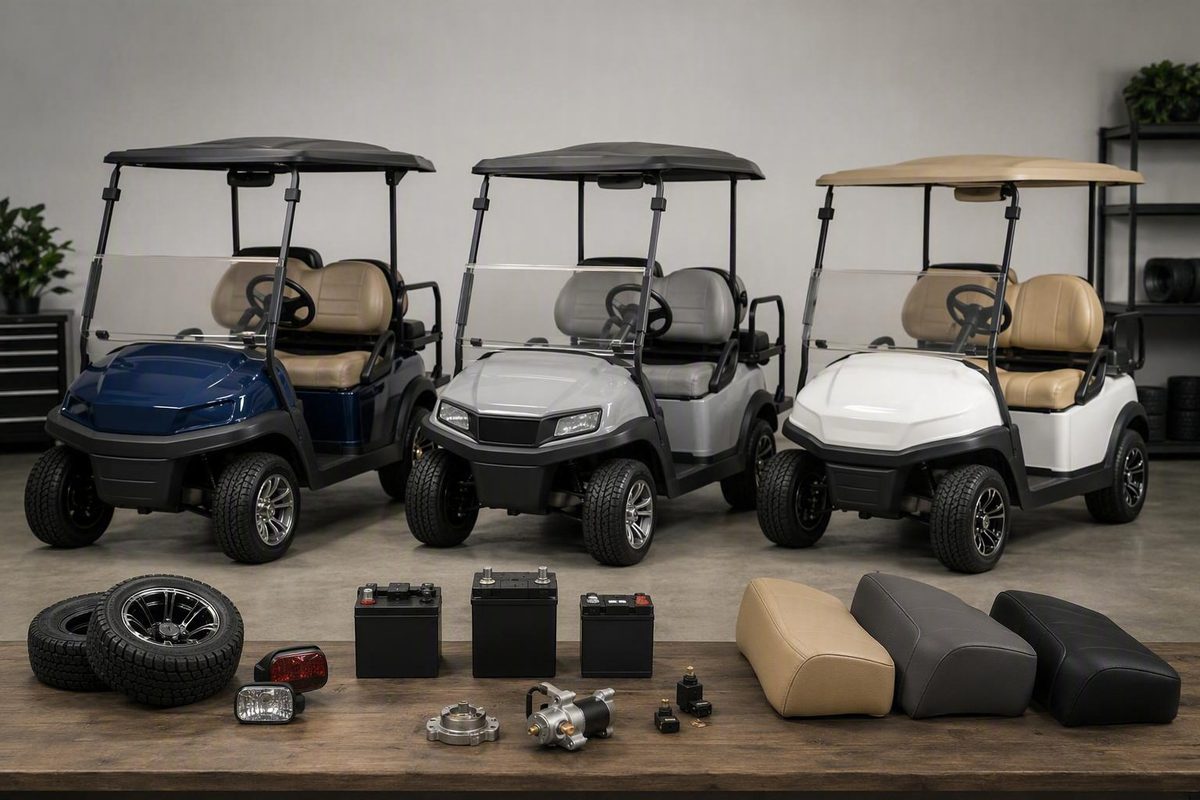
There is no universally best golf cart brand. Club Car, E-Z-GO, and Yamaha are the sensible first shortlist when established service and parts support matter, but that shortlist comes from retailer assessments—not independent reliability rankings.
The better buy is the correctly configured cart backed by a capable local service operation, accessible parts, clear written warranty terms, and an acceptable out-the-door price. Manufacturer specifications can confirm equipment and published coverage; they cannot prove failure rates, real-world range, resale value, or owner satisfaction.
The short answer: start with your ownership priorities
Start with Club Car, E-Z-GO, and Yamaha, then consider newer alternatives when their equipment, design, or price warrants extra investigation. The available comparisons contain no independent, standardized repair-rate or long-term reliability data that would justify declaring one brand the winner.
| Buyer priority | Brands to investigate first | Evidence-based reason | What to verify locally |
|---|---|---|---|
| Established service and parts support | Club Car, E-Z-GO, Yamaha | WilDar Golf Carts places these long-established platforms in its highest ownership tier for serviceability, parts access, and dealer support | Technician availability, stocked parts, labor rate, warranty turnaround |
| Broad capacity and powertrain choice | E-Z-GO | Its manufacturer-published lineup spans two to six passengers, with model-dependent gas, electric, and lithium choices | Exact model-year options, payload, seating direction, delivery date |
| Warranty emphasis | Yamaha | EA Carts reports a four-year limited Drive2 warranty | Current document, covered components, labor, exclusions, transfer rules |
| Coastal or corrosive conditions | Club Car | EA Carts reports welded aluminum-frame construction for the Club Car models in its comparison | Exact model construction, exposed steel parts, fasteners, accessories, corrosion care |
| Included equipment and technology | EA Carts and other newer brands | Some alternatives advertise richer equipment packages | Authorized repairs, parts lead times, warranty administrator, resale market |
E-Z-GO’s current manufacturer site illustrates the value of configuration choice: its displayed range includes two-, four-, and six-passenger carts, forward- and rear-facing seating, and model-dependent gas, electric, or lithium powertrains. Those options vary by model, so “E-Z-GO offers it” does not mean every E-Z-GO can be ordered that way. See the official E-Z-GO model lineup.
Club Car deserves investigation in salty or humid environments because EA Carts reports welded aluminum-frame construction for the Club Car models in its comparison. That may remove one concern associated with an exposed steel frame, but it does not make the entire vehicle corrosion-proof. Fasteners, suspension parts, wiring connections, accessories, and exposed steel components still require inspection.
For warranty-conscious buyers, EA Carts reports a four-year limited warranty for Yamaha Drive2 models. Treat that as a reason to request the current model-specific document—not as proof that Yamaha has the best warranty. Coverage for labor, batteries, commercial use, transport, and later owners may differ.
Why the badge matters less than the ownership system
Use this practical buying order:
- Intended use and legal category
- Local service quality
- Parts access
- Correct configuration
- Warranty scope
- Out-the-door price
- Expected ownership period
Intended use comes first because a two-seat course cart, a lifted property vehicle, a six-passenger people mover, and a certified low-speed vehicle solve different problems. Set passenger count, payload, terrain, storage, charging or fueling access, and public-road requirements before comparing badges.
Next, investigate the service operation—not merely the distance to the dealer. Ask how many technicians work on your model, whether the shop provides mobile service, which common parts it stocks, its hourly labor rate, and how long warranty repairs typically remain in the queue. A nearby showroom that orders every diagnostic part from elsewhere may be less useful than a slightly more distant shop with trained technicians and inventory.
A feature-rich cart can become poor value if a failed display, controller, charger, switch, or body component is difficult to diagnose or replace. Ask whether independent repairers can obtain service information and diagnostic access, whether parts must come through one seller, and what happens after the warranty expires.
WilDar Golf Carts cites rapid turnover among brands appearing in Florida low-speed-vehicle registrations. That is a fair prompt to investigate manufacturer and dealer continuity, but not a national golf-cart reliability measure. The underlying records cover registered Florida LSVs, exclude many ordinary carts, and cannot establish nationwide sales or failure rates. Its buyer guide explains the Florida registration method and its retailer opinions.
Manufacturer specifications remain useful for confirming seat layout, battery type, dimensions, accessories, and published coverage. They do not establish how far a cart travels on your hills, how often it needs repair, what it will sell for later, or how satisfied owners are.
Club Car, E-Z-GO, and Yamaha: the established shortlist
These three brands belong on the same initial list, but for different reasons. Comparable independent ownership data are unavailable, so an overall numerical ranking would suggest more certainty than the evidence supports.
Club Car: EA Carts reports welded aluminum-frame construction for the Club Car models covered in its comparison. Buyers near salt air, fertilizer, irrigation, or persistent humidity should compare that construction with the corrosion protection used on competing carts. It is a useful design distinction, not proof of better whole-cart reliability.
EA Carts also assigns Club Car its highest resale assessment, but acknowledges that its resale scoring is subjective. Without completed-sale data adjusted for model, age, condition, battery health, and region, that assessment does not demonstrate a resale winner.
E-Z-GO: Variety is its clearest first-party-supported strength. The manufacturer’s published lineup includes two-, four-, and six-passenger models, forward- and rear-facing seating, and model-dependent gas, electric, and lithium powertrains. That breadth makes it easier to start with the job and find a matching platform instead of modifying the wrong cart afterward.
E-Z-GO also advertises OEM parts, accessories, customer-care resources, and an optional extended-warranty program with coverage lasting up to 72 months. Optional extended coverage is not the standard vehicle warranty, so obtain separate prices and terms for the base warranty and any extension. E-Z-GO describes these resources and its optional coverage on its official site.
Yamaha: EA Carts reports a four-year limited warranty for Drive2 and a two-year term for UMAX. The difference shows why brand-level warranty statements can mislead: product line, model year, use, battery, and component may all affect coverage. The commercial comparison lists the reported Yamaha terms, but buyers should obtain the current Yamaha document for the exact cart.
Among these three, the strongest purchase may simply be the correctly configured model sold by the better local dealer at the clearer written price. General reputation cannot compensate for the wrong seating layout, weak local support, or a quote padded with unexplained fees.
Newer and feature-rich brands: value with more questions to settle
ICON, Denago, Evolution, Star EV, EA Carts, and other newer alternatives can be worth considering. They may advertise technology or equipment that costs extra elsewhere. The tradeoff is uncertainty: the available comparisons do not establish comparable long-term parts availability, nationwide service coverage, resale performance, or corporate continuity.
Be especially careful with rankings created by a participating seller. EA Carts designed a weighted comparison, included its own brand, and scored EA Carts at 8.22 while Club Car, Yamaha, and E-Z-GO each received 8.20. A 0.02-point difference built from the seller’s own category weights and judgments is too small and method-dependent to prove a meaningful winner.
The same comparison says EA Carts sells without a dealer network, provides a one-year eligible-parts warranty unless longer coverage is purchased, and offers an original-owner battery replacement program capped at $2,500. A capped replacement program is not automatically equivalent to a conventional battery warranty. Obtain the complete current terms, including eligibility, labor, freight, diagnostic approval, claim limits, and exclusions.
For any newer brand, verify:
- A nearby authorized repairer—not just a sales location
- Stock of common controllers, chargers, switches, brakes, body parts, and suspension parts
- Typical parts lead times
- Technician access to diagnostics and service information
- Written labor and vehicle-transport coverage
- The company that administers and authorizes warranty claims
- Original-owner and transfer restrictions
- Support and parts availability after warranty expiration
Do not use country of manufacture as a shortcut for quality or safety. Inspect the exact model, supplier network, certification, assembly quality, warranty, and local service path.
Make every price comparison apples to apples
Use one worksheet for every quote:
| Quote item | Cart A | Cart B | Cart C |
|---|---|---|---|
| Model year | |||
| New, prior-year, or run-out status | |||
| Passenger capacity | |||
| Seating orientation | |||
| Gas or electric powertrain | |||
| Battery chemistry and capacity | |||
| Charger | |||
| Lighting | |||
| Mirrors | |||
| Seat belts | |||
| Tires | |||
| Suspension | |||
| Delivery | |||
| Preparation fee | |||
| Accessories | |||
| Taxes | |||
| Optional warranty | |||
| Total out-the-door price |
Published starting prices show how quickly comparisons go wrong. EA Carts reported $10,099 for a two-passenger Club Car Onward and $11,299 for the four-passenger version; its reported $8,374 E-Z-GO Valor was a 2025 run-out model. These were dated, manufacturer-published starting prices compiled by a seller—not current dealer quotes or evidence that either brand is cheapest. See the EA Carts price comparison.
If you intend to buy a current four-seat lithium cart, compare current four-seat lithium carts with equivalent battery capacity, seating orientation, lights, mirrors, belts, charger, tires, suspension, and accessories. Do not mix a two-seat gas cart, a prior-model-year clearance vehicle, and a current lithium people mover in one starting-price ranking.
Require each seller to separate vehicle price, freight, preparation, delivery, accessories, dealer fees, taxes, and optional warranty charges. The available figures are insufficient to calculate a credible five-year ownership-cost or resale winner.
Read the warranty as separate layers of coverage
There is no defensible single warranty winner without complete, comparable first-party documents for every exact model. Break each offer into separate layers:
- Whole-vehicle coverage
- Battery coverage
- Chassis or frame coverage
- Named-component coverage
- Labor coverage
- Optional extended coverage
EA Carts reports a four-year Yamaha Drive2 term, an eight-year E-Z-GO ELiTE battery term, a three-year ICON vehicle term, and Denago terms of lifetime chassis, eight-year battery, and two-year coverage for other parts. These seller-compiled terms may vary by model year, component, owner, and use.
Separately, E-Z-GO’s official site advertises optional extended coverage lasting up to 72 months. That is an optional program, not evidence of a 72-month standard vehicle warranty. A long battery or chassis term likewise does not mean the entire cart receives equally long coverage.
Ask the dealer:
- What failures and components are excluded?
- Is diagnostic time and repair labor covered?
- Who pays pickup, transport, and return delivery?
- Is there a deductible or per-claim cap?
- What maintenance records are required?
- Does commercial, rental, fleet, or golf-course use change coverage?
- Must the claimant be the original owner?
- Can coverage transfer with the cart?
- Who authorizes repairs, and where must work be performed?
- Does an optional extension begin at purchase or after base coverage ends?
Obtain the warranty document for the exact model year, powertrain, battery, and configuration before paying a deposit. Save that document with the sales contract, battery serial information, and maintenance receipts.
Separate golf carts from street-legal LSVs
A conventional golf cart and a low-speed vehicle are not interchangeable buying categories. WilDar Golf Carts describes LSVs as federally regulated under FMVSS 500 and says Florida LSVs must be titled and registered. Its retailer guide is not a substitute for current federal, state, or local rules, so verify certification, title, registration, insurance, licensing, required equipment, and permitted roads with the relevant government authorities for your location. The WilDar guide explains the regulatory distinction it uses.
A generic “street legal” label is not enough. Verify the exact vehicle identification, factory certification, installed safety equipment, and rules for every road you intend to use before buying or modifying a cart.
Tomberlin illustrates why the categories should remain separate. WilDar treats it as a premium, LSV-focused brand and reports typical prices from the upper $20,000s to the lower $30,000s. That sticker price should not be compared directly with a basic course cart without accounting for certification, road equipment, construction, and intended use.
The pre-purchase test that settles the shortlist
Use this sequence before choosing a brand and model.
-
Define the job. Write down the actual route, passenger count, payload, hills, storage needs, charging access, weather exposure, and whether public-road operation is required.
-
Get matched quotes. Obtain written, configuration-matched quotes from at least two viable local sellers. Match model year, seating, powertrain, battery, charger, equipment, warranty, and delivery.
-
Drive representative terrain. Test each cart on pavement and hills resembling your normal route. Check acceleration, braking, steering, visibility, seat access, ride quality, turning space, and precise low-speed control. These are buyer observations, not substitutes for standardized test results.
-
Inspect the vehicle. Look at the frame, battery label and manufacturing date, charger, tires, brakes, wiring, lights, fasteners, and accessory installation. On a used cart, request maintenance records and confirm that the battery and charger match the vehicle.
-
Compare complete warranties. Read the actual documents and confirm in writing who pays for diagnostics, labor, parts freight, vehicle pickup, and return transport.
-
Interview the service department. Ask about lead times for common parts, mobile service, diagnostic capability, technician workload, labor rates, and paid support after warranty expiration.
-
Check recalls by exact identity. Search by model year and serial number, not brand alone. In 2015, the CPSC recalled about 11,600 specified 2014–2016 Club Car Precedent gas vehicles because an improperly installed hose clamp could damage the fuel tank and create a fuel-leak and fire hazard. No fires or injuries had been reported when the notice was issued. The CPSC recall notice lists the affected models, serial ranges, hazard, and remedy. That model-specific recall is a reason to check identity—not to make a brand-wide safety judgment.
-
Confirm road legality. Check the exact vehicle certification, equipment, registration, insurance, driver, and road-access requirements with the relevant authorities. Do not accept a seller’s generic street-legal claim as final.
Choose the cart that meets the use case and has the strongest verifiable local ownership support at an acceptable total price. Begin with Club Car, E-Z-GO, and Yamaha when established support is the priority, and include newer brands when their equipment or price justifies closer investigation. Let matched quotes, complete warranty documents, a representative test drive, recall checks, and the quality of the local service operation settle the purchase.