
How Much Space Does a Golf Cart Actually Need?
Many four-passenger carts exceed 8 ft, while rails, fenders, posts or ramp hardware can leave less usable trailer deck space than the nominal size.
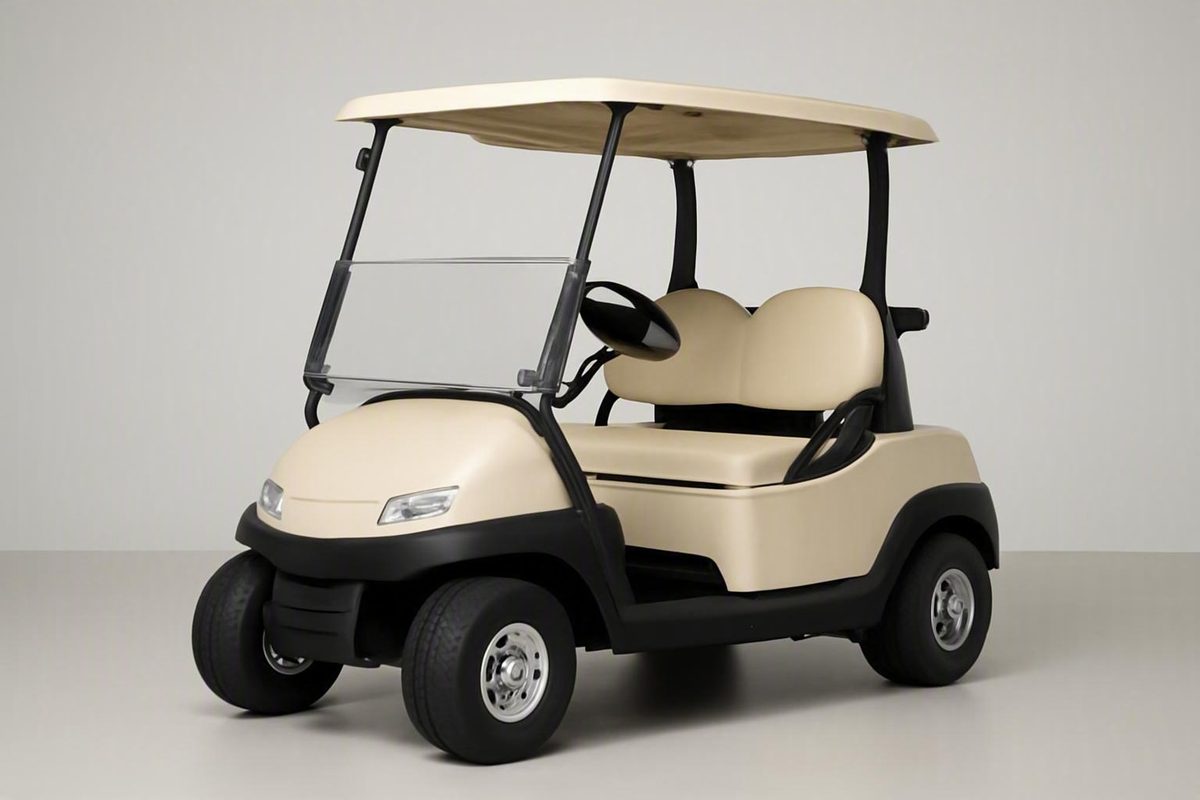
A conventional two-passenger golf cart commonly clusters around 92–96 inches long, 47–49 inches wide, and 68–72 inches high. In feet and inches, that is approximately 7 ft 8 in–8 ft long, 3 ft 11 in–4 ft 1 in wide, and 5 ft 8 in–6 ft high. These ranges synthesize representative model compilations and broader dealer planning guides; they are not an industry standard (Eco Planeta model compilation; TIGON planning ranges).
Published guides disagree even on whether the representative two-seat length is closer to 92 or 96 inches. Treating either number as universal would create false precision. Golf cart size varies by make, model, year, passenger capacity, suspension, roof, wheel-and-tire package, seating arrangement, and accessories.
The reliable way to approve a fit is to identify the exact configuration, measure the completed cart at its longest, widest, and highest points, and compare those measurements with the narrowest usable part of the garage, gate, route, trailer, pickup bed, or storage area.
Golf cart dimensions at a glance
The following figures are approximate planning estimates, not standardized dimensions. They describe conventional passenger carts rather than utility vehicles, commercial shuttles, low-speed vehicles, or custom builds.
| Passenger capacity | Approximate overall length | Approximate overall width | Approximate overall height | Planning takeaway |
|---|---|---|---|---|
| 2 passengers | 92–96 in (7 ft 8 in–8 ft) | 47–49 in (3 ft 11 in–4 ft 1 in) | 68–72 in (5 ft 8 in–6 ft) | Compact baseline, but mirrors, tires, roofs, and accessories can enlarge the clearance envelope |
| 4 passengers | 100–120 in (8 ft 4 in–10 ft) (range evidence) | Often near the two-seat range on conventional carts | Often near the two-seat range on non-lifted carts | A rear bench and a stretched four-forward-seat chassis need different amounts of space |
| 6 passengers | 120–148 in (10 ft–12 ft 4 in) (model examples) | Often changes less than length | Configuration-dependent | Expect considerably more parking depth and turning room; do not infer exact size from seat count |
Methodology: These planning ranges combine broad third-party capacity guides with dimensions reported for familiar fleet-style and multi-passenger models. The lower four-passenger estimate appears in dealer planning data, while longer six-passenger examples reach 148 inches in model tables. Because the sources use different model sets and definitions, the chart deliberately presents ranges rather than an “industry average.”
The two-passenger range reflects the cluster formed by common fleet-style carts. Familiar models are often listed around 92–95 inches long and approximately 47–49 inches wide, while general guides sometimes use 96 inches as the representative length. That disagreement is a reason to keep the range rather than collapse it into one number.
Four-passenger estimates vary because “four passenger” describes capacity, not construction. A cart with a rear-facing bench may differ substantially from one built on a stretched chassis with two forward-facing rows. Six-passenger estimates vary even more, with frame design, suspension, seating orientation, and roof configuration all affecting the final envelope.
The general pattern is straightforward: adding passengers tends to increase length more than width or height. A rear bench extends behind the original seating area, while a stretched cart adds frame and wheelbase for another row. Nevertheless, the passenger-capacity label cannot reveal a cart’s precise footprint.
Keep the following vehicles outside the main averages:
- Utility carts with cargo beds, side panels, tool racks, or commercial equipment
- Multi-row passenger shuttles
- Street-oriented low-speed vehicles with larger bodies or additional equipment
- Lifted and oversized-tire configurations
- Custom carts with nonstandard chassis, roofs, seats, steps, or bodywork
Any of these may be longer, wider, or taller than a conventional passenger cart with the same nominal seating capacity.
What length, width, and height really mean
A golf cart measurement is useful only when its endpoints match the intended purpose. A body-panel dimension may help compare models, but it does not necessarily tell you whether the assembled cart will pass through a gate.
Overall length is the straight-line distance from the foremost point to the rearmost point relevant to clearance. Depending on the cart, those points might be a front bumper or brush guard at one end and a rear seat, footrest, cargo box, bag holder, hitch, or rack at the other. Do not substitute wheelbase or body length for overall length.
Clearance width is the greatest left-to-right distance anywhere on the cart. Check the front tires, rear tires, body, roof edges, and accessories, then retain the largest measurement. A published width may exclude mirrors or other additions even though they still have to pass through an opening. For example, one retailer’s dimensional convention includes wheels but excludes mirrors and accessories, so its stated width is not automatically a rigid-clearance measurement (Golf Cart Garage measurement guide).
Overall height is the vertical distance from the supporting surface to the highest fixed point relevant to the opening. On most roof-equipped carts, that is the canopy. On another cart, a windshield, mirror, rack, enclosure fitting, or roof-mounted accessory could be higher.
A manufacturer may also report topped height, meaning overall height with the roof or canopy installed. That figure should not be confused with untopped height for a cart without its canopy.
For consistent measurements:
- Park the cart on level, firm ground.
- Configure the cart as it will pass through the opening or occupy the space.
- Measure in straight lines rather than following curved body panels.
- Use a straightedge or plumb line when an extremity is difficult to project.
- Record the result in inches first.
- Convert to feet and inches only after recording the precise measurement.
- Note whether mirrors are deployed or folded and whether any accessory is removable.
Include every item that could control physical clearance:
- Tires and outward wheel offset
- Side and center mirrors
- Roof edges and supports
- Windshields and frames
- Front bumpers and brush guards
- Rear-facing seats and footrests
- Cargo boxes and beds
- Side steps and fender flares
- Golf-bag holders
- Cargo carriers and equipment racks
- Hitches and other installed projections
Do not confuse overall dimensions with four related measurements:
- Turning radius: The space needed to turn. A cart may pass through a gate but still lack room to align with it.
- Roof length: A product-specific measurement used for some covers and enclosures, not a substitute for overall vehicle length.
A useful dimension illustration should show the cart from the side, front, and overhead. It should label overall length, true widest-point width, topped height, wheelbase, ground clearance, and roof length separately. The front or overhead view should also show that tires, mirrors, or roof edges can extend beyond the body.
How passenger capacity changes the footprint
Passenger capacity changes golf cart size primarily through seating arrangement. Two carts may both carry four people yet use substantially different layouts.
A conventional two-passenger cart has one seating row. It often provides the smallest parking footprint and is the easiest starting point for a tight garage, shed, gate, or trailer. That does not mean every two-seater is compact: street-oriented bodies, utility equipment, lifts, and custom wheels can move one outside the common range.
A common four-passenger arrangement combines two forward-facing front seats with a rear-facing bench. The bench may extend behind the original seating area and may convert into a cargo deck. Another four-passenger cart may place all occupants in forward-facing seats on a longer chassis. These layouts should not be assumed to share the same overall length, wheelbase, or turning requirement.
The Club Car Onward family illustrates the progression. Third-party model tables list the Onward 2 Passenger at 92 × 48.75 × 71 inches and the non-lifted Onward 4 Passenger at 108 × 48.75 × 71 inches. Listed six-passenger versions are substantially longer, reaching approximately 143 inches non-lifted and 148 inches lifted. These examples show how length can grow while width changes relatively little, but they should not be transferred to a different make, year, or seating design.
Six-passenger carts may use three rows, often with two forward-facing rows and a rear-facing bench, although layouts vary. Their extra length affects more than parking depth. A longer cart needs enough route width and alignment space to approach a gate, negotiate a corner, reach a ramp, and enter a storage bay.
When choosing capacity, ask:
- How many passengers will normally ride, rather than only the maximum you might carry occasionally?
- Does the seating orientation suit those passengers?
- How deep is the parking or storage space?
- What is the narrowest gate or path on the route?
- Is there enough space to turn and straighten the cart?
- Will the cart’s footprint be supported by the intended trailer or bed?
- Does the configuration provide the passenger and cargo arrangement you need?
- Would a smaller cart better suit the available storage and transport space?
Width often changes less than length among conventional passenger models, but that is a pattern rather than a guarantee. Lifted suspension, large tires, wheel offset, fender flares, side steps, utility bodies, and street-oriented designs can all create a wider vehicle.
Stock dimensions versus real-world dimensions
It helps to keep two dimensional records:
- Factory specification envelope: The manufacturer’s stated length, width, and height for the identified model and configuration.
- Accessory-inclusive clearance envelope: The actual longest, widest, and highest measurements after assembly, modification, and accessory installation.
The second envelope controls real-world fit. Factory dimensions may be accurate for the configuration measured while still omitting dealer-installed mirrors, an aftermarket rear seat, a different tire package, or equipment added by a previous owner.
Changes that can alter the envelope include:
- Lift kits
- Larger-diameter or wider tires
- Wheels with outward offset
- Extended roofs
- Fold-out or fixed mirrors
- Windshields and windshield frames
- Brush guards and bumpers
- Fender flares
- Side steps and running boards
- Rear seats and footrests
- Cargo boxes and beds
- Roof-, rear-, or hitch-mounted racks
- Golf-bag holders and cargo carriers
Official Club Car data provides a useful same-model comparison. Club Car lists the non-lifted Onward 4 Passenger at 108 inches long, 48.75 inches wide, and 71 inches high with its top installed. The lifted version is 114 inches long, 49.5 inches wide, and 80.5 inches high with its top installed (Club Car Onward 4 Passenger specifications).
For that specific model, the lifted configuration is:
- 6 inches longer
- 0.75 inch wider
- 9.5 inches taller
The manufacturer also reports different wheelbase and ground-clearance figures for the two configurations. The comparison disproves the oversimplification that lifting a golf cart can affect only height. It does not establish what any other lift kit or cart will do; those results apply specifically to the listed Onward configurations.
Body width should not be mistaken for clearance width. A body described as 47 or 48 inches wide may sit inside tires that project farther outward. Mirrors, roof edges, steps, and fender flares may extend farther still. Check all plausible widest points instead of deciding in advance that the body or tires must control.
For folding mirrors or removable accessories, record both conditions:
| Measurement condition | Length | Width | Height |
|---|---|---|---|
| Published factory configuration | |||
| Actual cart, accessories deployed | |||
| Actual cart, permitted items folded or removed |
Use a folded or removed measurement only if that is genuinely how the cart will pass through the entire opening. Any modified cart should be physically remeasured after the work is complete.
Checking garage, shed, gate, and path clearance
A cart can fit inside a room yet fail to pass through its entrance. It can pass through the entrance yet be impossible to steer into its final position. Measure the full route, not only the destination.
Use this worksheet:
| Fit measurement | Recorded value |
|---|---|
| Cart overall length, including front and rear projections | |
| Cart true widest width | |
| Cart topped or overall height with roof installed | |
| Narrowest usable opening width | |
| Lowest overhead clearance | |
| Usable floor depth | |
| Tightest route width | |
| Available turning or alignment area | |
| User-selected side maneuvering allowance | |
| User-selected front and rear working allowance | |
| Space needed for charging connection or cargo access |
Measure the narrowest usable point, not the nominal size advertised for the garage door, shed, storage unit, or gate. The limiting width might occur at trim, hinges, latches, handles, posts, shelving, or a change in wall angle. The limiting height might occur at a door panel, track, opener arm, threshold transition, hanging fixture, roof brace, or other hardware.
Match each cart dimension to the corresponding constraint:
- Length determines whether the parked cart fits within the usable floor depth.
- Width determines whether the tires, body, roof, and accessories pass through doors and gates.
- Height determines whether the roof, windshield, or mounted equipment clears the opening and overhead hardware.
Then separate the parked footprint from the operating space. Additional space may be needed to:
- Approach the opening at an angle
- Straighten the cart before entering
- Turn around posts, walls, or landscaping
- Enter and leave the seats
- Reach stored items
- Connect charging equipment
- Open a cargo box or convert a rear seat
- Inspect or maintain the cart
There is no universally sufficient margin. An allowance that works for a straight approach may be inadequate where the cart must turn through a tight gate. Select a maneuvering allowance based on the route, mirror position, visibility, surface, and frequency of use rather than treating a fixed number as an automatic rule.
A simple comparison can reveal obvious conflicts:
Usable opening width − measured cart width = total remaining lateral clearance
That is total clearance, not clearance on each side. It also says nothing about approach angle or turning space. When the difference is small, the route and alignment constraints deserve as much attention as the arithmetic.
Walk the proposed route before moving the cart. Check its narrowest opening, sharpest turn, lowest overhead obstruction, steepest transition, and any uneven surface that could make the cart lean or change its effective clearance.
Trailer and pickup fit: dimensions are only the first check
Transport requires two separate decisions:
- Does the cart physically fit?
- Does the proposed combination comply with the applicable equipment ratings and manufacturer requirements?
Passing the first test does not answer the second.
For a trailer, length determines whether the cart’s footprint is supported. Width governs clearance at the deck, rails, fenders, wheel wells, and ramp. Height matters in an enclosed trailer and at its doorway. For a pickup, the same dimensional principles apply, but wheel wells, bed rails, the tailgate position, and the truck’s rated capacities create additional model-specific constraints.
Measure genuinely usable space.
Do not rely on the claim that a 4-by-8-foot trailer fits most four-passenger carts. Many reported four-passenger lengths exceed eight feet, so a blanket promise conflicts with the cited dimensional ranges. Deck support, trailer design, ratings, and manufacturer instructions still require separate evaluation.
Use this as a planning checklist, not as a determination that a combination is suitable:
- [ ] Actual cart length, including rear seat, footrest, bumpers, and racks
- [ ] Actual widest point across tires and accessories
- [ ] Actual height for enclosed transport or overhead obstructions
- [ ] Usable deck or bed length
- [ ] Usable width between rails, wheel wells, posts, or fenders
- [ ] Ramp width
- [ ] Ramp geometry and transition
- [ ] Cart wheelbase and ground clearance
- [ ] Cart weight in its actual configuration
- [ ] Expected transported weight, including installed equipment
- [ ] Trailer or pickup rated payload
- [ ] Applicable axle, tire, hitch, tailgate, and towing limits
- [ ] Suitable cart and transport-equipment tie-down locations
- [ ] Securement equipment specified for the combination
- [ ] Tow-vehicle, trailer, pickup, and cart manufacturer requirements
- [ ] Clearance for mirrors, roof, windshield, seat backs, and accessories
Pickup planning requires the exact truck and exact cart. Verify the bed’s usable dimensions, the support arrangement, the cart’s actual weight, the truck’s rated payload, and the relevant manufacturer limits. General golf cart transport guidance likewise calls for checking payload, appropriate ramps, and securement rather than treating dimensional fit as sufficient.
If any support, loading, payload, securement, or towing question remains unresolved, do not infer compatibility merely because the tires appear to fit between the wheel wells. Obtain information for the specific cart, trailer or truck, ramp, and securement system.
Measuring for a cover or enclosure
Garage and trailer measurements answer, “Can the assembled cart clear this rigid space?” A cover manufacturer may instead ask, “Which fabric pattern fits this product?” The two methods can use different inclusion rules, so cover measurements should not automatically be reused for gates, storage openings, or transport.
One product-specific cover method is to:
- Measure the longest part of the cart in a straight line without following its contours.
- Measure the widest point, including the tires but excluding side mirrors.
- Measure from the ground to the tallest point.
- Round each result up to the nearest inch.
Those instructions are specific to the seller’s covers. Excluding mirrors may make sense for that fabric pattern, but fixed mirrors still matter when the cart must pass through a rigid opening. Coverstore publishes this method in its golf cart cover measurement instructions.
Classic Accessories uses a different product-specific method based on passenger capacity and roof length. Roof length is measured from the roof’s front outer edge to its back outer edge. The company uses these labels:
- Short: 68 inches or less
- Long: approximately 80 inches
- Extra-long: approximately 120 inches
These are Classic Accessories fit categories, not universal roof standards. Passenger counts overlap between categories, and the company states that its covers are not designed to cover the wheels fully (Classic Accessories measuring guide).
A label such as “four-passenger cover” does not guarantee compatibility. Two four-seat carts can have different roof lengths, rear-seat projections, windshield shapes, or accessory arrangements.
Before ordering:
- Identify the exact cover or enclosure.
- Follow that manufacturer’s measuring diagram.
- Confirm whether mirrors are included or excluded.
- Confirm whether width is measured across the body or tires.
- Determine whether the product is intended to cover the wheels.
- Check whether the roof, rear seat, windshield, and racks are accommodated.
- Compare your measurements with the product dimensions, not passenger count alone.
- Follow the manufacturer’s rounding instructions.
Keep cover measurements in a separate record from rigid-clearance measurements. They may look similar but serve different purposes.
How to verify the exact size before buying or moving a cart
Capacity-based averages are useful for creating a shortlist. They are not a final fit test. Use this verification sequence before purchasing, storing, or transporting a cart.
1. Identify the complete configuration.
Record:
- Manufacturer
- Model
- Model year
- Passenger capacity and seating arrangement
- Seat orientation
- Roof or canopy type
- Lifted or non-lifted suspension
- Wheel size, tire size, and wheel offset
- Windshield configuration
- Mirrors
- Rear seat, cargo deck, or utility box
- Bumpers, brush guards, steps, racks, and bag holders
- Dealer-installed and aftermarket equipment
The model name alone may not be enough. Lifted and non-lifted versions can have different dimensions even when the family name and passenger capacity match.
2. Obtain the official specification sheet.
Prioritize the current manufacturer specification for the relevant model, year, and configuration. Dealer tables and third-party averages are useful for comparison, but they may omit the model year, roof assumption, suspension package, wheel options, or installed accessories.
Look for clearly separated entries for:
- Overall length
- Overall width
- Topped height
- Untopped height
- Wheelbase
- Ground clearance
- Turning radius
- Curb weight
- Vehicle load or payload rating
Club Car’s Onward specification illustrates why configuration detail matters: it separates lifted from non-lifted dimensions and topped from untopped height rather than presenting one number for every Onward 4 Passenger.
3. Confirm what the specification includes.
Determine whether the published envelope includes the roof, windshield, mirrors, bumpers, rear-seat kit, footrest, bag holder, and selected wheel-and-tire package. A precise measurement can still be unsuitable if it describes a different configuration.
4. Physically measure the actual cart.
Measure after accessories and modifications have been installed. Record the greatest straight-line length, width, and height. Do not assume dealer-installed or aftermarket equipment is included in the manufacturer’s base specification.
5. Measure the complete route or transport system.
Check the final storage bay and every potential limiting point along the way: gates, door trim, tracks, turns, ramps, wheel wells, trailer rails, roof hardware, branches, and changes in grade.
6. Record both envelopes.
| Dimension | Factory specification | Actual accessory-inclusive measurement | Usable destination or transport dimension | Difference |
|---|---|---|---|---|
| Length | ||||
| Width | ||||
| Height |
A positive difference may indicate nominal dimensional clearance, but it does not automatically account for steering, loading, charging access, payload, or other operating requirements.
Printable final checklist
- [ ] Make, model, and model year confirmed
- [ ] Seating layout and passenger capacity confirmed
- [ ] Roof configuration recorded
- [ ] Suspension configuration recorded
- [ ] Wheel-and-tire package recorded
- [ ] Installed accessories listed
- [ ] Official specification sheet obtained
- [ ] Longest point measured
- [ ] Widest point measured
- [ ] Highest point measured
- [ ] Wheelbase recorded
- [ ] Ground clearance recorded
- [ ] Curb weight or actual cart weight verified
- [ ] Narrowest opening measured
- [ ] Lowest overhead point measured
- [ ] Usable floor, deck, or bed dimensions measured
- [ ] Route and turning space checked
- [ ] Charging, passenger, and cargo-access space considered
- [ ] Transport ratings and securement requirements verified where applicable
Use capacity-based dimensions to shortlist carts, not to approve a fit. Record the make, model, year, suspension, seating, roof, tires, and accessories; verify the official specification; measure the actual longest, widest, and highest points; and compare those figures with the narrowest usable part of the entire route or transport system. If any dimension, load rating, or transport requirement remains uncertain, do not substitute a generic golf cart average for a model-specific check.
Frequently asked questions
What is the average size of a two-seat golf cart?
For preliminary planning, a conventional two-seat golf cart commonly falls around 92–96 inches long, 47–49 inches wide, and 68–72 inches high. That is approximately 7 ft 8 in–8 ft long, 3 ft 11 in–4 ft 1 in wide, and 5 ft 8 in–6 ft high (representative model dimensions).
Do not treat those figures as standardized dimensions. Published sources use both 92-inch and 96-inch representative lengths, and actual size depends on the model, year, roof, suspension, tires, and accessories.
How wide is a standard golf cart with mirrors and tires included?
There is no dependable universal width once mirrors, tires, and accessories are included. Conventional stock carts often have published widths near 47–49 inches, but some published methods exclude mirrors and accessories from that figure (width measurement convention).
Measure across the front tires, rear tires, body, roof edges, mirrors, fender flares, and steps, then retain the largest result. If mirrors fold, record both deployed and folded widths, but use the folded figure only if that is how the cart will pass through the entire opening.
Does a lift kit make a golf cart longer and wider as well as taller?
It can. The effect depends on the cart, suspension, wheels, tires, and overall configuration.
For the Club Car Onward 4 Passenger, the manufacturer lists the non-lifted version at 108 × 48.75 × 71 inches and the lifted version at 114 × 49.5 × 80.5 inches. In that model-specific comparison, the lifted cart is 6 inches longer, 0.75 inch wider, and 9.5 inches taller with the top installed (official Club Car specifications).
Other carts and aftermarket kits may produce different changes, so physically remeasure the completed cart.
Will a golf cart fit in a standard garage or through a five-foot gate?
Possibly, but neither “standard garage” nor “five-foot gate” establishes fit. Many conventional carts are near four feet wide before every protruding accessory is considered, while trim, hinges, latches, posts, tires, mirrors, roof edges, and the approach angle can reduce the apparent clearance.
Measure the opening at its narrowest usable point and the cart at its true widest point. Check height, parking depth, turns, charging access, and space to enter or leave the cart as separate requirements.
Can a golf cart fit in a pickup bed or on a 4-by-8-foot trailer?
Some combinations may physically fit, but no generic answer establishes compatibility. Many reported four-passenger carts exceed eight feet in overall length, and usable deck dimensions may be smaller than the nominal trailer size because of rails, fenders, posts, or ramp hardware (capacity-based length ranges).
For either a pickup or trailer, verify the exact cart dimensions and weight, usable bed or deck dimensions, width between obstructions, ramp geometry, ground clearance, rated payload, tie-down locations, and relevant manufacturer limits. Physical fit alone does not establish that the combination is suitable for transport.