
Accessories for a Golf Cart, in a Practical Buying Order
Choose golf cart accessories by fit, electrical load and use. Prioritize visibility, weather protection, storage and lighting before cosmetic upgrades.
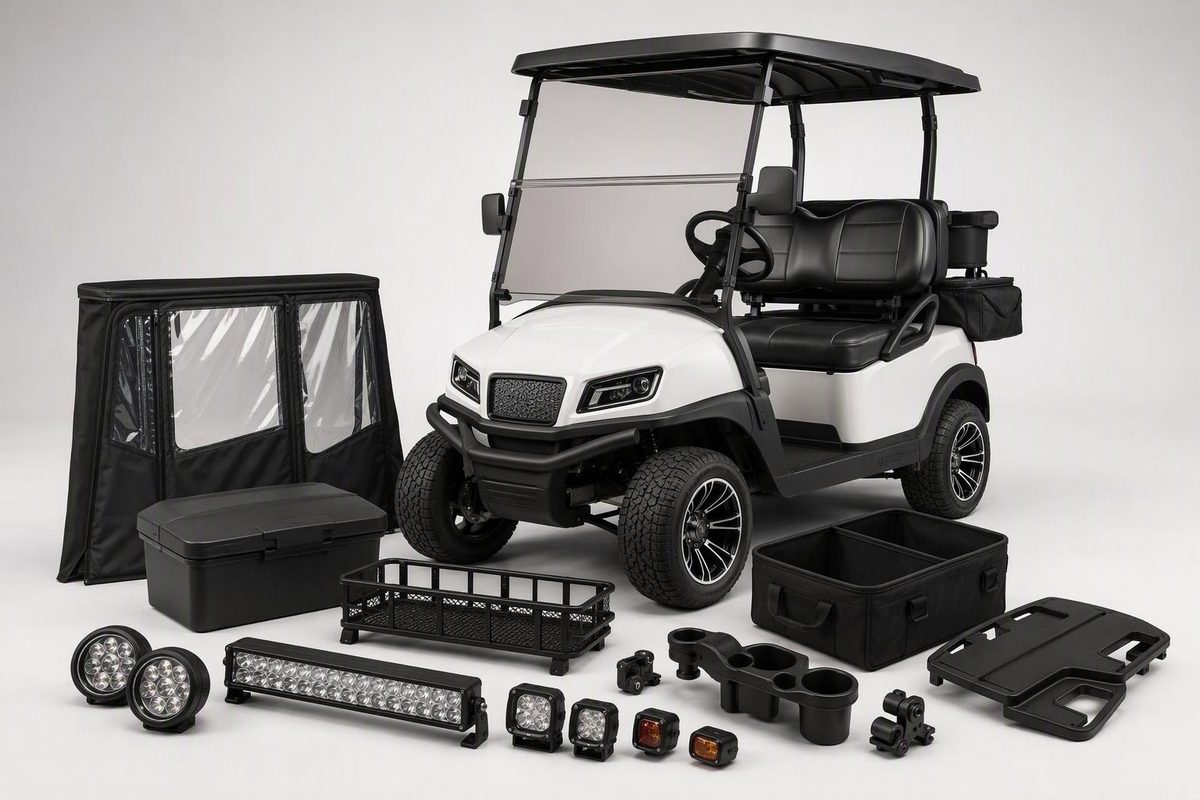
The most useful accessories for a golf cart solve a recurring problem: poor rear visibility, wet-weather exposure, unsecured small items, inadequate lighting or insufficient cargo space. Start there. Wheels, audio systems and decorative lighting can wait until the cart is safe, comfortable and correctly wired.
Before shopping, record the cart’s:
- Make, model and model year
- Serial or PIN number
- Gas or electric powertrain
- Battery-pack voltage and chemistry
- Two-, four- or six-passenger configuration
- Roof, windshield and rear-seat configuration
- Tire size and whether the suspension is stock or lifted
“Fits Club Car,” “fits E-Z-GO” or “universal” is not enough. Mounting points can differ by model, generation, roof and rear body. E-Z-GO says its official accessories are guaranteed to fit the applicable vehicle, while listing categories such as lights, seats, speakers and racks. That illustrates the advantage of model-specific parts, even if you ultimately choose aftermarket equipment (E-Z-GO).
Five accessories and upgrades to consider first
1. Mirrors
For many carts, an adjustable rearview mirror and a pair of side mirrors provide the most useful first upgrade. They help when reversing, passing parked vehicles or sharing a path, but they do not eliminate blind spots.
Check that the brackets match the cart’s roof supports or occupant structure without drilling into wiring. The mirrors should remain stable over rough ground and must not block the driver’s forward view. E-Z-GO’s Liberty manual instructs drivers to adjust the mirrors before use and still check blind spots when reversing or merging (E-Z-GO Liberty manual).
2. A windshield or weather enclosure
A folding windshield is useful in wind, rain and cool weather; an enclosure adds side and rear coverage. Look for:
- Exact roof and body fitment
- Clear, distortion-free viewing areas
- Vents or a folding section for airflow
- Zippers and panels that can be secured when open
- Access to mirrors, the charge port and storage
- Installation and cleaning instructions
Club Car’s accessory range demonstrates why configuration matters: it lists separate enclosures for the Onward LSV, Onward LSV 4 Forward and CRU rather than one universal enclosure (Club Car).
Do not assume a recreational windshield satisfies on-road rules. A federally defined low-speed vehicle is a specific class of four-wheel vehicle capable of more than 20 but no more than 25 mph, with a gross vehicle weight rating below 3,000 pounds. NHTSA says an LSV windshield must use qualifying safety glazing; state and local authorities separately control registration and road use (NHTSA). A light-and-windshield kit does not, by itself, turn an ordinary golf cart into a road-legal vehicle.
If the cart travels on a trailer, check its manual before leaving the windshield installed. E-Z-GO’s Valor manual directs owners to remove the windshield before trailer transport and gives additional instructions for securing the cart and loose components (E-Z-GO Valor manual).
3. Lockable storage
An enclosed dash compartment, under-seat bin or locking rear trunk is usually more useful than an exposed basket. Choose storage that:
- Does not obstruct batteries, wiring or service access
- Latches positively over bumps
- Protects electronics and valuables from water
- Works with the rear seat in both passenger and cargo positions
- Keeps the cart within its cargo and total-weight limits
A cooler, ball washer, sand bottle and club-cleaning accessories make sense for course use, but secure them so they cannot enter the pedal area or leave the cart during a turn.
4. Lighting suited to the cart and its use
Headlights can improve the driver’s view; taillights, brake lights and turn signals help other users understand what the cart is doing. Buy a complete, model-specific kit when possible. Confirm that it includes the necessary harnesses, switches, connectors, fuse protection and instructions—not merely lamp housings.
Road-equipment requirements vary. Federal LSV rules specify categories of equipment that include lighting, mirrors, a parking brake, a windshield and seat belts, while states can set operating and registration conditions (NHTSA). Check the law where the cart will actually be driven before buying a “street legal” bundle.
5. A correctly sized 12V accessory supply
Plan the power supply before installing USB outlets, a soundbar, a heater or additional lights. On a 36V or 48V electric cart, do not casually draw 12V from one battery in a series pack. Use the cart maker’s approved accessory circuit or a compatible DC-to-DC converter.
E-Z-GO’s 48V Valor manual expressly says additional 12V accessories must connect to the DC-to-DC converter. It also warns that accessories left active after shutdown can discharge the battery pack (E-Z-GO Valor manual).
Add up the maximum current draw of the powered accessories and compare it with the ratings for the converter, wiring, switches and fuse protection. Follow the accessory and cart manufacturers’ circuit-protection instructions. If the cart has been converted to lithium, settle the 12V supply as part of the conversion design, not after installing accessories.
Accessories that need more scrutiny
Rear seats and cargo boxes
A rear-seat kit changes passenger capacity and weight distribution. Match it to the exact frame and body, and make sure it includes the specified footrest, handholds and mounting hardware. Do not treat a folded cargo deck as a passenger seat. The E-Z-GO Liberty manual warns against carrying passengers on the load deck and instructs owners to fill the forward-facing seat before the rear-facing seat to reduce tipping risk (E-Z-GO Liberty manual).
The combined weight of occupants, accessories and cargo must remain within the limits in the cart’s manual. Adding seats does not increase the chassis rating.
Larger tires, wheels and lift kits
These changes are not cosmetic alone. Different tire diameters, wheel offsets and lift heights can change clearance and handling. Confirm:
- Permitted tire diameter and load rating
- Wheel bolt pattern, offset and lug-seat type
- Clearance at full steering lock and suspension travel
- Alignment requirements
- Any effect on warranty coverage
- Whether the kit manufacturer specifies brake or suspension changes
After a wheel change, use the manufacturer’s tightening procedure and set inflation from the applicable cart and tire specifications—not a generic accessory listing. See the golf cart tire-pressure guide for the correct way to find and check pressure.
Hitches and towing equipment
A receiver that bolts to the frame does not establish how much the cart can tow. Use only a tow rating published for that exact cart and configuration, including trailer-weight and tongue-load limits. If the manufacturer gives no rating, do not infer one from the receiver’s nominal size.
Audio, heaters and decorative lights
These can be worthwhile, but only after checking electrical capacity, water resistance, mounting security and key-off current draw. A soundbar or light controller that remains active can discharge the accessory supply or traction pack. Avoid cutting the factory harness when a compatible plug-in harness is available.
Match the buying order to the job
For golf: folding windshield, bag cover or enclosure, cooler, sand bottle, club or ball washer, USB charging and secure small-item storage.
For neighborhood or private-community driving: mirrors, suitable lighting, horn, windshield, weather enclosure and lockable storage—then verify local operating rules.
For property work: cargo box, floor mat, weather protection and an approved hitch or tool holders, with payload and towing limits checked first.
For recreation: storage and weather protection before audio, custom seats, wheels or suspension changes.
Stop before purchase if the seller cannot identify compatible models and years, provide installation instructions, state electrical ratings or explain how the accessory affects available load capacity. A worthwhile accessory fits without improvisation, remains within the cart’s ratings and solves a problem on trips you actually make.