
Build a golf cart shutdown budget from routine service, storage, transport and an annualized battery reserve—not one package price.
Estimate annual golf cart maintenance and off-season shutdown costs using powertrain, storage, transport, battery reserve and local quotes.
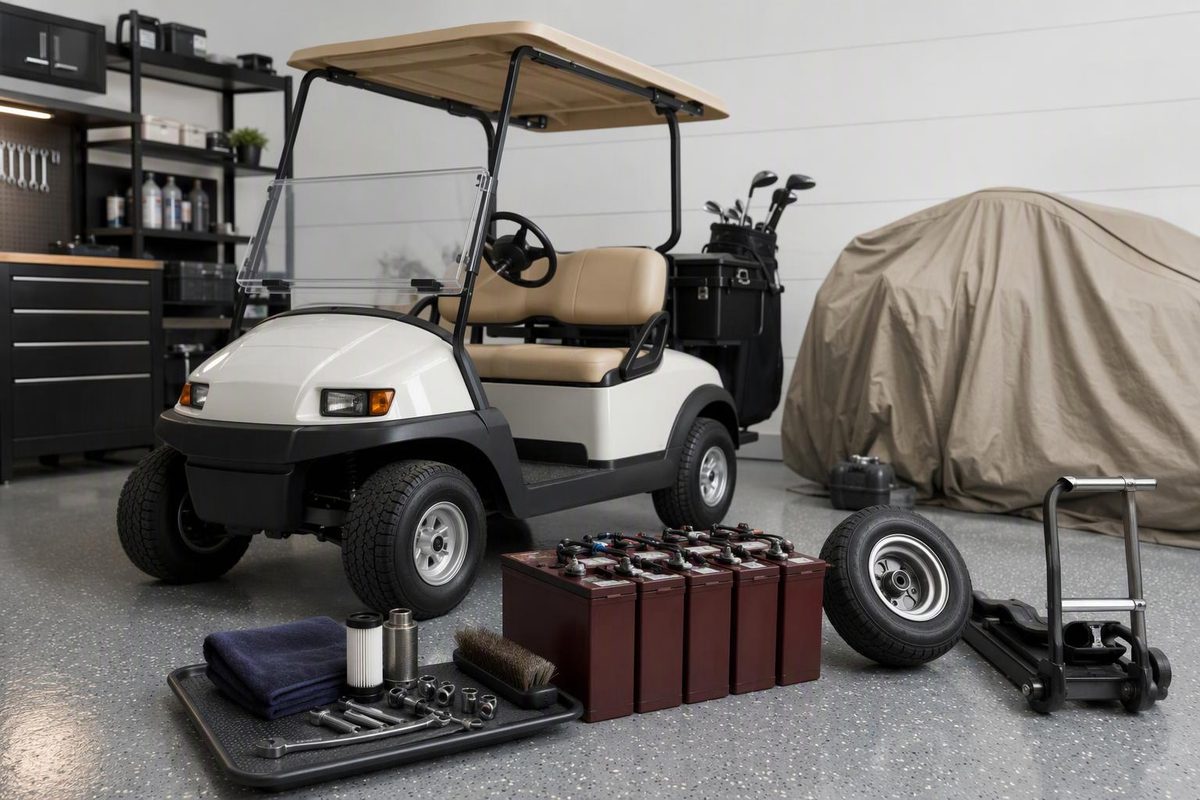
As a rough planning point, one 2026 third-party cost model estimates $100–$400 a year for routine electric golf-cart maintenance and $300–$600 for a gas cart (Golf Cart Search). Those are not universal shop prices. Make, model, year, usage, service scope and local labor rates can move the total substantially, so use an itemized local quote for the actual budget.
Storage, transport, insurance, major repairs, tires and traction-battery replacement should be counted separately. An “annual shutdown” usually means preparing a cart for several months of storage; it is not necessarily a second full service. If annual maintenance and winterization are booked together, ask the shop to separate labor, parts, transport and storage so overlapping work is not charged twice.
Build the annual budget
Use these categories rather than relying on one advertised package price:
| Cost | Electric—flooded lead-acid | Electric—lithium | Gas |
|---|---|---|---|
| Routine maintenance planning band | $100–$400 | Usually toward the lower end of $100–$400 | $300–$600 |
| Battery replacement reserve | Installed pack quote ÷ chosen planning years | Installed pack quote ÷ chosen planning years | Starting-battery quote ÷ chosen planning years |
| Shutdown supplies and labor | Add actual quote | Add actual quote | Add actual quote |
| Storage | Monthly rate × stored months | Monthly rate × stored months | Monthly rate × stored months |
| Pickup and return | Add both charges | Add both charges | Add both charges |
| Unexpected repairs | Keep separate | Keep separate | Keep separate |
The price bands provide an initial comparison, but battery reserve, paid storage and transport can materially change the annual figure. A cart stored at home may have little direct shutdown expense. Indoor storage with collection, periodic battery checks and spring delivery may cost more than routine service.
Worked example—not a price quote
Suppose a flooded lead-acid cart has:
- $250 routine annual service
- a current $1,200 installed battery-pack quote
- an owner-selected four-year budgeting horizon
- $40 of shutdown supplies
- $300 for seasonal storage and transport
The planning total would be:
$250 + ($1,200 ÷ 4) + $40 + $300 = $890 per year
This does not predict when the pack will fail. It spreads a possible future replacement across the budget instead of treating it as a zero-cost item until the bill arrives.
What routine maintenance should cover
Start with the schedule for the exact cart, not a generic checklist. Record the manufacturer, model, model year, serial number, voltage and battery chemistry. Gas and electric versions of an otherwise similar cart do not have the same service requirements.
For an electric cart, an inspection may cover:
- tires, wheel hardware and steering
- service and parking brakes
- suspension and visible chassis damage
- battery cables, terminals and hold-downs
- charger operation and charge receptacle
- flooded-battery electrolyte levels
- lights and fitted accessories
- a controlled operational check
Flooded batteries require recurring attention, not just one shutdown visit. Club Car’s Onward guidance calls for water-level, battery-cleanliness, terminal and tire-pressure checks every 30 days under average use (Club Car). Trojan recommends checking flooded batteries monthly at first, adding distilled water after a full charge and tightening connections to the applicable battery-terminal specification (Trojan Battery). AGM and lithium packs must not be watered.
For a gas cart, use its manual to identify engine-oil, filter, spark-plug, belt and fuel-system service. As one model-specific example, Club Car says a gasoline Onward needs its oil and filter changed after the first 100 operating hours, then every 200 hours or annually, whichever comes first (Club Car). Do not transfer that interval to an E-Z-GO, Yamaha or another Club Car model without checking its manual.
Poor electric-cart performance does not automatically justify a new battery pack. Test the batteries under consistent conditions before turning one voltage reading into a replacement decision; see how to test golf cart batteries.
What off-season shutdown adds
A proper shutdown is more than parking the cart and disconnecting a cable at random. The procedure depends on the cart, battery chemistry and charging system.
For an electric cart, the shutdown quote should state:
- Whether the cart remains connected to an approved charger or is disconnected.
- Who checks charge state and flooded-cell water levels during storage.
- Whether parasitic accessories are isolated.
- How the cart is secured against rolling.
- Whether spring recommissioning and battery testing are included.
Club Car’s fleet long-term-storage guide shows why model-specific instructions matter. For the covered systems, its connected-charger procedure includes cleaning and tightening terminals, switching off accessories, checking charger operation and inspecting electrolyte at least monthly. It provides an alternative procedure when continuous AC power or electrolyte maintenance is unavailable (Club Car fleet storage guide). This fleet document does not authorize leaving every cart or charger plugged in indefinitely; follow the manual for the installed system.
For a gas cart, shutdown may include model-specific fuel treatment or draining steps, oil-level checks, starting-battery care and engine or carburetor procedures. Follow the manual for the exact engine and cart. Do not improvise fuel-system work from instructions written for another model.
Questions to ask before approving a quote
Request an itemized estimate and confirm:
- Is this annual service, shutdown service or both?
- Which model-specific schedule and service interval are being followed?
- Are parts, shop supplies and environmental fees included?
- Are pickup, return and spring recommissioning separate?
- Does storage include periodic charging or battery inspection?
- Is battery capacity testing included, or only a voltage check?
- Will the shop obtain authorization before additional repairs?
- Could the work affect an active vehicle or battery warranty?
Treat tires, a failed charger, brake or suspension repairs and a replacement traction pack as repairs rather than routine annual maintenance. Keeping those items separate makes year-to-year costs and competing service quotes easier to compare.