
Find the Right Charger for Your Yamaha—and Rule Out the Receptacle First
Identify the exact cart and battery system, test the external charging path, and get written confirmation of connector, polarity, profile and fitment.
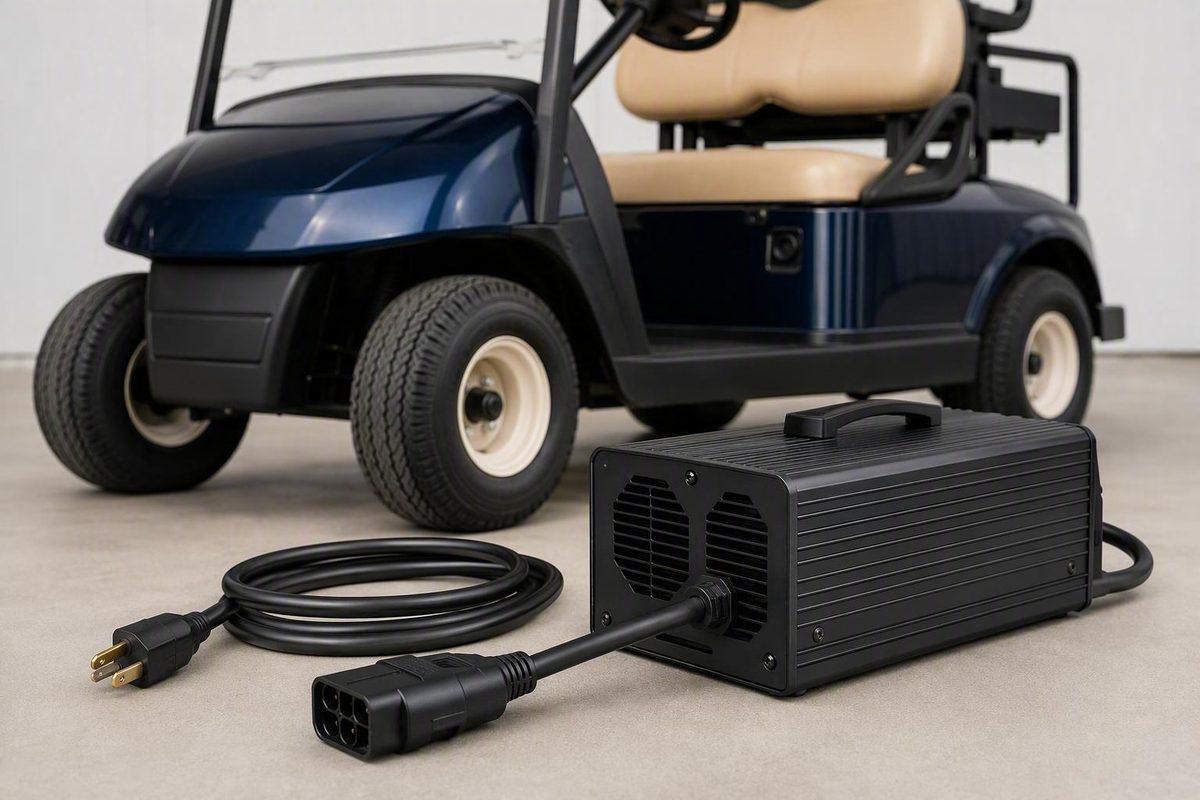
Do not buy a Yamaha 48 volt golf cart charger based only on the Yamaha name and a nominal 48V rating. Those two labels do not establish model-year fitment, connector compatibility, polarity, battery chemistry, charging profile, output current, or whether the charger is intended for onboard or offboard installation.
Use this sequence instead:
- Identify the exact cart and battery system.
- Test the external charging path before deciding the charger has failed.
- Obtain written confirmation of fitment before ordering.
This is an evidence-limited buyer’s guide, not a Yamaha fitment chart. The available sources are retailer listings, retailer troubleshooting material, and individual forum reports; they do not include a Yamaha-confirmed model-year, receptacle, protocol, and charger map. Use the products below as listing leads that still require verification.
Commercial snapshot reviewed 13 August 2026. Prices, availability, shipping, repair turnaround, and warranty terms may change.
Start here: the six details needed before shopping
Complete this worksheet before comparing prices or plugs.
| Detail | What to record | Where to find it | Why it matters |
|---|---|---|---|
| 1. Exact Yamaha model or model code | G19, G20, G22, G29/Drive, Drive2, or the complete model code | Cart data plate, serial-number label, owner documentation | Retailer listings divide chargers by Yamaha family; “Yamaha 48V” is too broad |
| 2. Model year | Exact year rather than an estimate based on appearance | Data plate, serial-number documentation, dealer records | A family name alone does not establish the connector, wiring, controls, or supported charger |
| 3. Nominal pack voltage | 48V, battery count, and each battery’s nominal voltage | Battery labels and pack layout | Voltage must match, but it is only the first compatibility check |
| 4. Battery chemistry | Flooded lead-acid, AGM, or the exact lithium chemistry, such as LiFePO4 | Battery labels, invoice, and battery-manufacturer documentation | Packs with the same nominal voltage may require different charging profiles |
| 5. Receptacle and plug style | Contact arrangement, keying, housing shape, cable orientation, and any identifying marks | Cart receptacle and old charger plug | Physical engagement does not prove correct polarity, contact function, or charging behavior |
| 6. Existing charger identification | Manufacturer, full model or part number, suffixes, input, output, and serial details | Charger label | The complete number can locate a replacement or repair service and distinguish similar-looking units |
Then make one final installation check: Is the current charger offboard or onboard?
- An offboard charger is a separate unit connected to the cart during charging.
- An onboard charger is mounted on the cart and normally travels with it.
Do not assume a product marketed as “universal” or “onboard” is a drop-in substitute for an original offboard system. Ask whether installation may require different mounting, AC routing, DC wiring, cable protection, polarity, ventilation, control wiring, or charger-enable behavior.
Retailer catalogs illustrate why identification comes first. Their listings commonly separate G19/G20/G22 applications from G29/Drive/Drive2 applications, while one Steeleng listing extends only across the seller-stated G14–G22 range. Those groupings are retailer claims, not evidence that every model year or receptacle within a family is interchangeable.
Before contacting a seller, photograph:
- The cart data plate and complete model code
- Every battery label
- The overall pack arrangement
- The receptacle straight on and from the side
- The old charger plug and cable
- The complete charger label
- Any corrosion, heat discoloration, broken plastic, or bent contacts
The replacement must also have the correct contact functions, polarity, charging profile, output current, model-year fitment, and any activation behavior required by the cart or battery system.
Stop rule: If you cannot confidently identify the cart, battery chemistry, polarity, or wiring, do not connect a prospective charger. Obtain the correct documentation or have a qualified golf-cart technician identify the system.
Compatibility by Yamaha model family
The table below is a retailer-market overview, not a Yamaha-approved compatibility chart. Where the evidence supplies only a collection listing rather than a dedicated specification sheet, the product is labeled as an incomplete listing lead.
| Retailer-claimed family | Advertised listing leads | Advertised chemistry and current | Installation type | Captured price and availability | Information still missing |
|---|---|---|---|---|---|
| G19/G20/G22 | FORM “YAMAHA 48V 15A Golf Cart Charger – G19 & G22 – Lead Acid”; FORM multi-chemistry G19/G22 version; FORM refurbished G19/G22 unit; Golf Cart Stuff Reliance and Instamatic G19/G20/G22 listings; Steeleng listing naming G14–G22 | FORM new lead-acid and multi-chemistry listings: 15A; multi-chemistry listing names lead-acid, AGM, lithium, and LiFePO4. Current and chemistry were not supplied for the Reliance, Instamatic, or Steeleng leads | Not supplied in the captured listing details | FORM: $229.95 lead-acid, $249.95 multi-chemistry, and $129.95 refurbished. Golf Cart Stuff: Reliance $394.95, Instamatic $269.95 and marked out of stock, Steeleng $299.95. Other listings were present, but explicit in-stock status was not established. FORM collection · Golf Cart Stuff collection | Exact year, connector, polarity, charging profile, AC input, warranty, and exact SKU for incomplete listing leads |
| G29/Drive/Drive2 | FORM “YAMAHA 48V 15A Golf Cart Charger – G29, Drive & Drive 2 – Lead Acid”; FORM multi-chemistry version; FORM refurbished lead-acid unit; Golf Cart Stuff Steeleng, Reliance, and Instamatic listings | FORM new lead-acid and multi-chemistry listings: 15A; multi-chemistry listing names lead-acid, AGM, lithium, and LiFePO4. Chemistry and current were not supplied for the other listing leads | Not supplied in the captured listing details | FORM: $229.95 lead-acid, $249.95 multi-chemistry, and $139.95 refurbished. Golf Cart Stuff: Steeleng $299.95, Reliance $394.95, and Instamatic $269.95 and marked out of stock. Other listings were present, but explicit in-stock status was not established. FORM collection · Golf Cart Stuff collection | Exact model year, connector, polarity, charging profile, AC input, warranty, and exact SKU for incomplete listing leads |
| Exact Yamaha fitment not established | Lester Summit II 48V; Delta-Q IC650 36V/48V | Chemistry and Yamaha-specific configuration not established by the captured collection details | Not supplied | Lester Summit II: $489.95. Delta-Q IC650: $449.95. Listings were present, but explicit in-stock status was not established. Source: Golf Cart Stuff collection cited above | Exact Yamaha model and year, voltage configuration, connector, polarity, chemistry, programming, and installation requirements |
Treat the Steeleng G14–G22 description as no broader than the seller stated. It does not establish fitment for every earlier Yamaha, every G-series cart, or any G29/Drive application.
Likewise, the Lester Summit II and Delta-Q IC650 remain verify-fitment leads unless the seller or charger manufacturer confirms the reader’s exact model, year, connector, polarity, battery chemistry, and required configuration. Placement within a “Yamaha chargers” collection does not prove all those details.
No source in the evidence provides a Yamaha-confirmed map matching every model year to its receptacle, contact functions, polarity, protocol, and approved charger. The table is therefore a shortlist for further investigation—not authority to connect any listed unit.
Match the charger to the battery chemistry—not just the voltage
| Battery type | Buying decision | Questions to resolve before use |
|---|---|---|
| Flooded lead-acid | Select a profile documented for the battery manufacturer’s flooded lead-acid pack | Does the specified profile match the battery documentation? What maintenance and charging-environment instructions apply? |
| AGM | Do not assume a flooded lead-acid profile is suitable merely because both packs are lead-acid | Is AGM expressly supported? What charging voltage and termination method are specified? |
| Lithium, chemistry unspecified | Treat “lithium” as an incomplete compatibility claim | What exact cell chemistry is supported? What pack limits, BMS requirements, and charging profile apply? |
| LiFePO4 | Require confirmation for the exact battery model and series configuration | Is the maximum charging voltage correct? Is charger current within the BMS limit? Are wake-up, communication, or recovery functions required? |
FORM advertised both lead-acid-only and multi-chemistry Yamaha-family chargers at 48V and 15A. Its multi-chemistry listings name lead-acid, AGM, lithium, and LiFePO4, but the captured collection does not establish whether profile selection is automatic, manual, factory configured, or firmware dependent. It also does not prove approval by any particular battery manufacturer.
For a lithium conversion, obtain written confirmation from both the battery manufacturer and charger maker that:
- The profile is approved for the exact battery model and cell chemistry
- The pack’s maximum charging voltage matches the charger configuration
- Charger output does not exceed the BMS-permitted charging current
- Any required communication, ignition, enable, or wake-up function is supported
- Charger behavior following a BMS disconnect or cutoff is acceptable
- The charger can resume or recover in the manner required by the battery system
A 15A output appears repeatedly in the captured FORM listings, but that does not make it appropriate for every pack.
Do not reuse a lead-acid charger after a lithium conversion unless the battery and charger manufacturers document that pairing. Conversely, do not connect a lithium-only charger to a lead-acid pack merely because both labels say 48V and the plug appears to fit.
New, refurbished, remanufactured, repaired, or onboard: compare the routes
There is no universally best replacement category. The right route depends on documented fitment, whether the existing unit is serviceable, acceptable downtime, and total cost after shipping, core charges, cables, installation, and warranty coverage.
Dated market snapshot
The model-family table above contains the captured prices for the FORM and Golf Cart Stuff listing leads. The additional routes below complete the 13 August 2026 snapshot.
| Route | Captured example | Main advantage | Main question or tradeoff |
|---|---|---|---|
| New aftermarket, lead-acid | FORM model-family listings at $229.95 | Lower captured purchase price than several other listing leads | Confirm exact model year, connector, polarity, profile, AC input, and warranty |
| New aftermarket, multi-chemistry | FORM model-family listings at $249.95 | Advertised support for several chemistry categories | Determine how the profile is chosen and whether the exact battery is approved |
| Refurbished aftermarket | FORM G19/G22 at $129.95 and G29/Drive/Drive2 at $139.95 | Lowest captured purchase prices in the comparison | Ask what was inspected or replaced and how warranty and return terms differ |
| Remanufactured OEM | Cloud Electric JW2H210701 at $357.93 | Preserves an OEM-number route where the full number is verified | Exact cart fitment, core terms, remanufacturing scope, and warranty |
| Repair service | Cloud Electric JW2H210701 repair service at $286.15 | May preserve a charger already known to match the cart | Diagnosis outcome, shipping, downtime, unrepaired-unit terms, and warranty |
| Onboard conversion | FORM universal multi-chemistry 48V 15A at $249.95; FORM onboard lithium 48V 15A at $199.95 | The charger travels with the cart | “Universal” marketing does not establish drop-in compatibility; installation and controls still require confirmation |
Cloud Electric’s captured page offered JW2H210701 as a $357.93 remanufactured OEM unit or a $286.15 repair service. It also described a core arrangement for rebuilt units, normal remanufactured-unit shipping of 1–3 days, typical repair turnaround of 3–5 business days, and a six-month warranty upgradeable to 36 months. These are dated seller terms, and the page did not identify compatible Yamaha models or model years. Review the captured JW2H210701 listing and terms
How the routes differ
New aftermarket: A different charger replaces the original unit. This route can make sense when fitment, charging profile, warranty, and return rights are documented. “New” by itself does not establish better compatibility.
Refurbished aftermarket: Ask what was tested, whether cords and plugs are included, and whether coverage differs from the new version.
Remanufactured OEM: This may be attractive when the complete original part number is known and a specialist supports that exact unit. An OEM label does not remove the need to confirm the number, suffix, connector, and cart application.
Repair service: Repair may be economical when the charger is a known match and its defect is serviceable. Final cost depends on diagnosis, freight, downtime, warranty, and what happens if repair is declined or impossible.
Onboard conversion: Ask about mounting orientation, airflow, cable protection, AC access, DC wiring, polarity, weather exposure, charger controls, and whether the original receptacle remains active.
Before comparing headline prices, request the complete cost:
- Core deposit and refund conditions
- Outbound and return shipping
- Freight responsibility on warranty claims
- Diagnostic charges and unrepaired-unit terms
- Repair turnaround and expected downtime
- Standard warranty length and exclusions
- Cost and terms of any warranty upgrade
- Restocking fees
- Replacement DC cable, plug, or cart receptacle
- Mounting hardware and professional installation
- Taxes and other nonrefundable charges
Save a copy of the listing and written terms. Prices, ratings, stock, shipping estimates, turnaround, and warranties are dated commercial information.
Using Yamaha charger part numbers without assuming fitment
The old charger label is one of the best search tools available—but only if you copy it completely.
Record:
- Manufacturer
- Full model or part number
- Every prefix, hyphen, space, and suffix
- Input voltage and frequency
- Output voltage and current
- Serial number, if relevant
- Connector or cord number, if separately labeled
Do not rely on a marketplace title that removes hyphens or final digits. Similar housings and related-looking numbers do not establish interchangeability.
Worked example: JW2H210701
Cloud Electric’s page identifies JW2H210701 and supplies these cross-references:
- CL7006259
- HU4026561
- YAJW2H210701
- YP550027550
- YP5500275-50
- 7006259
- 4026561
- 550027550
- 5500275-50
Those references can broaden a parts search, but the seller page does not identify compatible Yamaha models, model years, plug type, output current, or battery chemistry. A matching cross-reference is therefore a verification lead rather than proof of fitment. Source: Cloud Electric listing cited above.
A separate user-generated discussion concerns JW2-H2107-03. It demonstrates that visually similar Yamaha part-number families exist, but it does not establish interchangeability with JW2H210701 or any other charger. Review the reported JW2-H2107-03 case
A verification message to send the seller
I need written fitment confirmation for a Yamaha [model/model code], model year [year], with a nominal 48V pack made from [number and nominal voltage of batteries]. The battery is [flooded lead-acid/AGM/exact lithium chemistry], manufactured by [manufacturer], model [battery model].
The existing charger’s complete number is [full number with suffixes]. It is an [onboard/offboard] unit. I have attached photographs of the cart data plate, battery labels, pack layout, receptacle, old plug, and charger label.
Please confirm in writing:
- Exact model-year fitment
- Connector and receptacle compatibility
- Contact functions and DC polarity
- Charging profile and how that profile is selected
- Output current
- Battery-manufacturer or BMS compatibility, where applicable
- Required installation or wiring changes
- Return eligibility if the charger does not connect or operate as confirmed
Save the response with the purchase record. A familiar housing, similar plug, or matching number fragment is not enough.
Troubleshoot the no-charge condition before replacing anything
Begin with non-invasive checks. Do not open the charger or alter receptacle wiring as the first diagnostic step.
1. Verify the wall outlet
Test the outlet with a known-working device or an appropriate tester. Check the associated breaker or GFCI where applicable. A light on the charger does not necessarily prove the outlet is supplying power.
2. Inspect the charger externally
Disconnect the charger from the wall and cart before inspecting:
- AC plug and cord
- Charger enclosure
- DC charging cable
- Strain reliefs
- Plug contacts and alignment
- Signs of crushing, cuts, overheating, melting, or prior repair
Remove a charger with exposed conductors, a damaged enclosure, or a heat-damaged plug from service and refer it for qualified inspection. Opening a charger may expose mains-voltage circuits and components that retain hazardous energy after disconnection. See the electrical-hazard cautions in the charger-testing guide
3. Inspect the cart receptacle
Look for:
- Dirt or foreign material
- Corrosion
- Loose or recessed contacts
- Bent contacts
- Broken plastic
- Heat discoloration
- A plug that cannot seat fully
- Movement in the receptacle or terminals
Do not force the plug into a damaged or obstructed receptacle.
4. Measure total pack voltage only if competent to do so
A person competent with a properly rated multimeter can record total pack voltage using the correct procedure for the cart. If meter settings, probe placement, pack configuration, exposed terminals, or polarity are uncertain, stop and use a qualified technician.
The reading is diagnostic information, not a complete battery-health test. A plausible total pack voltage does not prove that each battery is healthy, that the pack can accept a charge, or that the same voltage is present at the charging receptacle.
5. Compare pack and receptacle readings only with correct documentation
If the correct documentation for the cart says the receptacle should reflect full pack voltage, a competent person can compare the readings using the proper schematic and procedure. Do not copy wiring from a forum photograph or another cart merely because both vehicles are described as 48V Yamahas.
In one user-reported 2008 Yamaha Drive case, the owner measured approximately 49V across four 12V batteries but only 12V at the charging receptacle. Correcting that cart’s receptacle connection across the full pack restored charging with the original charger. This is a useful example of why the external path deserves testing, but it is not a universal diagnosis or wiring diagram. Read the reported Yamaha Drive case
In the separate JW2-H2107-03 discussion, the owner reported that broken plastic at a receptacle prong prevented the plug from seating fully and concluded that the charger did not need replacement. That case likewise supports inspecting the connection, not presuming every similar symptom has the same cause.
6. Cross-test only after compatibility is established
When feasible and safe:
- Try another known-compatible charger on the affected cart, or
- Test the suspected charger on another known-compatible cart
“Known-compatible” means voltage, chemistry, connector, polarity, profile, and relevant cart requirements have already been established. Generic troubleshooting guidance recommends this form of cross-testing to separate cart or battery faults from charger faults, but it does not make a random 48V charger safe to use. See the general cross-testing guidance
Do not apply one generic activation-voltage threshold to every Yamaha charger. Retailer troubleshooting sources publish differing general ranges, and neither establishes a specification for every Yamaha or aftermarket unit. Some automatic chargers may also remain off when disconnected from a compatible battery pack, making an unloaded-output test inconclusive.
Read charger symptoms cautiously—and know when to stop
Charger behavior provides clues, not verdicts. The outlet, battery pack, receptacle, wiring, charger, or lithium BMS can produce overlapping symptoms.
| Symptom | Possible clues | External checks | What the symptom does not prove |
|---|---|---|---|
| No activity | No AC supply, insufficient detectable pack voltage, poor connection, cable problem, or charger fault | Outlet, cords, plug seating, receptacle, documented pack voltage | That the charger itself has failed |
| Power light but no charging | LED may be powered from the cart; plug may not seat; charger may not detect the pack | Outlet, contacts, receptacle condition, pack voltage, documented receptacle voltage | That wall power is present or charging current is flowing |
| Intermittent charging | Loose, dirty, corroded, misaligned, or heat-damaged connection; cable fault | Firm plug fit, contacts, strain reliefs, and heat marks | A particular internal component failure |
| Early shutoff | Battery-system fault, interrupted connection, incorrect configuration, or charger fault | Battery condition, plug fit, selected profile, documented fault code | That replacement alone will solve the problem |
| Failure to finish or shut off | Battery fault, sensing problem, incorrect configuration, or charger fault | Correct charger selection, battery condition, indicators, and documented codes | That continuous operation is normal |
| Visible plug or cord damage | Unsafe or unreliable electrical connection | Disconnect and identify the correct replacement part | That the charger should remain in service |
In the JW2-H2107-03 forum thread, one participant reported that the discussed charger’s LEDs were powered by the cart batteries rather than the wall outlet. That statement is user-generated and specific to the charger under discussion, but it illustrates why an illuminated LED should not be treated as proof of good AC supply or an active charging cycle.
An unloaded-output test is not universal. Some automatic chargers may wait until they detect a connected battery pack, so no measurable output while disconnected can be normal for a particular design. Generic symptom guides similarly describe silence, clicking, early shutoff, and continuous operation as tendencies requiring further testing rather than conclusive diagnoses.
Reasonable owner checks
Keep owner-level diagnosis to:
- External visual inspection
- Outlet verification
- Recording indicator lights and fault codes
- Confirming plug engagement without forcing it
- Pack-voltage measurement by someone competent
- Receptacle measurement only when supported by the correct documentation and a safe procedure
Technician-only work
Use a qualified technician for:
- Opening the charger enclosure
- Testing internal capacitors, transformers, diodes, rectifiers, or mains wiring
- Repairing AC mains-voltage circuits
- Rewiring a receptacle without the correct schematic
- Working where polarity is uncertain
- Diagnosing lithium BMS or communication faults
- Modifying enable, wake-up, or interlock circuits
- Investigating overheated wiring or melted connections beyond external identification
Internal charger work can expose mains voltage, and capacitors may retain hazardous energy after the charger is disconnected. The general testing source discusses internal component checks but also identifies those electrical hazards; such work belongs with someone trained and equipped for it. Review the testing limitations and hazard warning
The final pre-purchase checklist
Do not place the order until every applicable item is answered yes or resolved in writing.
Cart and battery identification
- [ ] Yes / No: I have the exact Yamaha model or model code.
- [ ] Yes / No: I have confirmed the model year.
- [ ] Yes / No: I have confirmed nominal pack voltage.
- [ ] Yes / No: I know the number and nominal voltage of the batteries.
- [ ] Yes / No: I know the exact battery chemistry.
- [ ] Yes / No: I have the battery manufacturer and model.
- [ ] Yes / No: I know the battery capacity.
- [ ] Yes / No: I have photographed the data plate, batteries, pack layout, receptacle, plug, and charger label.
Electrical and charging compatibility
- [ ] Yes / No: The seller has confirmed exact model-year fitment.
- [ ] Yes / No: The plug and receptacle are mechanically compatible.
- [ ] Yes / No: Contact functions and DC polarity are confirmed.
- [ ] Yes / No: The charging profile is documented for the battery.
- [ ] Yes / No: Output current is permitted by the battery manufacturer.
- [ ] Yes / No: Required AC input matches the available supply.
- [ ] Yes / No: I know whether the charger is onboard or offboard.
- [ ] Yes / No: Required mounting, wiring, controls, or installation changes are documented.
Multi-chemistry questions
- [ ] Yes / No: I know whether profile selection is automatic, manual, factory configured, or firmware dependent.
- [ ] Yes / No: I know how to identify the active profile.
- [ ] Yes / No: I understand whether an incorrect profile can be selected.
- [ ] Yes / No: The active profile is documented for my exact battery.
Additional lithium checks
- [ ] Yes / No: The battery manufacturer approves the charger or profile.
- [ ] Yes / No: Charger current does not exceed the BMS maximum.
- [ ] Yes / No: The exact lithium chemistry and voltage limits are confirmed.
- [ ] Yes / No: Communication, wake-up, ignition, or enable requirements are supported.
- [ ] Yes / No: Charger behavior following a BMS cutoff is documented.
- [ ] Yes / No: Required recovery after a BMS disconnect is supported.
- [ ] Yes / No: Maximum charging voltage is approved for the pack configuration.
Physical specifications and operation
- [ ] Yes / No: AC and DC cable lengths are adequate.
- [ ] Yes / No: The enclosure or weather-resistance rating suits the installation.
- [ ] Yes / No: Applicable safety certifications are identified.
- [ ] Yes / No: Indicator-light and fault-code meanings are documented.
- [ ] Yes / No: Normal fan behavior is documented.
- [ ] Yes / No: I know whether the charger can be tested without a connected battery.
- [ ] Yes / No: Required clearance, airflow, and mounting orientation are documented.
Purchase protection and total cost
- [ ] Yes / No: I have current warranty terms and exclusions.
- [ ] Yes / No: I know whether coverage differs for new, refurbished, remanufactured, or repaired units.
- [ ] Yes / No: I have the return window in writing.
- [ ] Yes / No: I know the restocking fee.
- [ ] Yes / No: I know outbound and return shipping costs.
- [ ] Yes / No: I know who pays warranty freight.
- [ ] Yes / No: I understand any core deposit and refund conditions.
- [ ] Yes / No: I know whether cords, plugs, adapters, and mounting hardware are included.
- [ ] Yes / No: I have saved the listing, written fitment confirmation, and correspondence.
Use this decision framework:
- Repair a known serviceable charger when its fitment is established and the combined repair cost, shipping, downtime, and warranty are reasonable.
- Replace a damaged external cord or receptacle only when the correct part, polarity, schematic, and procedure are established.
- Choose a model-specific replacement when model-year fitment, connector, polarity, profile, and output current are documented.
- Consider an onboard conversion only after mounting, wiring, airflow, weather exposure, and system-control requirements are confirmed.
Do not select a charger solely because it is inexpensive, sponsored, or highly rated. Those factors do not prove fitment, charging-profile compatibility, safety, or durability for a particular cart.
Frequently asked questions
Do all Yamaha 48-volt golf carts use the same charger plug?
No. Retailer listings divide Yamaha chargers among different model families, including G19/G20/G22 and G29/Drive/Drive2, and the available evidence does not establish one universal plug, polarity, protocol, or charging profile.
Even when two plugs look similar, confirm the model year, contact functions, polarity, chemistry, charging profile, and activation requirements.
Why will my Yamaha charger not start even though the battery pack reads about 48 or 49 volts?
Total pack voltage may not be reaching the receptacle. Other possibilities include a failed outlet, damaged cord, poor plug engagement, corrosion, incorrect wiring, a battery-system problem, insufficient detectable voltage for that charger, or a charger fault.
The reported 2008 Yamaha Drive case involved approximately 49V across the pack but only 12V at the receptacle; correcting that cart’s receptacle wiring restored operation. It is an example, not a presumed diagnosis for every cart.
Do not use a generic activation threshold or unloaded-output range as the specification for a particular Yamaha charger.
Is a 48V 15A charger suitable for every Yamaha battery pack?
No. The charger must also match the exact cart and year, connector, polarity, battery chemistry, charging profile, manufacturer limits, onboard or offboard configuration, and any required BMS or activation behavior.
Do not assume 15A is permitted or estimate charging time without the battery capacity, manufacturer limits, and charge-curve information.
What Yamaha carts use charger part number JW2H210701?
The captured Cloud Electric listing identifies JW2H210701 as a Yamaha 48V charger and supplies multiple cross-references, but it does not state compatible Yamaha models or model years. No specific cart fitment can therefore be established from that page alone.
Use the complete number as a search lead and request written confirmation based on the cart model, year, battery, receptacle, connector, polarity, and installation type.
Should I repair my Yamaha charger or buy a replacement?
Consider repair when the charger is a known match, the defect is serviceable, and repair cost, freight, downtime, and warranty compare favorably with a documented replacement.
Replacement may be more practical when damage is uneconomical to repair or when a new, refurbished, or remanufactured unit offers clearly documented compatibility and better purchase protection. An onboard conversion is a separate installation decision, not an automatic substitute.
Before choosing either route, verify that the charger is actually at fault. The final rule is simple: identify the exact cart and battery system; test the external charging path before condemning the charger; and obtain written confirmation of connector, polarity, charging profile, output current, and model-year fitment before ordering. The best purchase is the option whose compatibility is documented for your specific Yamaha and battery pack.