
How to Choose the Right Charger Without Guessing at the Plug, Pack, or Profile
Start with the cart's serial number and installed pack. Check voltage, battery chemistry, charging limits, connector and polarity before comparing products.
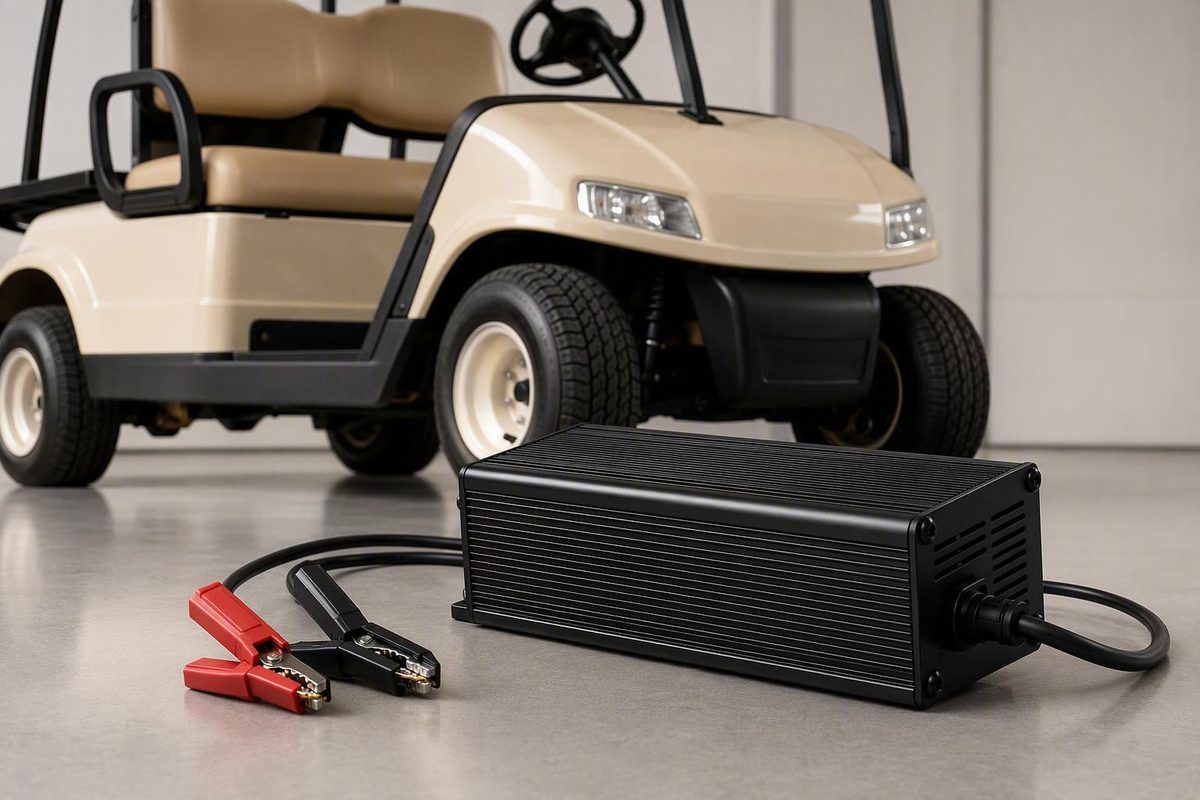
There is no single best EZGO golf cart battery charger for every TXT, RXV, Marathon, Freedom, S4, or converted cart. A model name can narrow the search, but it cannot confirm the installed pack voltage, battery chemistry, connector, polarity, charging profile, or permitted current.
The reliable buying process is compatibility-first: verify the cart, battery pack, connector, and battery-approved charging requirements before comparing price or convenience. If any of those facts remains unknown, identify it before ordering.
This guide is a compatibility and pre-purchase framework, not a product endorsement. The products and prices below are seller-described retail snapshots; no charger was independently tested for this article, and the available evidence does not provide complete model-year fitment, certification, warranty, or connector-polarity documentation for every listing.
Start Here: The Five Checks That Determine Charger Compatibility
Use this decision sequence before shopping:
- Identify the cart and its year or serial number.
- Confirm the nominal voltage of the installed battery pack.
- Identify the battery chemistry: flooded lead-acid, AGM, lithium, or another documented type.
- Match the physical connector, pinout, and polarity.
- Verify the battery manufacturer’s approved charging profile and maximum charging current.
A label such as TXT, RXV, Marathon, Freedom, or S4 is not sufficient by itself. Configurations may differ by year, powertrain, battery installation, charging system, and previous conversion work.
Start with information attached to the equipment:
- Find the cart’s data plate or serial-number label.
- Read the voltage and chemistry labels on the installed batteries.
- Record the make, model, output rating, and part number from the existing charger.
- Compare the installed receptacle with the cart manual.
- Read the battery manual for charging-voltage and current limits.
- Look for records of lithium conversions, pack-voltage changes, receptacle replacements, or onboard-charger installations.
The official E-Z-GO Battery & Chargers category supports searches by model, powertrain, year, or serial number. That is more useful than searching only for a “TXT charger” or “RXV charger.” The supplied category view also contains batteries, cables, harnesses, meters, and related components, however, so it is not a complete charger-fitment table.
Pre-purchase charger checklist
- Cart model: ________
- Year or serial number: ________
- Powertrain or exact configuration: ________
- Nominal pack voltage: ________
- Battery brand and model: ________
- Battery chemistry: Flooded lead-acid / AGM / Lithium / Other
- Battery capacity in amp-hours: ________
- Battery maker’s maximum charge current: ________
- Battery maker’s approved charging profile: ________
- Connector name or description: ________
- Connector pinout and polarity confirmed: Yes / No
- Charger format: Portable / Onboard
- Current charger make and part number: ________
- Conversions or wiring modifications: ________
Do not fill these fields by guessing from photographs. A familiar-looking battery case may also conceal a chemistry or voltage different from the cart’s original installation.
Final fitment should be verified against the exact cart, battery, and charger documentation. If the manuals do not settle the question, ask a knowledgeable supplier or qualified technician to check the serial number, current battery installation, connector, and polarity before purchase.
Confirm Whether the Cart Has a 36V or 48V Battery Pack
The charger’s rated output must match the nominal voltage and configuration of the installed pack. The aftermarket listings reviewed for this guide primarily separate E-Z-GO-associated products into 36V and 48V categories, with model names used as additional fitment descriptions.
Use the pack label, individual battery labels, battery manual, conversion records, or a qualified inspection. Do not infer voltage from the body style, seat configuration, model badge, or charging-plug shape.
Illustrative arithmetic includes:
- Six nominal 6V batteries in series: 36V
- Six nominal 8V batteries in series: 48V
- Four nominal 12V batteries in series: 48V
These examples explain the calculation; they are not universal configuration maps. Count only the batteries that form the traction pack, read their labels, and confirm how they are connected.
Conversion work is another reason not to rely on an original specification. A cart that left the factory with one voltage or chemistry may now have a different pack, receptacle, charger, or onboard system. Charger selection must follow the current installation and its documentation.
Also distinguish nominal pack voltage from a voltage measured during charging. A charger for a nominal 36V pack can raise pack voltage above 36V during its charging cycle. That does not make it a 48V charger. A resting or deeply discharged pack also will not necessarily measure exactly its nominal label voltage.
A 36V and 48V charger are not interchangeable merely because a plug fits. Confirm nominal pack voltage first, then chemistry, charging profile, connector, polarity, and allowable current.
Match the Charging Profile to Lead-Acid, AGM, or Lithium Batteries
Voltage is only one part of compatibility. The charger must also use a profile approved for the installed battery chemistry and system.
Flooded lead-acid batteries require an appropriate lead-acid charging process and maintenance according to the battery manufacturer.
AGM batteries belong to the lead-acid family, but that does not make every flooded-battery setting suitable. Confirm the AGM manufacturer’s permitted voltage, current, temperature behavior, and maintenance-mode requirements.
Lithium batteries, including LiFePO4 products, require a charging profile approved for the particular battery and battery-management system. Nominal voltage and plug fit do not establish compatibility because voltage limits, termination behavior, permitted current, and BMS operation can vary.
A bounded example is the retailer-listed Allied 48V, 15A charger with an E-Z-GO-style plug. The seller describes it as intended for Allied lithium batteries and expressly advises against using it with lead-acid batteries. The page does not establish compatibility with every 48V lithium battery or BMS (retailer product description and chemistry warning).
Other sellers advertise chargers as supporting lead-acid, AGM, lithium, and LiFePO4 batteries. Such a charger may be suitable when it has documented, selectable profiles, but a multi-chemistry title does not show:
- How the profile is selected
- Whether accidental profile changes can be prevented
- Which voltage limits apply to each mode
- Which batteries or BMS designs have been approved
- Whether maintenance behavior changes with the selected chemistry
Obtain the operating instructions and profile specifications before treating “multi-chemistry” as proof of compatibility.
For a lithium conversion, confirm:
- Maximum charging voltage
- Maximum permitted charging current
- Exact approved charger profile
- Battery-management-system requirements
- Whether the installation requires charger-to-BMS communication
- How charging is permitted, interrupted, or resumed
- Connector pinout and polarity
- Documented temperature restrictions
- Any required sensing, interlock, enable, or wake-up arrangement
- Whether any storage or maintenance behavior is permitted
Not every lithium charger works with every battery carrying the same nominal voltage. Product-specific battery and charger documentation must establish the match.
If an existing charger is lead-acid-only and the cart has been converted to lithium, stop and verify the new battery’s charging requirements instead of adapting the old charger until it connects.
Identify the Connector—and Verify More Than Physical Fit
Connector descriptions represented in the reviewed E-Z-GO aftermarket listings include:
- 2-pin D-style
- Crowfoot
- SB50 Anderson
- E-Z-GO plug
- OEM-style plug
These names can narrow the field, but the supplied evidence does not provide an authoritative connector map covering every model and year.
One retailer, for example, markets a Firstpower PRO 36V, 18A charger with a 2-pin D-style plug for a seller-described lead-acid TXT application. The listing expressly excludes lithium batteries (36V TXT product specifications). Other listings associate SB50 Anderson and crowfoot connectors with particular 36V products. These examples do not prove that every cart bearing the same model name uses that plug.
Before ordering, compare:
- The installed cart receptacle
- The old charger’s connector
- The prospective charger’s connector photograph
- The documented pinout
- Positive and negative polarity
- Any smaller sensing, logic, or interlock contact
- Model-, year-, and serial-specific documentation
Do not cut off plugs, reverse wires, bypass smaller contacts, or add an undocumented adapter merely to make a charger connect. One reviewed specialty retailer also warns buyers against altering connections, although that warning remains retailer guidance rather than model-specific manufacturer documentation (retailer charger collection and cautions).
If an adapter is part of a documented installation, verify its exact wiring and purpose. Otherwise, use a charger supplied with the correct connector and instructions.
Understand Amps, Charging Time, and the Features Worth Comparing
A charger’s amp rating is its rated output current. It does not establish pack compatibility, battery condition, or a fixed charging time.
The reviewed listings include multiple 48V, 15A products and several 36V, 18A products (seller-described E-Z-GO charger collection). Those ratings become useful only after voltage, chemistry, charging profile, connector, polarity, and battery-current limits have been verified.
For rough planning:
Estimated amp-hours to replace = battery capacity × depth of discharge
Then:
Idealized charging time = amp-hours to replace ÷ charger current
For a hypothetical 100Ah pack that has used approximately half of its available charge:
- Estimated charge to replace: 100Ah × 0.50 = 50Ah
- Idealized time at 10A: 50Ah ÷ 10A = 5 hours
- Idealized time at 15A: 50Ah ÷ 15A = about 3.3 hours
These are planning calculations, not promised completion times. Charging can take longer because of losses, current tapering, battery condition, temperature, balancing, BMS behavior, and the charger’s termination process. The battery manufacturer’s current limit takes priority over a preference for faster charging.
Do not use isolated customer reports as benchmarks. A reported two-hour or four-hour charge is not meaningful without the pack capacity, initial state of charge, battery condition, temperature, and definition of “full.”
Compare charger functions precisely:
-
Maintenance or storage mode may monitor the pack and resume charging under specified conditions.
-
Status lights may indicate only operating stages or faults.
Read the manual to determine what the charger actually does at the end of its cycle. Product pages may use “float,” “trickle,” “maintenance,” and “automatic” inconsistently.
Other comparison points include:
- Complete voltage and chemistry specifications
- Documented electrical protections
- Certification marks tied to the exact charger model
- Warranty length, exclusions, and claim procedure
- Return terms for fitment errors
- AC and DC cable lengths
- Replaceable plugs and cords
- Status indicators and fault reporting
- Installation instructions
- Serviceability and parts support
- Technical support familiar with the charger and cart
Treat “waterproof,” IP65, IP67, reverse-polarity protection, short-circuit protection, thermal shutdown, and similar language as seller claims unless supported by product-specific documentation or an independently verifiable certification listing. A category-wide marketing statement should not be assumed to apply identically to every charger.
Charger Options for Common E-Z-GO Applications
The table below is a seller-described market snapshot, not a ranking, recommendation, or fitment guarantee. Prices were reviewed for publication on August 11, 2026 and can change. Exact model years, polarity, certification records, warranties, and battery approvals were not established unless expressly noted.
| Seller-listed product or application | Voltage | Stated chemistry | Plug description | Output | Format | Observed price | Evidence limitations |
|---|---|---|---|---|---|---|---|
| Firstpower PRO, SKU SYGLC0001BFI-YHUS, marketed for E-Z-GO TXT1 | 36V | Lead-acid only | 2-pin D-style | 18A | Portable | $109.99 | Seller-described fitment; no model-year range or independently verified protection, water-resistance, or certification evidence |
| FORM charger marketed for E-Z-GO TXT/RXV2 | 48V | Lead-acid | E-Z-GO application plug not fully documented in the collection excerpt | 15A | Portable/model-specific | $229.95 | Exact years, pinout, polarity, certification, and warranty terms require confirmation |
| FORM charger marketed for E-Z-GO TXT/RXV2 | 48V | Seller-described lithium, LiFePO4, lead-acid, and AGM | Not fully specified in the collection excerpt | 15A | Portable/model-specific | $249.95 | Profile-selection method and battery/BMS approvals not established |
| FORM charger marketed for E-Z-GO TXT2 | 36V | Seller-described lithium, LiFePO4, lead-acid, and AGM | Not fully specified in the collection excerpt | 18A | Portable/model-specific | $229.95 | Multi-chemistry support is a vendor claim; no model-year range supplied |
| FORM charger marketed for E-Z-GO Marathon2 | 36V | Lead-acid | SB50 Anderson | 18A | Portable/model-specific | $209.95 | No authoritative model-year connector map, pinout, or polarity documentation supplied |
| FORM charger marketed for E-Z-GO Marathon2 | 36V | Seller-described multi-chemistry | SB50 Anderson | 18A | Portable/model-specific | $229.95 | Exact profiles and approved batteries were not identified |
A separate specialty-retailer collection displayed nine E-Z-GO-associated chargers covering 36V, 48V, and one 36V/48V product. Displayed prices ranged from $269.95 to $489.95 (nine-product retailer snapshot). Across the reviewed listings, the broad observed range was therefore $109.99 to $489.95. The FORM collection also displayed some refurbished chargers at $139.95. These figures are time-sensitive examples, not stable market averages.
The listings show that buyers may encounter:
- Low-cost portable replacements
- Higher-priced model-associated chargers
- Universal onboard units
- Lead-acid-only products
- Lithium-specific products
- Seller-described multi-chemistry chargers
- New equipment
- Refurbished equipment
Price does not identify the correct option. A higher-priced charger may offer better documentation, support, serviceability, or features, but the supplied evidence does not establish that price predicts safety, durability, or compatibility. A lower-priced charger may suit a narrowly defined application while remaining unsuitable for a converted cart.
Ratings, sponsored placement, stock status, and seller-hosted reviews should not determine fitment. They may describe purchaser satisfaction, but they do not establish electrical compliance, long-term reliability, or compatibility with every cart named in a product title.
For refurbished equipment, ask:
- Was the charger tested under load?
- Which components were replaced?
- Were both cords, the plug, and the case inspected?
- Does the unit match the required hardware revision?
- Is a written test report available?
- What warranty and return rights apply?
- Are revision-correct replacement parts still obtainable?
The reviewed listings establish that refurbished chargers are sold. They do not establish a consistent testing, refurbishment, or warranty standard across sellers.
Portable, Onboard, OEM, Aftermarket, or Refurbished?
Portable chargers are removable units connected when needed. They can be convenient when the charger is stored securely, transported, or shared only among carts already known to have compatible packs and charging systems. Compare weight, handle design, cable reach, storage requirements, and whether damaged cords or plugs can be replaced.
Onboard chargers remain installed on the cart. They can simplify routine connection to AC power, but compatibility may involve wiring, mounting, connector arrangements, interlocks, battery profile, and lithium-system integration. These requirements vary by product. Follow product-specific installation instructions or use a qualified installer rather than improvising a conversion.
The purchasing route also matters:
- OEM-specified equipment may provide the clearest path to serial-number-specific fitment when complete documentation is available.
- New aftermarket equipment can offer more choices in price, format, connector, and chemistry, but seller claims must be checked against cart and battery documentation.
- Refurbished equipment may lower purchase cost or keep an older charging system in service, but revision, condition, cord integrity, testing, warranty, and parts support become especially important.
An aftermarket charger with an OEM-style plug remains aftermarket unless first-party documentation identifies it as an E-Z-GO product or approved accessory.
Use this framework for every category:
| Question | What satisfactory evidence looks like |
|---|---|
| Does it fit this cart? | Model, year or serial range, powertrain, voltage, and connector documentation |
| Does it fit these batteries? | Approved chemistry profile, voltage limits, current limit, and battery/BMS documentation |
| Is the connector electrically correct? | Pinout, polarity, and sensing or interlock details |
| Is safety certification documented? | A verifiable certification record tied to the exact charger model |
| What if it does not fit? | A clear return policy without unresolved fitment exclusions |
| Can it be repaired? | Available cords, plugs, boards, or authorized service |
| What does the warranty cover? | Written term, exclusions, and claim process |
| Was a refurbished unit tested? | Documented inspection and under-load testing |
| Is installation required? | Complete mounting and wiring instructions |
| Is knowledgeable help available? | Technical support familiar with the charger and cart |
The E-Z-GO-branded battery-and-charger category includes batteries, chargers, cables, harnesses, meters, and related components. The available category view does not expose enough complete charger data for a meaningful model-by-model OEM comparison.
When retailer titles conflict, omit model years, or use terms such as “universal,” return to the exact manuals and serial-number verification. If a seller cannot provide the charger manual, connector documentation, charging profile, or return terms, treat that absence as a purchasing risk.
Before Replacing It: A Safe No-Start Troubleshooting Sequence
A silent charger does not automatically mean the charger has failed. Low pack voltage, loose terminals, an inadequate connection, receptacle damage, incorrect wiring, or a cart-side detection circuit can produce a similar symptom.
Use this noninvasive sequence:
AC outlet has no power → Confirm the outlet with an appropriate known-working device or have the circuit checked.
Outlet works → Disconnect the charger and inspect the AC cord, DC cable, plug, strain reliefs, and case for visible damage.
No obvious charger damage → Inspect battery terminals and interconnect cables for looseness, corrosion, damaged insulation, or incorrect routing.
Connections appear sound → Identify the exact charger model and hardware revision from its label.
Charger is identified → If qualified and properly equipped, measure total pack voltage on the correct DC range. Otherwise, have it measured.
Pack voltage is plausible for the documented system → With power disconnected, inspect the charging receptacle for looseness, displaced contacts, corrosion, melting, or damaged wiring.
External components appear intact → Consult the exact charger manual for startup behavior, indicator lights, and fault codes.
Fault remains unresolved → Cross-test only with known-compatible equipment or arrange professional diagnosis.
Stop if the batteries or charging hardware show visible damage, abnormal heat, melting, or scorching. Retailer troubleshooting guidance also identifies temperature and moisture as factors that can affect charging, but the correct response depends on the exact battery and charger instructions (commercial troubleshooting guidance).
Why a low pack can leave an automatic charger silent
Some automatic chargers must detect a minimum pack voltage before activating, but reported thresholds differ by charger family.
A FORM Charge retailer guide cites approximately 20–25V for some 36V systems. A dated PowerWise forum discussion reports approximately 28V for the particular system being discussed (PowerWise forum example). A separate expert Q&A describes roughly 28–30V as common for many 36V chargers. These are source-reported approximations, not universal specifications. Use the manual for the exact charger.
A cart may still move even when its charger cannot activate. Driving and charging do not necessarily depend on every part of the same circuit. In one customer-support exchange, two chargers reportedly worked away from the cart while the receptacle, fuse, logic wire, reed switch, or related cart-side wiring remained suspect (cart-side charging-circuit discussion). That single exchange is illustrative, not a confirmed universal diagnosis.
Do not attempt to raise pack voltage with an automotive charger unless the exact battery and charger manufacturers provide a suitable procedure and you have the required training and controls. Retailer instructions conflict on this practice, and the reviewed specialty-retailer guidance warns against using or jump-starting with a car battery. Voltage, chemistry, polarity, and connection errors can create serious battery or electrical hazards.
Inspect before measuring
With power disconnected, look for:
- Cuts, flattened cable sections, or exposed conductors
- Burned plug contacts
- Loose receptacle hardware
- Corrosion on pack terminals
- Damaged terminal covers
- Incorrectly routed interconnect cables
- Evidence of recent battery or wiring replacement
- A charger label that conflicts with the installed pack
Loose or corroded connections can prevent charger detection or current flow. Correct them only according to the cart and battery documentation. If pack-voltage measurement is outside your experience, stop after the external inspection and have a technician identify the correct measurement points.
Use cross-testing carefully
Cross-testing can help separate charger-side and cart-side faults, but only when the comparison equipment is known to match:
- Nominal pack voltage
- Battery chemistry and approved profile
- Connector and polarity
- Sensing and interlock arrangement
- Charging-system configuration
If the suspect charger operates correctly on another fully compatible cart, the original cart’s pack, receptacle, or charging circuit becomes more suspect. If another known-compatible charger works correctly on the original cart, the first charger becomes more suspect.
Neither result identifies the failed component by itself. Do not cross-test based only on a plug that fits, use a 48V charger on a 36V pack, or test a lead-acid-only charger on a lithium conversion.
Treat symptoms as clues, not diagnoses
Complete silence can result from no AC power, inadequate detected pack voltage, a poor plug connection, receptacle damage, cart-side wiring, or charger failure.
Incomplete charging can involve a weak battery, high-resistance connection, charger fault, temperature condition, incorrect profile, or BMS interruption.
Repeated or abnormal clicking may involve unstable detection, connections, control behavior, or an internal component. Sound alone cannot identify a failed relay.
Overheating may involve ventilation, ambient temperature, high-resistance connections, battery condition, current, or a charger fault. Disconnect the equipment if heat is abnormal and follow its instructions.
Failure to shut off can involve battery condition, sensing, an incorrect profile, charger control, or the definition of maintenance mode.
For PowerWise QE, Delta-Q, and other indicator-equipped chargers, consult the exact manual. Blink patterns and expected behavior can differ across charger families and revisions.
Technician-only internal work
Internal fuse, diode, relay, transformer, control-board, and cord testing should be performed only by a qualified technician using revision-correct documentation. A retailer’s PowerWise repair guide is specific to a particular older 36V application and includes procedures involving internal circuitry; it does not establish a safe or valid method for every PowerWise, PowerWise QE, Delta-Q, onboard, or lithium charger (scope of the PowerWise-specific repair guide).
Do not open the charger, bypass a relay, bridge terminals, or probe energized internal components based on a generic video, retailer article, or forum post. Also do not assume that a disconnected charger must show nominal output voltage; some designs require battery detection before enabling output.
Repair-versus-replacement decisions should follow diagnosis rather than symptoms alone. Consider:
- The confirmed fault
- Charger age and exact revision
- Condition of the case, plug, and both cords
- Availability of revision-correct parts
- Technician labor
- Cost of a verified-compatible replacement
- Warranty on the repair or replacement
- Whether a battery conversion has made the old profile unsuitable
- Availability of manuals and technical support
The supplied evidence does not support a universal rule that repair is cheaper or better. Obtain a diagnosis and compare the documented repair with a compatible replacement.
Frequently Asked Questions
Can I use a 48V charger on a 36V E-Z-GO, or a 36V charger on a 48V cart?
No. Treat nominal voltage as a mandatory compatibility specification. Do not use a 48V charger on a 36V pack or a 36V charger on a 48V pack merely because the connector fits.
Confirm voltage from the installed battery system, not only the cart model. Then verify chemistry, charging profile, connector, polarity, and permitted current. A converted cart must be matched to its present pack.
Can an E-Z-GO lead-acid charger be used after converting the cart to lithium?
Do not assume so. A lead-acid charger may use voltage, termination, or maintenance behavior that the lithium battery manufacturer has not approved.
A lithium conversion requires confirmation of maximum charging voltage, maximum current, approved profile, BMS requirements, temperature limits, connector polarity, and any communication or enable arrangement. For a multi-chemistry charger, the instructions should explain how the correct profile is selected and protected from accidental misconfiguration.
Why is my E-Z-GO charger completely silent even though the cart still runs?
The drive system can operate while the charging system has a fault. Possibilities include no AC supply, inadequate pack voltage for charger activation, loose or corroded connections, receptacle damage, a sensing or logic-wire problem, a cart-side protection device, or charger failure.
Complete the safe external checks first: outlet, visible charger condition, terminals, total pack voltage if qualified, receptacle, and the exact charger manual. Cross-test only with fully compatible equipment.
How long should an E-Z-GO golf cart battery charger take to charge the pack?
There is no universal charging time. It depends on battery capacity, depth of discharge, charger current, chemistry, battery condition, temperature, charging losses, current tapering, and charger or BMS behavior.
For planning, multiply battery capacity in amp-hours by the estimated depth of discharge, then divide the amp-hours to replace by charger current. Allow additional time beyond that idealized result, and never exceed the battery manufacturer’s permitted charging current.
Does an OEM-style plug mean the charger is made or approved by E-Z-GO?
No. “OEM-style” ordinarily describes the connector’s shape or intended fit in a retail listing. It does not prove that E-Z-GO manufactured, tested, approved, or endorsed the charger.
Verify the charger manufacturer, exact product identity, connector pinout, polarity, model-year fitment, voltage, and chemistry independently. If E-Z-GO approval matters, require explicit first-party documentation.
Final Compatibility Checklist
Before comparing products, record the cart’s year or serial number, installed pack voltage, battery brand and chemistry, charging-voltage and current limits, connector, polarity, and current charger details.
Then require satisfactory answers to five questions:
- Does the charger match the installed pack’s nominal voltage?
- Is its profile approved for the battery chemistry and BMS?
- Are the connector, pinout, polarity, and auxiliary contacts correct?
- Is its output current within the battery manufacturer’s limit?
- Is fitment documented for the cart’s current configuration?
If any answer remains uncertain, verify it through the exact cart, battery, and charger manuals, E-Z-GO’s vehicle or serial-number selector, or a qualified technician.
For a charger that will not start, complete only the safe external checks before buying a replacement. Low pack voltage, battery problems, a damaged receptacle, poor connections, or cart-side wiring can imitate charger failure—and a new charger will not correct those underlying faults.
-
Price, output, chemistry, connector, SKU, and application are from the Firstpower PRO retailer listing. ↩
-
Prices, chemistry descriptions, output ratings, connectors, and marketed applications are from the FORM E-Z-GO collection linked earlier. The collection is seller-provided evidence, not independent fitment testing. ↩↩↩↩↩