
Choose the Right Low-Speed Vehicle for Your Route
See how the Fiat Topolino stacks up against a 4-seat lithium LSV cart on cost, speed, range, charging, weather coverage, golf use and legality.
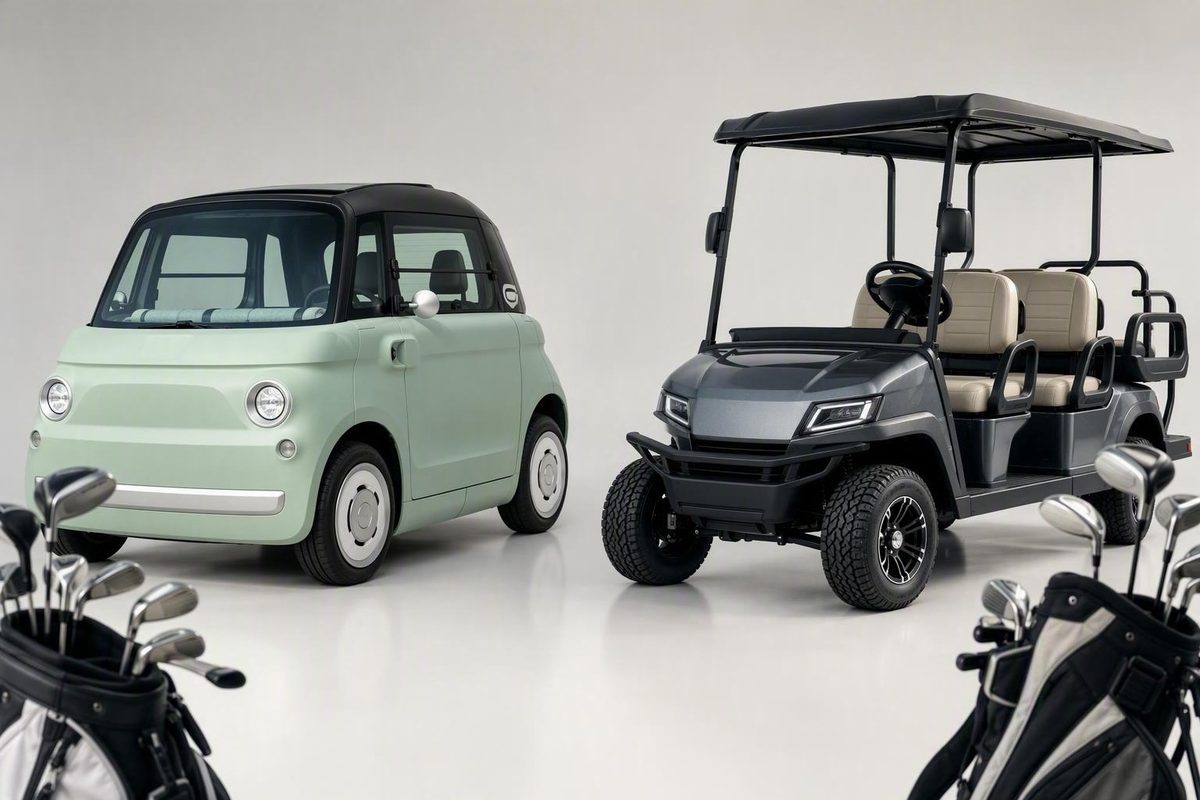
Choose the Fiat Topolino for enclosed, two-person trips on permitted neighborhood roads; choose a four-seat lithium LSV cart when passenger capacity, golf bags, cargo flexibility, or course use matters more. For public roads, either vehicle must have the correct certification and local approval. For fast arterial roads or highways, choose neither.
Pick your main use, configure the vehicles, and enter your ownership costs to see which one fits.
Select the trip that matters most. Then enter your own cart specifications and ownership costs; unknown amounts remain excluded rather than being treated as zero.
- Two seats
- 19 mph as initially delivered
- Estimated 25 mph with Fiat’s planned conversion
- Up to 46 miles of manufacturer-estimated range
- Standard model has doors, windshield and defroster
- Four-seat configuration
- Speed, range and battery depend on the named model
- Factory LSV certification must be verified
- Golf-bag and convertible cargo options may be available
- Weather enclosure depends on installed equipment
| Measure | Fiat Topolino | Your LSV Cart | Decision Effect |
|---|---|---|---|
| Purchase price | $14,985 before tax and other charges | — | Compare delivered totals |
| Seats | 2 | 4 | Topolino is eliminated when more than two seats are routinely needed |
| Maximum speed | 19 mph initially | Enter the certified model’s figure | Neither is for highways |
| Battery | 5.4 kWh | — | Battery size alone does not determine range |
| Stated range | Up to 46 miles, manufacturer estimate | — | Load, terrain and weather affect both |
| Full charge | About 5 hours from 120 volts | — | Verify charger input and parking access |
| Enclosure | Doors and windshield on standard model | Model and accessory dependent | Neither comparison establishes climate comfort |
| Golf use | Course approval and bag fit unestablished | Verify course approval and tires | Purpose-built cart is the stronger starting point |
Electricity estimate equals five years of annual miles multiplied by battery kWh divided by stated range, then multiplied by your electricity rate. Maintenance, financing, accessories, battery replacement and resale value are not included.
Sources: Fiat U.S. Topolino specifications; 49 CFR § 571.500; supplied reporting from Car and Driver, Moneyweb and Yahoo Autos. Cart figures marked — require the exact model’s specification sheet and delivered quote.
The Main Differences at a Glance
The U.S. Fiat Topolino starts at $13,995 plus a required $990 destination charge, bringing the opening price to $14,985 before tax, registration, insurance, accessories, and dealer charges. A new four-seat lithium LSV cart has no reliable category-wide price because equipment, battery size, certification, delivery, and dealer preparation vary. Use the delivered quote for a named model.
The Topolino seats two, has a 5.4-kWh battery, an estimated range of up to 46 miles, and takes about five hours to charge from a 120-volt outlet. It is initially limited to an estimated 19 mph. Fiat’s planned dealer-installed conversion raises the estimate to 25 mph and adds equipment intended to support LSV registration. Fiat lists the U.S. specifications and planned conversion equipment.
| Factor | Fiat Topolino | 4-Seat Lithium LSV Cart |
|---|---|---|
| Delivered starting price | $14,985 before other charges | Requires a model-specific quote |
| Seats | 2 | 4 |
| Maximum speed | 19 mph initially; estimated 25 mph after Fiat’s kit | Verify the certified configuration |
| Stated range | Up to 46 miles | Verify battery, load and test basis |
| Charging | About 5 hours from 120 volts | Charger and battery dependent |
| Weather coverage | Doors and windshield on standard model | Open or enclosed, depending on equipment |
| Golf utility | Bag capacity and course approval unestablished | Usually the more suitable starting point |
| Public roads | Configuration and jurisdiction dependent | Requires LSV certification and local permission |
The Topolino figures are manufacturer estimates or reported specifications, not independent test results. Range will vary with terrain, weather, load, battery condition, accessories, tire pressure, and driving style.
The Topolino Wins on Enclosure, Not Capacity
The standard Topolino has doors, a windshield, a glass roof panel, seatbelts, lights, turn signals, mirrors, a horn, a parking brake, and a defroster. Those features make it more car-like in daily use than an open cart, particularly in wind or light rain.
It is not climate-controlled. Neither the standard model nor the Dolcevita has air conditioning. The Dolcevita also replaces the doors with rope-style openings and uses a roll-up soft top, so it should be treated as an open-air version rather than an equally weather-protected alternative. Reporting on the U.S. model confirms the lack of air conditioning.
No independent rain-sealing, ventilation, cabin-temperature, or cold-weather results were supplied. Doors and a roof reduce direct exposure, but they do not establish all-weather comfort. The glass roof may also affect glare and cabin heat, which should be checked during a drive in local conditions.
The firmest limitation is seating. The Topolino carries two people. A household that regularly transports three or four occupants should compare four-seat carts rather than planning around occasional extra trips in another vehicle.
The same constraint applies to cargo. Fiat lists a rear luggage rack and small-item storage, but the supplied specifications do not establish conventional trunk volume, usable payload after occupants are aboard, secure storage, or golf-bag capacity. Bring the bags, grocery bins, mobility aid, cooler, or work equipment you expect to carry and test the production vehicle.
A four-seat cart may provide a rear seat that converts to a cargo deck, a basket, golf-bag attachments, or a utility bed. Those features are model-specific. Confirm payload limits and whether changing seats, tires, suspension, or cargo equipment affects the vehicle’s certification.
A Golf Cart Is the Better Starting Point for Course Use
The Topolino competes for buyers in gated communities, resorts, campuses, retirement villages, and small towns, but that overlap does not make it a course vehicle. Its tire suitability, path clearance, turf effect, bag storage, and acceptance by individual courses are not established.
A purpose-built golf cart is the natural starting point when the vehicle’s primary job is carrying players and bags. Before buying, ask the course about approved vehicle types, tire requirements, insurance, path dimensions, charging, bag attachments, and privately owned cart rules.
A four-seat street-oriented cart is not automatically suitable either. Lift kits, road tires, rear passenger seats, and LSV equipment can produce a vehicle intended mainly for pavement. The exact configuration still needs course approval.
The Topolino measures 99.6 inches long, 56.4 inches wide, and 61.2 inches high, with a stated curb weight of 1,073 pounds. Its compact length may help in a small garage, but it does not prove that it will fit cart paths, trailers, storage bays, or tight turns. Measure the intended space and obtain a documented turning radius.
For more context on cart dimensions, see golf-cart size ranges for two-, four-, and six-seat layouts.
Public-Road Legality Depends on the Exact Configuration
The stock 19-mph Topolino should not be assumed to be a federally classified Low-Speed Vehicle. The federal LSV category covers qualifying four-wheel vehicles capable of more than 20 mph but no more than 25 mph. Fiat’s planned conversion must therefore be considered separately from the initially delivered vehicle.
Federal Motor Vehicle Safety Standard No. 500 limits an LSV to 25 mph in its prescribed maximum-speed test. It also requires specified lighting, turn signals, stop lamps, reflectors, mirrors, a parking brake, compliant windshield glazing, a conforming VIN, seatbelts, rear visibility, and an alert sound. The requirements appear in 49 CFR § 571.500.
Speed alone does not create an LSV. Raising a cart to 25 mph without the required equipment and certification is not equivalent to buying a compliant LSV. Adding lights and seatbelts by themselves also does not prove compliance.
Fiat described its dealer-installed conversion as adding a rearview mirror, backup camera, pedestrian-alert system, and an estimated speed increase from 19 to 25 mph. The kit was expected in fall 2026 and described as included at no additional cost. Buyers still need written confirmation that it is available for the vehicle’s VIN, properly installed and documented, accepted by the state motor-vehicle agency, and covered by insurance.
A 25-mph LSV does not travel at 35 mph. References to 35-mph roads concern the posted limit on roads where some jurisdictions permit qualifying LSVs. State and local rules may be narrower, and a legal neighborhood segment is not useful if the only route to a destination requires a prohibited arterial or crossing.
For either vehicle, verify:
- The classification and certification tied to its VIN.
- Title, plate, registration, inspection, and insurance requirements.
- Driver licensing and minimum-age rules.
- Municipal restrictions and permitted streets.
- Every crossing, bridge, connector, and detour on the intended route.
- Separate HOA, resort, campus, and private-property rules.
Public-road permission does not settle golf-course access, and federal LSV compliance does not authorize operation on every public road.
Aftermarket Speed Controllers Change the Comparison
Fiat’s planned 25-mph conversion should not be confused with an aftermarket controller. One vendor claims its replacement control unit can push the Topolino above 35 mph and has reported testing near 51 mph. Those are seller claims, not independent validation. Yahoo Autos attributes the figures to the company selling the replacement unit.
A higher indicated speed does not prove adequate braking, stability, tire capability, legal operation, continued LSV certification, warranty coverage, or insurability. Because the federal LSV standard caps the category at 25 mph, a modification that takes the vehicle beyond that limit defeats the legal premise of comparing it with a compliant LSV cart.
Treat modified vehicles as a separate purchase requiring written answers from the manufacturer, installer, insurer, and motor-vehicle agency. They do not belong in a stock Topolino-versus-cart cost comparison.
Neither Vehicle Provides Passenger-Car Protection
The Topolino’s doors and body panels improve weather separation and may reduce exposure to road debris. They do not establish passenger-car crashworthiness.
Reporting on the U.S. Topolino says it lacks airbags and a conventional crumple zone and is not subject to standard passenger-car crash tests. Its bodywork should not be interpreted as protection equivalent to a highway-certified car. The supplied evidence also does not support claiming that it is safer than a particular golf cart.
A model-specific safety comparison would require braking, rollover, restraint, visibility, tire-grip, structural, and crash-outcome evidence. No such comparative dataset was supplied.
The route can matter more than the body style. A vehicle traveling at 19 or 25 mph faces a large speed and mass difference around conventional traffic. Check actual traffic speed, intersection width, sight distance, hills, shoulders, lighting conditions, bicycle activity, and the behavior of drivers on the route.
If regular travel requires merging with fast traffic, crossing several arterial lanes, or maintaining normal passenger-car speed, neither the Topolino nor an LSV cart is suitable.
Five-Year Cost Requires an Exact Cart Quote
The Topolino’s known opening figure is $14,985 after destination. Taxes, title, registration, insurance, dealer charges, accessories, charging work, maintenance, tires, and eventual battery costs are not included.
There is no defensible category-wide price for a new four-seat lithium LSV cart in the supplied evidence. Compare a named model with its battery, charger, seating package, enclosure, road equipment, certification, freight, and dealer preparation included.
Electricity can be estimated from battery capacity and rated range. For the Topolino, the calculator uses its 5.4-kWh battery and 46-mile manufacturer estimate. This is a planning calculation, not a prediction of real energy use. For the cart, enter the battery capacity and stated range from its specification sheet.
Insurance, registration, maintenance, financing, battery replacement, resale value, and service downtime remain unknown until quotes are obtained. A five-year total that silently treats unknown costs as zero is misleading, so the comparison tool marks the result incomplete until required entries are supplied.
Fiat began delivering about 300 pre-launch Topolinos to U.S. dealers in July and August 2026 ahead of an October launch. Early demand was reported as concentrated in gated and resort communities seeking a golf-cart alternative. Car and Driver describes that early U.S. positioning. Service access, parts availability, insurance experience, and resale values therefore lack the longer record available for established cart brands.
The Best Choice Changes by Use Case
Course-Only Use Favors the Golf Cart
Choose a purpose-built cart after confirming course approval. The Topolino’s bag capacity, tires, turf suitability, and course access remain unestablished. Its enclosure does not compensate for an unsuitable vehicle layout.
Gated-Community Trips Favor the Topolino for Two People
The standard Topolino is compelling when two seats are sufficient, the property permits it, the routes fit its speed, and doors and a windshield have real value. A four-seat lithium cart is stronger when guests, grandchildren, golf bags, groceries, or convertible cargo space are routine.
Public 35-Mph Roads Require LSV Documentation
A converted Topolino or factory-certified LSV cart may qualify where state and local rules permit LSVs on roads posted at 35 mph or less. Neither travels at the posted limit merely because it is allowed there. Check the complete route and avoid treating technical permission as proof that the traffic environment is sensible.
Rental Fleets Usually Benefit From Cart Flexibility
A resort or campus operator should compare passenger throughput, luggage capacity, accessibility, charging logistics, cleaning, service response, parts supply, and downtime. The Topolino offers distinctive styling and greater enclosure in standard form, but its two-seat limit can reduce fleet productivity.
The final decision is narrow: buy the Topolino when two-person enclosure and neighborhood-road use define the job. Buy the four-seat lithium LSV cart when capacity, golf equipment, cargo conversion, or established cart service matters more. Buy neither when the route demands passenger-car speed or protection.