
What Golf’s Priciest Balls Actually Cost—and Whether They’re Worth It
March 2024 comparisons put Attomax atop surveyed retail-playable balls at $249 a dozen, or about $20.75 per ball.
The available evidence supports a dated market comparison, not a verified live worldwide ranking. Current stock, checkout prices, package quantities, and tournament eligibility were not established in the supplied records.
The short answer: one question, several expensive-ball winners
The strongest supportable answer is historical: Attomax was the highest-priced surveyed retail-playable golf ball in the supplied March 2024 comparisons at $249 per dozen, or approximately $20.75 per ball. That does not prove Attomax holds the same position in 2026, remains available at that price, or is the most expensive golf ball sold anywhere.
A single universal winner would also mix incompatible markets. Playable retail balls, tournament-conforming equipment, scarce resale products, antiques, and decorative luxury objects are priced for different reasons. Package size, customization, discounts, availability, and resale demand can all change the apparent leader.
The category-specific findings are:
- Surveyed specialty retail-playable ball: Attomax at $249 per dozen in March 2024.
- Widely sold conforming tour balls in one comparison: Titleist Pro V1, Titleist Pro V1x, and Callaway Chrome Tour at $57.99 per dozen.
- Scarce conforming resale ball: Titleist Pro V1 Left Dot at a reported $200–$225 per dozen on the 2024 secondary market.
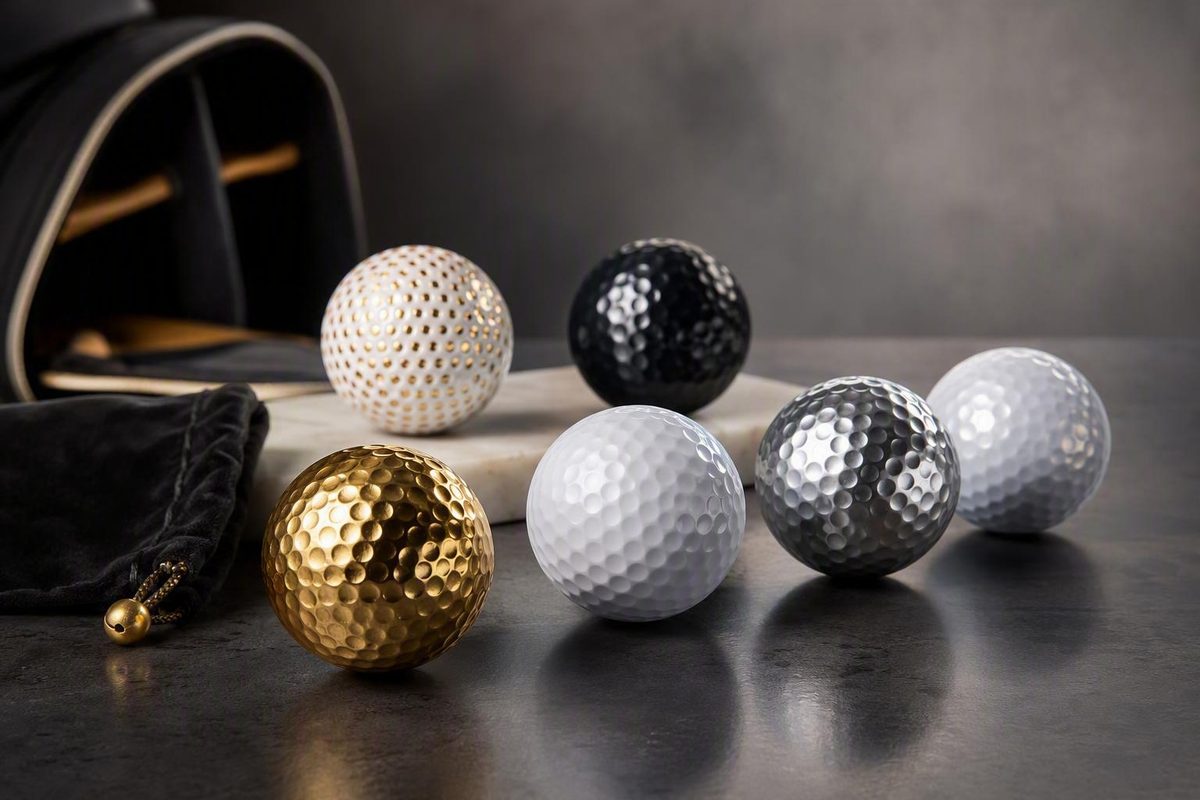
- Decorative collectible: a reported solid-gold golf-ball-shaped object priced near $70,000.
All figures below are in US dollars. The table consolidates the dated findings reported by GolfLink in March 2024 and the category-based prices published by BallCaddie. Neither source provides an exhaustive worldwide inventory or verifies current stock and checkout prices for every product.
| Product | Cited price | Price per ball | Price date | Category | Reported conformity | Market type | Evidence limitation |
|---|---|---|---|---|---|---|---|
| Attomax | $249 per dozen | $20.75 | March 2024 price publication | Specialty playable ball | GolfLink reported it absent from the lists consulted in 2024 | Manufacturer-published price and editorial retail snapshot | Dated, non-exhaustive finding; current price, stock, and status not established |
| Titleist Pro V1 / Pro V1x | $57.99 per dozen | About $4.83 | Price-observation date not established in the supplied BallCaddie capture | Mainstream tour ball | BallCaddie reported the models as conforming | Standard retail comparison | Not a verified current transaction price or worldwide ranking |
| Callaway Chrome Tour | $57.99 per dozen | About $4.83 | Price-observation date not established in the supplied BallCaddie capture | Mainstream tour ball | BallCaddie reported the model as conforming | Standard retail comparison | Listed price may differ from an available checkout price |
| Titleist Pro V1 Left Dot | $200–$225 per dozen | About $16.67–$18.75 | Reported March 2024 | Scarce tour ball | GolfLink reported it as conforming | Secondary market | Scarcity-driven resale range, not normal manufacturer retail |
| Solid-gold golf-ball-shaped object | About $70,000 | Not meaningfully comparable | Date of price observation not established | Decorative collectible | Not practical golf equipment | Reported collectible price | No completed $70,000 transaction documented |
The gold object should not be ranked with equipment intended for play. BallCaddie described it as weighing about 705 grams and as a decorative collectible rather than a practical golf ball. The available evidence does not show that anyone completed a purchase at the reported $70,000 price.
The practical answer therefore depends on what “golf ball” means. Attomax is the strongest dated answer for an unusually expensive ball intended to be hit. Pro V1, Pro V1x, and Chrome Tour illustrate the upper end of one mainstream comparison. Left Dot illustrates scarcity-driven resale pricing. The gold object belongs to the luxury-collectible market.
Because current product pages, authorized-retailer stock records, and official governing-body database results were not supplied, this article cannot identify a verified current 2026 winner. Buyers should confirm the exact model, package quantity, currency, seller, stock status, and final checkout price before purchasing.
Why “most expensive” needs a precise definition
Different rankings produce different winners because they often compare fundamentally different products and price measures. Four categories must remain separate.
Standard retail equipment consists of balls distributed through ordinary manufacturer, pro-shop, or golf-retail channels. Familiar tour models include Pro V1, Pro V1x, Chrome Tour, TP5, TP5x, and Tour B. A useful comparison identifies package quantity and distinguishes a regular price from a temporary offer.
Specialty or nonconforming playable products are intended to be hit but may not be eligible for sanctioned competition. They can emphasize distance, unusual materials, novelty, or a narrowly defined player profile. A high specialty price does not establish tournament eligibility or suitability for every golfer.
Scarce conforming balls on the secondary market may have been produced in limited quantities or released through channels unavailable to most consumers. Their resale prices reflect supply and buyer demand. That premium is not proof of more expensive construction or better performance.
Decorative and historical collectibles include vintage balls, antique gutta-percha examples, presentation pieces, and precious-metal objects. Their value can depend on provenance, age, condition, rarity, materials, historical importance, and collector interest. They do not belong in a performance-equipment ranking.
Price terminology matters too:
- Retail price is the amount requested through an ordinary sales channel.
- RRP or MSRP is a recommended price, not necessarily the amount paid.
- Discounted price is a particular offer that may depend on timing, stock, membership, or order quantity.
- Secondary-market price describes a resale environment rather than normal manufacturer distribution.
- Completed-sale price records an agreed transaction, although authenticity, condition, fees, and cancellation risk still matter.
- Asking or listing price shows what a seller hopes to receive. It does not prove market value.
Personalization further complicates comparisons. Limited availability can have the same effect.
This article therefore applies four rules:
- Every amount is tied to its source context and date where the evidence establishes one.
- Dozen prices are converted to per-ball costs.
- Retail prices, RRPs, resale ranges, completed-sale reports, and asking prices are labeled separately.
- Manufacturer performance claims are not treated as independent test findings.
Even then, a publisher can rank only the products it located. Finding the highest price in a selected group is not equivalent to searching every manufacturer, retailer, custom workshop, auction house, and resale platform worldwide. Taxes, shipping, currency conversion, package quantity, and stock status can also reverse an apparent ranking.
The March 2024 GolfLink article mixed ordinary products with personalized editions and limited-availability balls. That illustrates why a high package price may reflect customization or scarcity as well as the underlying equipment. Live verification is essential for anyone making a purchase now.
Attomax: the $249-per-dozen specialty ball in the supplied rankings
Attomax’s manufacturer published a March 5, 2024 comparison listing its balls at $249 per dozen or $139 per half dozen. The page described a multilayer, distance-oriented product using a proprietary blend involving amorphous metal alloy or powder. Those construction and performance descriptions came from the company and should be understood as product claims. The same article listed Dixon Fire at $75, LA Golf at $69, Titleist Pro V1 at $55, and Titleist AVX and Bridgestone Tour B XS at $50 per dozen. Attomax’s manufacturer-authored article provides the dated prices and product descriptions.
The unit-price calculations are:
$249 ÷ 12 = $20.75 per ball
$139 ÷ 6 = about $23.17 per ball
The cited half-dozen package therefore had a higher unit price than the dozen. These are calculations from prices published in March 2024, not current quotes.
GolfLink separately listed Attomax Medium, Soft, and Hard at $249 per dozen in its March 2024 snapshot. It described Attomax as an ionomer-covered distance ball incorporating an amorphous metal alloy. Agreement between the manufacturer article and GolfLink supports the conclusion that $249 was a published price at the time, but it does not establish current availability or a completed retail transaction.
Tournament conformity requires particular caution. GolfLink reported that Attomax did not appear on the USGA and R&A conforming-ball list it consulted in 2024. BallCaddie also characterized Attomax as nonconforming. Those are historical secondary reports, not current official database results.
The supplied evidence does not include an official USGA or R&A record for the exact Attomax models and identifying markings. This article therefore cannot state that every Attomax ball is currently nonconforming. Competitive golfers must verify the exact ball against the latest official governing-body records before sanctioned play; an old article, product-family name, retailer description, or search result is not enough.
Even without establishing present eligibility, the historical price gap is clear. Attomax’s cited unit cost of $20.75 was more than four times the approximately $4.83 cost of a $57.99 dozen. It also occupied a distinct specialty tier beside the roughly $50–$75 models listed in the manufacturer’s 2024 comparison.
That gap creates a substantial burden of proof for a performance-focused purchase. At the cited prices, a buyer would pay roughly $16 more per ball than for a model costing $57.99 per dozen. The relevant question is whether the unusual design or a repeatable benefit for that golfer justifies the difference—not whether the product has the most dramatic price tag.
Does the expensive ball deliver its claimed distance?
Attomax claimed that its ball traveled 15–20 yards farther than ten leading brands in a robot test. The manufacturer’s article referred to a robot swing machine and certification but did not provide the underlying report, identify every compared model, disclose the swing and impact conditions, publish shot-level data, or explain clearly what the cited certification covered. The 15–20-yard figure originates in Attomax’s own March 2024 marketing article.
Without those details, readers cannot determine whether the test used equivalent comparison balls, representative launch conditions, sufficient repetition, appropriate controls, or a fair interpretation of the results. Ball construction can affect launch, spin, speed, height, and descent, but that general possibility does not verify a specific 15–20-yard advantage.
Rick Shiels supplied useful but limited counterevidence in a November 2022 video. He alternated approximately ten shots with the tested Attomax ball and ten with Titleist Pro V1, using a GCQuad launch monitor before conducting an outdoor fairway comparison. He reported broadly similar launch-monitor ball speed and carry, while describing Attomax as unusually high-flying and loud. He also said the longest two or three fairway shots were Pro V1s. His comparison did not reproduce the advertised advantage. Watch Rick Shiels’s November 8, 2022 Attomax comparison on YouTube.
That result is not definitive proof that Attomax can never benefit any golfer. The test involved one player, approximately ten shots per model, outdoor wind, lost shots, subjective sound and flight observations, and no complete shot-by-shot statistical analysis in the available transcript.
Several variables could affect an individual result:
- One Attomax version or hardness may suit a particular delivery better than another.
- Higher flight can help or hurt distance depending on launch, spin, wind, and landing conditions.
- Carry distance and total distance are different measures.
- Human strike variation can conceal small product differences.
- A small sample remains vulnerable to outliers.
- Sound and feel are preferences, not measurements of distance.
Large robot studies provide stronger general evidence because they can standardize impact and measure multiple variables. Today’s Golfer reported testing 62 models through 2,232 robot shots, recording speed, launch, spin, carry, peak height, and descent. It also stressed that the best ball depends on swing speed, delivery, conditions, and desired performance. Attomax was not among the products documented in the supplied results, so the study cannot confirm or reject Attomax’s claim. Today’s Golfer describes the scope of its 62-model robot program.
The supportable conclusion is narrow: the supplied evidence does not independently establish that Attomax travels 15–20 yards farther than leading tour balls. The company asserted that advantage; a small independent comparison did not reproduce it; and the broader robot evidence did not test Attomax.
A personal trial should use the same club and alternate balls instead of hitting one entire group first. Establish a mishit rule in advance, compare medians or full shot distributions rather than only the longest drive, and record carry, total distance, launch, spin, and dispersion. Repeat the comparison with an iron and wedge because a driver-only gain would reveal nothing about approach control.
The priciest mainstream and tournament-conforming alternatives
BallCaddie listed Titleist Pro V1, Titleist Pro V1x, and Callaway Chrome Tour at $57.99 per dozen, with TaylorMade TP5 or TP5x and Bridgestone Tour B models at $54.99 per dozen. It characterized those products as conforming tour balls, but the supplied capture does not establish the exact date on which the prices were observed, current stock, or completed checkout totals. BallCaddie reports the $57.99 and $54.99 comparison prices.
The unit costs are:
- $57.99 per dozen = about $4.83 per ball
- $54.99 per dozen = about $4.58 per ball
- Attomax’s cited $249 dozen = $20.75 per ball
At those cited prices, Attomax cost more than four times as much per ball as the $57.99 group. That comparison shows scale, not present-day availability or a current worldwide ranking.
A separate dataset produced a different leader. Among the 62 models in Today’s Golfer’s robot program, Callaway Chrome Tour, Chrome Tour X, and Chrome Tour Triple Diamond shared the highest stated RRP of $54.99 per dozen. The page also displayed a $47.99 retail offer for Chrome Tour X, illustrating why RRP and transaction price must remain separate. Today’s Golfer identifies the price leaders within its 62-ball test.
There is no contradiction between a $57.99 leader in one comparison and a $54.99 leader in another. The datasets differed in three important respects:
- Selection: One comparison covered a chosen set of premium retail balls; the other covered the 62 products in a performance test.
- Timing: Prices and product generations may change.
- Price definition: A listed retail price, RRP, discount, and completed checkout amount are not interchangeable.
The available evidence does not establish which conforming golf ball is currently the most expensive. It also does not include official database results confirming the present status of each exact model and marking. Buyers should verify live prices, while competitors should separately confirm current eligibility through the official governing-body lists.
For most golfers, the useful shortlist is not “whichever conforming ball costs the most.” It is the group of eligible balls that produces suitable driver flight, iron trajectory, wedge behavior, feel, and replacement cost.
One player may accept slightly less driver distance in exchange for more wedge stopping power. Another may prefer lower driver spin or a flatter flight in wind. A third may value consistency of model availability enough to use the same ball over many rounds. None of those priorities requires selecting the price leader.
Rare resale balls and collectibles can cost more for different reasons
Scarcity can push a playable ball toward Attomax pricing without making it an ordinary retail competitor. GolfLink reported that the conforming Titleist Pro V1 Left Dot was briefly offered to the public in September 2021 at $50 per dozen, then appeared on the 2024 secondary market at $200–$225 per dozen. That resale range implies a unit price of approximately $16.67–$18.75 per ball. GolfLink reports the release price, conformity characterization, and 2024 resale range.
It does not mean Titleist established a standard $225 retail price or that Left Dot cost four times as much to manufacture. Buyers may have been paying for limited supply, a specific playing profile, tour association, unopened packaging, or difficulty obtaining replacements.
GolfLink also reported completed eBay sales of two-color PING balls at $50, $299, and $389, along with historical gutta-percha balls at $375 and $363. The same article described a $3,799 lot of PING balls and an unused gutta-percha ball listed at $4,200, but those latter amounts were asking prices rather than completed transactions.
These examples remain secondary reports because direct transaction records were not supplied. They should not be treated as dependable appraisals. Even a documented sale needs context: authenticity, condition, packaging, buyer’s premium, shipping, lot size, cancellation status, and whether the object was accurately described can all affect the headline amount.
The solid-gold object reported near $70,000 sits farther outside the equipment market. BallCaddie described it as a roughly 705-gram decorative collectible rather than a practical ball, and the supplied evidence does not document a completed sale.
Collectors should concentrate on evidence that can withstand scrutiny:
- Provenance: documented ownership and a credible chain of custody.
- Authenticity: reliable confirmation of maker, age, materials, and markings.
- Condition: cuts, cracking, fading, repainting, restoration, and package damage.
- Rarity: demonstrably limited supply, not merely an unusual color.
- Historical significance: a connection to a manufacturer, player, event, era, or technological transition.
- Comparable completed sales: recent transactions involving genuinely similar objects.
- Transaction terms: premiums, taxes, shipping, cancellations, and grouped lots.
A collectible can cost more than playable equipment, but it is expensive for a different reason. Its price is not evidence of greater speed, spin, durability, or usefulness on a course.
What premium golf-ball pricing can—and cannot—buy
Premium pricing is commonly associated with urethane covers, multilayer construction, molding precision, quality control, research and development, tour validation, marketing, and branding. Personalization and scarcity may add further cost without changing the underlying performance design.
The supplied evidence does not support a reliable percentage breakdown for materials, labor, research, sponsorship, distribution, retailer margin, or brand premium. It would therefore be misleading to assign each part of the selling price to a particular cost category.
Robot testing can show differences among finished products, but it does not automatically prove that price or one construction feature caused those differences. Today’s Golfer compared 62 models using drivers at 78, 93, and 114 mph, an 80 mph 7-iron, and a 40-yard pitch with a 56-degree wedge. In its selected premium-versus-budget comparison, the premium Callaway models generally produced more driver carry and more iron or wedge spin than the selected budget products. Maxfli StraightFli was competitive for driver distance but ranked last for wedge spin in that comparison. The published test explains the shot conditions and bounded premium-versus-budget findings.
The pattern was not “expensive always means longer.” Instead, the tested balls showed different combinations of distance, launch, spin, height, and stopping potential. StraightFli’s driver result and wedge-spin position demonstrate how a less expensive ball can compete in one measure while trailing in another.
Depending on the exact models compared, a premium ball may provide:
- More spin on partial wedges or scoring shots.
- A steeper approach trajectory.
- A more suitable driver-spin window.
- A preferred flight, sound, or feel.
- A better balance between long-game distance and short-game control.
No price point guarantees leadership in every measure. A high-spin wedge ball may not be the longest driver ball. A firm product that performs well at high speed may feel unpleasant to one golfer. A low-spin design may help someone control excessive driver spin while producing more rollout than another player wants near the green.
Robot tests are useful because they standardize impact. Human fitting remains necessary because golfers do not deliver the club identically. Swing speed is only one input; dynamic loft, angle of attack, strike position, face orientation, club design, wind, temperature, and ground conditions can all affect the result.
Feel and sound should remain separate from measured performance. A loud, firm impact may sound powerful without producing more carry. A soft sensation does not prove high spin, just as a hard sensation does not prove greater ball speed.
A practical comparison process is:
- Select two or three models that meet the required eligibility and budget.
- Compare driver carry, total distance, peak height, and dispersion.
- Test mid-iron trajectory and green-holding performance.
- Compare chips and partial wedges for launch, rollout, and predictability.
- Putt with each model to assess sound and pace control.
- Repeat the test in another session if the differences are small.
The highest-priced option is worthwhile only when its relevant benefits are repeatable for that golfer and valuable enough to justify the replacement cost.
Is an ultra-expensive golf ball worth putting in your bag?
The buying decision comes down to four questions:
- Can the exact model be used in the format you play?
- Is there credible evidence that it improves the performance measures you need?
- Does it fit your delivery, preferred flight, and short-game requirements?
- How many balls do you usually lose or retire?
The final question can overwhelm the others. Using the cited March 2024 prices, losing three Attomax balls would cost:
3 × $20.75 = $62.25
Losing three balls from a $57.99 dozen would cost:
3 × ($57.99 ÷ 12) = about $14.50
The difference is approximately $47.75 for three lost balls. These calculations derive from the cited historical package prices; they are not current purchase quotes.
A simple cost-per-round estimate is:
Ball cost per round = price per ball × average balls lost or retired per round
Use an average drawn from several rounds. Include balls retired because of meaningful cuts or damage, but do not assume every cosmetic mark makes a ball unusable. The purpose is to reveal whether a manageable box price becomes uncomfortable once hazards enter the calculation.
Lower-priced and recycled balls are alternatives for golfers with high loss rates, but they should not automatically be treated as performance equivalents. Condition, age, model consistency, and prior use may vary. A mixed selection can also make it harder to distinguish equipment behavior from swing variation.
Competitive golfers should verify the exact model and identifying markings against the latest official conforming-ball records before sanctioned play. The available evidence contains only historical secondary reports about Attomax and does not establish its current status.
Recreational golfers curious about Attomax can reasonably treat it as an experiment, novelty, or unusual gift. The cited construction is distinctive, but the supplied evidence does not establish the advertised 15–20-yard advantage. Buyers should not assume that claim will appear in their own game.
A fair personal trial should compare the specialty ball with the golfer’s usual model under the same conditions and include ordinary misses rather than only the longest drive. If the expensive ball produces similar carry, wider dispersion, or less useful short-game behavior, the higher price has not bought practical improvement. If it produces a repeatable and valuable benefit, the remaining question is whether that benefit justifies the cost and any competition restrictions.
The four buyer verdicts are straightforward:
- Competitive golfer: Prioritize current conformity and fit. Use the exact eligible model that produces the required flight, spin, and control.
- Recreational golfer: Prioritize evidence and cost per round. Treat extraordinary distance claims cautiously and account for ball losses.
- Rarity buyer: Distinguish ordinary retail from secondary-market scarcity. A high resale price may reflect limited supply rather than better construction.
- Collector: Require provenance, condition records, authentication, and comparable completed sales. Spectacular listings are not proof of value.
The category-based conclusion is that Attomax remains the strongest dated answer for the highest-priced surveyed retail-playable golf ball, at $249 per dozen in March 2024. It is not a verified current worldwide champion. Mainstream tour balls occupied a much lower price tier in the supplied comparisons, scarce resale balls approached Attomax pricing because of availability, and collectibles followed an entirely different valuation logic.
For a golfer, the best ball is the one that is eligible, fits the required shots, and can be replaced without making every hazard a financial crisis. For a collector, the strongest evidence is a documented transaction—not the largest number attached to a listing.
How much was the most expensive surveyed retail golf ball per ball?
Attomax was listed at $249 per dozen in the March 2024 comparisons. Dividing by 12 gives approximately $20.75 per ball. That is a historical calculation, not a current quote or verified worldwide record.
Is Attomax legal for USGA- or R&A-governed tournaments?
GolfLink and BallCaddie reported that Attomax was absent from, or did not conform under, records they consulted. Those secondary reports do not establish current eligibility. The supplied evidence contains no present official database result for the exact models, so competitors must check the latest official USGA and R&A records using the ball’s precise identifying markings.
Did independent testing confirm that Attomax is 15–20 yards longer?
No. The 15–20-yard figure came from Attomax’s marketing. Rick Shiels reported similar launch-monitor speed and carry against Pro V1 in a limited one-golfer comparison and did not reproduce the claimed advantage. His small test cannot settle the issue definitively, while the supplied large robot studies did not include Attomax.
What was the most expensive conforming tour ball in the supplied comparisons?
BallCaddie listed Titleist Pro V1, Pro V1x, and Callaway Chrome Tour at $57.99 per dozen. In a different 62-model dataset, Callaway Chrome Tour, Chrome Tour X, and Chrome Tour Triple Diamond shared the highest stated RRP at $54.99 per dozen. The selections and price definitions differed, and neither dataset establishes the current worldwide leader.
Are collectible golf balls worth more than playable golf balls?
They can be, but their value comes from rarity, provenance, condition, materials, historical significance, and collector demand rather than playing performance. Documented completed sales are more informative than asking prices. A listing—even one in the thousands of dollars—does not establish market value by itself.