
Find the Right Tire Pressure for Your Golf Cart
Learn where to find the correct PSI, compare documented cart specifications, check tires cold, and diagnose leaks or uneven tread wear on your cart.
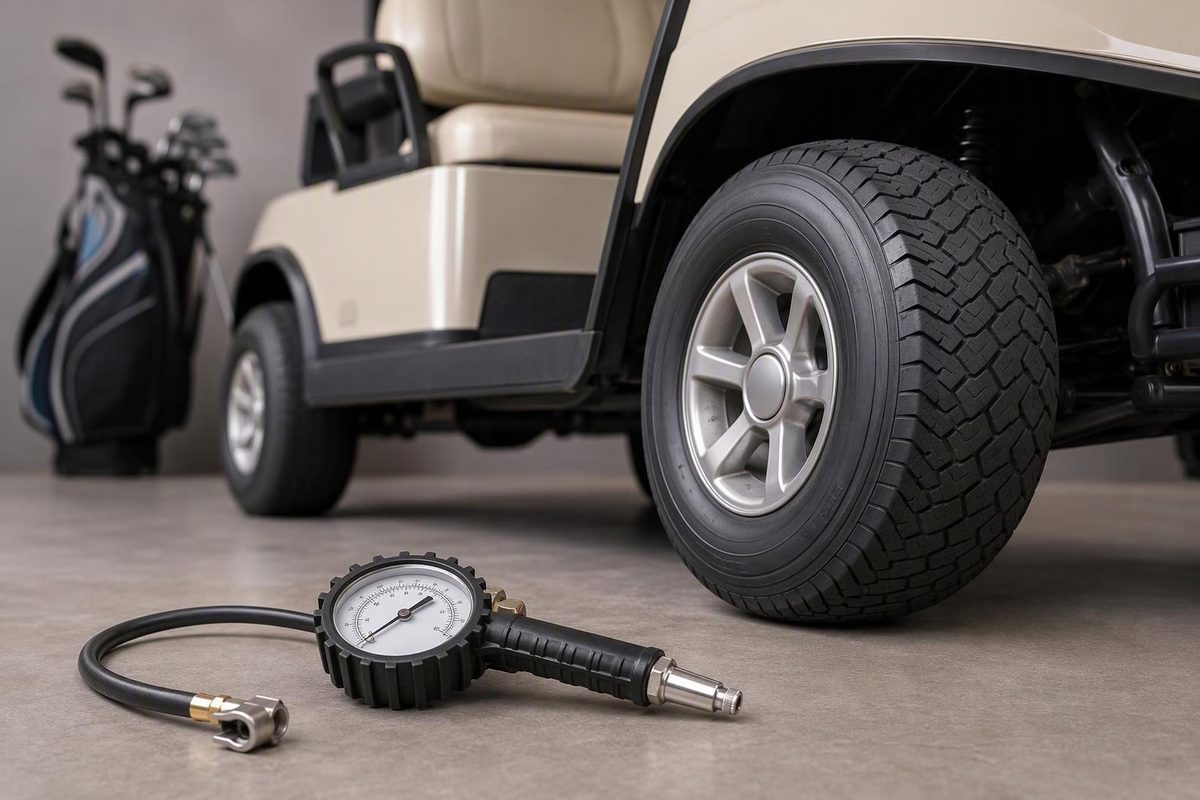
Many golf carts operate around 18–22 PSI, but that is only a provisional range—not a universal specification. Set the tires cold and use the documented pressure for the cart’s exact make, model, year and installed tire-and-wheel package.
Select an exact cart or approved tire package to see its documented pressure.
Documented Golf Cart PSI Finder
For the 2024-and-newer E-Z-GO Liberty. Use the upper part of the range on pavement and the lower part on soft terrain or turf.
Check and set pressure with cold tires.
Sources: 2024+ E-Z-GO Liberty manual; mid-model-year 2024–current E-Z-GO Express S2/S4 ELiTE manual; 2021 Yamaha Drive2 Quietech PTV manual; Club Car approved tire matrix.
Use pressure guidance in this order:
- The owner’s manual or tire-pressure label for the exact cart
- The vehicle manufacturer’s guidance for an approved replacement tire-and-wheel package
- Written guidance from the tire or wheel-kit manufacturer for an aftermarket setup
Do not automatically inflate a tire to the PSI molded into its sidewall. That figure is normally the tire’s maximum inflation pressure, not the cart manufacturer’s everyday target, as Bridgestone’s tire-inflation guidance explains.
Published PSI Varies by Cart and Tire Package
Manufacturer documents show why a generic golf cart tire pressure can be misleading:
- The 2024-and-newer E-Z-GO Liberty manual specifies 18–22 PSI. It recommends the upper part of the range for pavement and the lower part for soft terrain or turf. The manual also warns against incorrect or uneven pressure.
- The mid-model-year 2024-to-current E-Z-GO Express S2/S4 ELiTE manual uses the same 18–22 PSI range and terrain guidance. It says to adjust pressure within that range for the load carried. See the Express S2/S4 manual.
- Yamaha’s 2021 Drive2 Quietech PTV manual specifies 22 PSI and calls for checking pressure before operation. That value applies to the model covered by the manual, not every Yamaha cart.
- Club Car’s approved accessory matrix lists 18 PSI for several 205/55-10 and 215/40-12 packages, but 20 PSI for listed 22- and 23-inch Kraken packages. Club Car ties pressure to the specific approved package.
Gas versus electric does not determine tire pressure on its own. Tire fitment, vehicle configuration, load and manufacturer guidance matter. Lifted carts, rear-seat conversions, utility bodies and low-profile street tires are particularly poor candidates for a generic PSI guess.
If the installed tire size or wheel package does not match the owner’s manual, do not assume the original specification still applies. Identify the replacement package and obtain its written guidance. The draft source material does not provide a reliable universal pressure for unidentified aftermarket tires.
Check and Adjust Pressure While the Tires Are Cold
- Let the tires cool. Check them before driving or after the cart has been parked for at least three hours. Pressure rises in use, so bleeding a warm tire down to its cold specification can leave it underinflated later.
- Confirm the specification. Match the manual to the cart’s model and year, then verify that the installed tire size and wheel package match. If they do not, identify the replacement package before adding air.
- Use a low-pressure gauge. A gauge with a range and graduations suited to roughly 10–30 PSI is easier to read accurately than one intended mainly for high-pressure truck tires.
- Measure every tire before adjusting. Record the readings. One low tire suggests a localized leak; all four changing by a similar amount may reflect temperature or overdue maintenance.
- Add or release air in small steps. Follow any separate front and rear values in the manual rather than assuming every position uses the same pressure.
- Recheck with the same gauge. Replace the valve caps when finished and keep every tire within the manufacturer’s specified range.
Where the cart manual does not require more frequent checks, monthly is a sensible minimum. Check again before carrying a heavy load or towing and after a large temperature change.
The U.S. Tire Manufacturers Association recommends cold monthly checks and notes that pressure can change by about 1–2 PSI for each 10°F temperature change. Follow a stricter schedule if the cart manual gives one: Yamaha includes tire pressure and condition in its daily pre-operation check.
Tire inspection also belongs in a broader annual maintenance and shutdown plan.
Repeated Air Loss Requires More Than a Top-Off
Stop repeatedly adding air and inspect further when one tire will not hold its specified pressure. Possible causes include a puncture, leaking valve core or stem, bead leak, damaged wheel or tire damage.
Correct unequal side-to-side pressure before driving. E-Z-GO warns that incorrect or uneven pressure can contribute to loss of control. If the pressures become unequal again, find the leak rather than continuing to compensate with air.
Cracks, bulges, exposed cords or embedded objects also require inspection. Correcting the PSI does not make a damaged tire safe. Remove the cart from use until the tire has been assessed.
Tread Wear Can Reveal a Pressure Problem
Wear patterns can help narrow down the cause:
- Wear on both tread shoulders: Chronic underinflation is a common cause.
- Faster wear in the tread center: Chronic overinflation is a common cause.
- Wear on one edge: Set the pressure correctly, then inspect alignment, steering, suspension and wheel condition.
- A cart that pulls: Verify all tire pressures first, then inspect alignment and steering components if the pull remains.
Michelin’s wear guide associates center wear with overinflation, both-edge shoulder wear with underinflation and one-sided wear with alignment. These patterns are diagnostic clues rather than proof of a single cause. Loading, wheel damage and operating conditions can also affect wear.
Use 18–22 PSI only until you can verify the exact specification. Once identified, set that pressure with the tires cold, account for any manufacturer-approved adjustment for terrain or load, and investigate any tire that repeatedly falls below it.